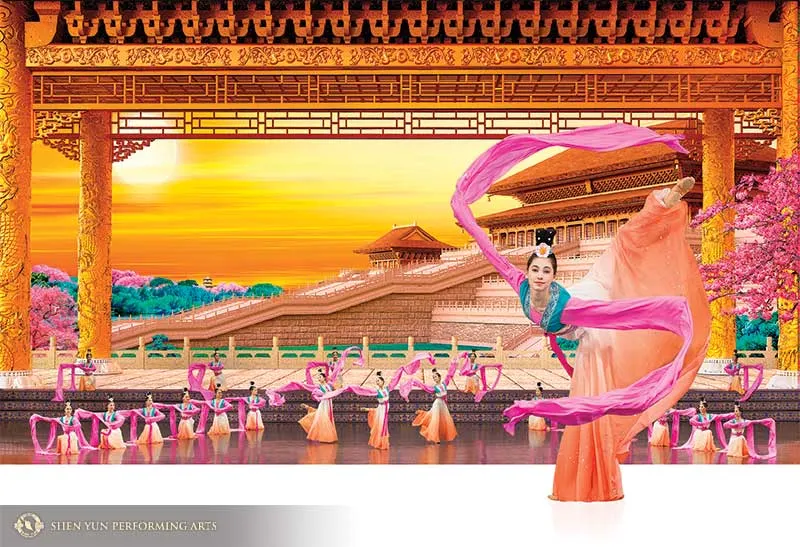
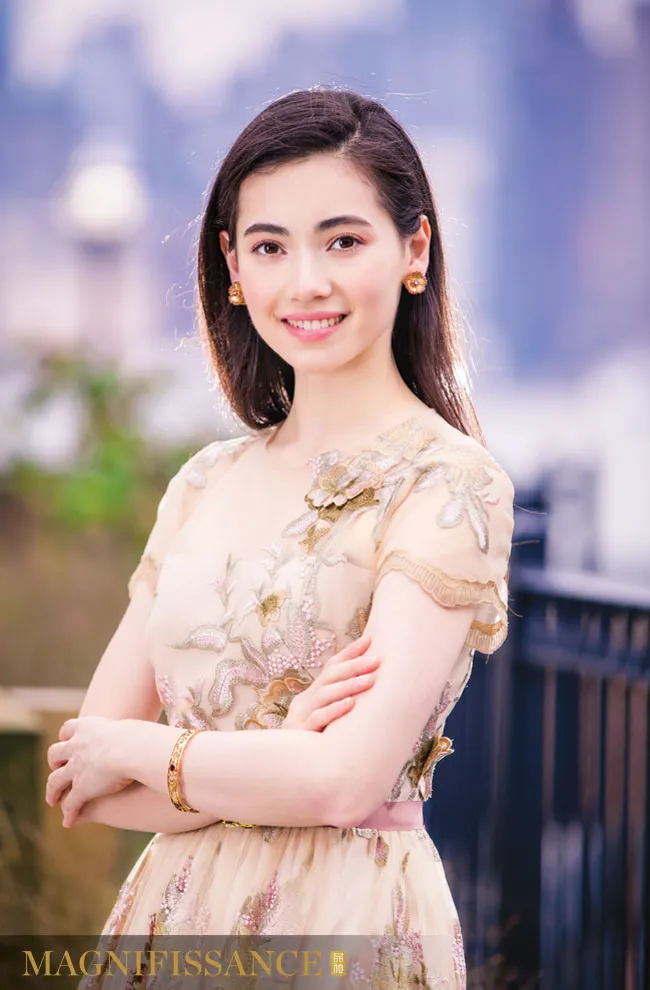
A principal dancer for Shen Yun Performing Arts, Miranda Zhou-Galati poses in a classical dance stance, showcasing the flexibility and form required of her role.
In the realm of classical Chinese dance, movement is often characterized by fluid sleeves and gravity-defying leaps. Yet, for Miranda Zhou-Galati, a principal dancer with Shen Yun Performing Arts, one of her most profound artistic challenges was not a motion, but a total cessation of it.
For the piece Awakening, Zhou-Galati was tasked with portraying a Bodhisattva statue—a deity carved from stone. The role required more than mere stillness; it demanded the suspension of biological reality. For over a minute at the opening of the dance, she had to stand frozen, suppressing the urge to flinch, to breathe visibly, or even to blink.
“I wanted to convince the audience that I was truly made of stone,” Zhou-Galati reflects.
This physical discipline served a narrative of redemption. In the dance, a military general, tormented by the memory of a man he killed in battle and the grief of the widow left behind, renounces violence to become a monk. His piety summons a miracle: the stone statue awakens. When Zhou-Galati finally broke her stillness, transitioning from granite to flesh, the transformation was visceral.
“I recall the audience gasping the moment when I came to life,” she says. It was in that collective intake of breath that the dancer realized the power of the illusion. She was not merely acting out a scene; she was facilitating an experience of the miraculous.
To dance with Shen Yun is to engage with a name that translates to “the beauty of divine beings dancing.” For Zhou-Galati, this is not a metaphorical title but a technical and spiritual objective. The company’s mission is to revive five millennia of Chinese civilization—a culture once known as the “Celestial Empire,” where the boundary between the mortal and the divine was believed to be permeable.
Creating this connection on stage requires a surrender of the self. “I don’t want to be me, Miranda, dancing this character,” she asserts. “I really have to dive into the character’s feelings or emotions at the time. It has to have conviction.”
This philosophy prevents the performance from becoming a mere display of technique. When she portrays a Bodhisattva, she strives to embody divine compassion, projecting a benevolence that feels tangible to the spectator. It is an act of channeling rather than pretending. This depth resonates with modern audiences who, according to Zhou-Galati, are often starved for such spiritual connection. She recounts moments near tour buses where tearful audience members would embrace the dancers, expressing that the performance gave them hope.
Zhou-Galati’s repertoire spans thirteen years and covers the vast spectrum of Chinese archetypes, from the ethereal Lady of the Moon to the martial heroine Mulan. Each role demands a different internal configuration.
To become Mulan, the legendary figure who disguised herself as a man to take her ailing father’s place in war, Zhou-Galati had to internalize a specific set of virtues: filial piety, selflessness, and martial courage. “She showed… internal strength, perseverance, humble character,” the dancer notes. The process is symbiotic; as she lends her body to these historical figures, their moral fortitude imprints upon her.
This internal work is supported by her personal spiritual practice, Falun Dafa. Rooted in the principles of Truthfulness, Compassion, and Tolerance, the practice offers a method of “self-cultivation” that Zhou-Galati views as essential to her art. She believes that the audience can perceive the dancer’s internal state—that purity of mind translates to purity of movement. “I feel if my self-cultivation improves, so does my performance,” she explains. “Whatever is on the inside is shown to the audience, too.”
Born in Canada to a Chinese mother and an Italian father, Zhou-Galati began her journey in ballet before dedicating half her life to the expressive richness of classical Chinese dance. Now 26, she stands as a veteran of the company, yet she views her art form as a path without a terminus.
“Dance is an art form that can never be satisfied,” she observes. Even after thousands of performances, the potential for refinement remains infinite—a movement can always be more fluid, a posture more accurate, a character portrayal more profound.
Each year brings a new program, new legends, and new landscapes to inhabit. Yet, the mindset remains constant. Before every tour, Zhou-Galati reminds herself to maintain the ambition and diligence of a novice. It is a discipline of constant renewal, ensuring that whether she is a warrior in the heat of battle or a statue waiting to breathe, the magic remains alive.
Joining Shen Yun in 2007, Angelia Wang (b. Xi'an, China) represents a benchmark in the…
"We're a team." It is a simple phrase, just three words, yet it holds more…
In the high-stakes theater of grand opera, survival requires a bifurcation of the self. For…
They say the second year of marriage is defined by cotton. It sounds simple, almost…
Two decades together is no small feat. It is a milestone that speaks to patience,…
poems The Merchant of Venice Student Edition---PDF and Complete TextThe water in Venice is never…
There is a specific kind of silence that settles in the garden after a loss.…
There is a specific kind of magic that happens when a photographer doesn't just capture…
In the ancient Italian town of Santarcangelo di Romagna, where history clings to the cobblestones…
The Princeton Club of New York, usually a bastion of quiet networking, recently became the…
A decade together is no small feat. It’s ten years of inside jokes, shared silences,…
In the vast and fragmented linguistic landscape of China, the spoken word has always been…
In an art world often preoccupied with jarring intellectualism or the pursuit of hyper-realistic technicality,…
For Joseph Scheier-Dolberg, the Oscar Tang and Agnes Hsu-Tang Associate Curator of Chinese Paintings at…
I still remember watching you when Grandma passed away. I saw how deeply you mourned,…
There is a distinct difference between seeing a moment with your eyes and seeing how…
Clothing has never been merely about protection against the cold. Across five millennia of human…
The first year of marriage is often a whirlwind of emotions. It is a period…
Ralph Waldo Emerson once observed that "Earth laughs in flowers," a poetic sentiment that reverberates…
There is a specific gravity to a poem carried in the pocket. It is different…
Mother’s Day is approaching, and if you are miles away from the woman who raised…
Winter has a way of changing the landscape of our lives, not just the view…
The allure of Japanese art often lies in its masterful negotiation between the void and…
There is a distinct fairy-tale quality to the work of Lison de Caunes, a resonance…
William Wordsworth (1770–1850) remains a titan of English letters, a figure whose life spanned the…
I was thinking today about how much ground we've covered together. You know, between two…
There is a paradoxical nature to porcelain. In its raw state, it is dense earth;…
The sonnet is not merely a form; it is a vessel for concentrated thought. To…
The intersection of heritage craftsmanship and avant-garde installation art often yields the most compelling dialogues…
I've been thinking a lot about the power of visibility lately, especially as we celebrate…