Heinrich Wang standing in the NewChi flagship store surrounded by his creations
To work in white is to work without camouflage. In the realm of ceramics, glaze and pigment often serve as a veil, softening the edges of the firing process. But for Heinrich Wang, the founder and creative director of NewChi, white is not merely a color-it is an exacting standard of truth.
“White porcelain can’t hide any flaws,” Wang observes from his flagship store in Taipei. It is a medium that demands absolute precision, where the slightest impurity or structural hesitation is magnified. It is here, within this unforgiving spectrum, that Wang seeks to redefine the poise and gracefulness of Chinese porcelain for the contemporary era.
The journey to achieve the specific luminosity of NewChi porcelain was not a matter of aesthetics alone, but of chemical fortitude. Wang’s white is not the cold, sterile white of industrial manufacturing, nor is it the creamy softness of traditional bone china. It is a “pristine white,” conceived to be as precious as jade.
The process of discovery was exhaustive. Wang and his team kilned approximately 10 tons of 20 different clay varieties before the ideal formula emerged. This material integrity is the foundation of his work-a canvas of silence upon which light and shadow can perform.
This pursuit culminated in the collection Lighter than White, showcased at La Triennale di Milano in 2012. Here, the artist stripped away the ornamental excess often associated with “oriental” ceramics. By removing color, Wang forced the viewer to focus entirely on the silhouette and the philosophy embodied within. It was an interpretation of traditional Chinese culture-Zen aesthetics, the rhythms of Feng Shui, the balance of Tai Chi-translated into a modern, minimalist dialect that transcends global boundaries.
Wang’s approach to porcelain is sculptural, almost architectural. He treats the material with a defiance that contradicts its fragile reputation. His creations often appear to defy gravity: tea cups that mimic the tension of a ballerina on tiptoe, pencil holders shaped like gourds, and rectangular teapots with suspended handles that challenge the structural limits of clay.
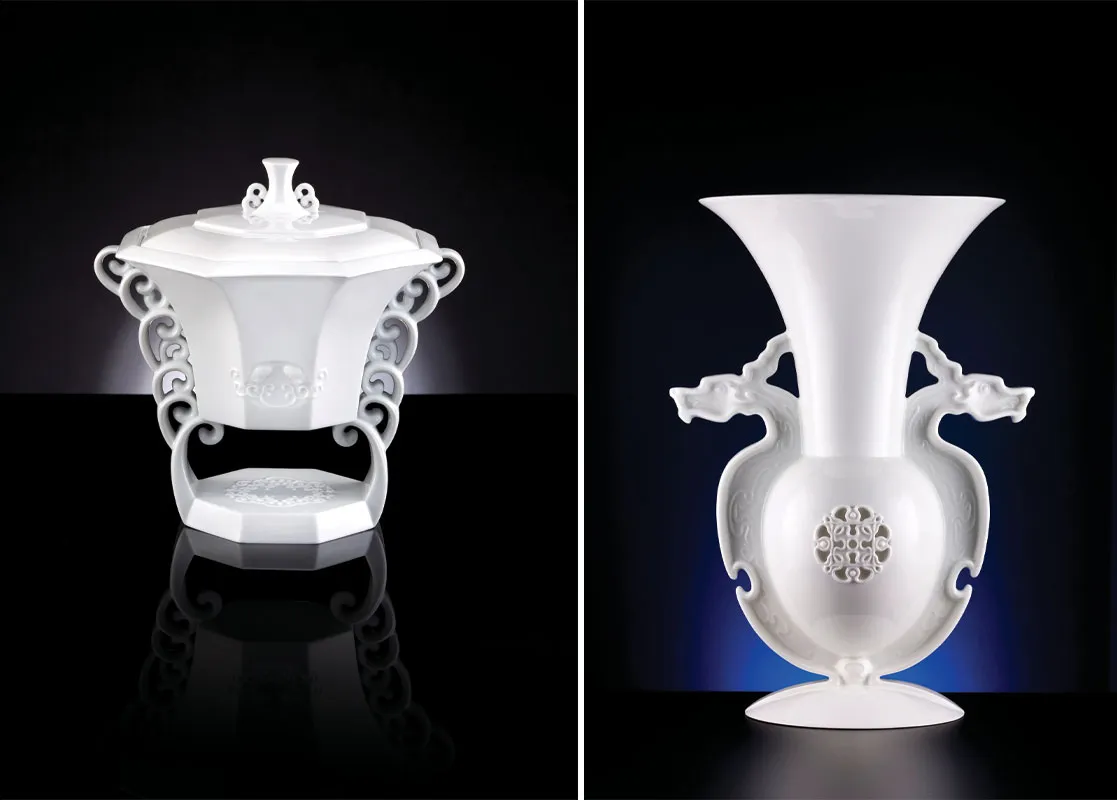
In works like Year of Abundance (pictured left), swirling waves symbolize boundless energy while flying fish leap in a suspended animation of prosperity. In Readiness (right), twin dragons are coiled with ears pricked, their bodies retracted in a state of potential energy, guarding five millennia of history. These are not static objects; they possess a kinetic quality, a sense of movement frozen in the heat of the kiln.
“Everyone told me it would be impossible to create such complex shapes and angles out of porcelain,” Wang recalls. Yet, his disregard for “impossible” is perhaps rooted in his past life-not as a potter, but as a director.
Before the clay, there was celluloid. In the 1980s, Heinrich Wang was a recognized figure in the Taiwanese entertainment industry. A graduate of the Film Department at Shih Hsin University, he worked in advertising and fashion, eventually earning a nomination for a Taipei Golden Horse Film Festival Award-the highest accolade in Taiwanese cinema.
One can still trace the director in the artist. With his dark suit and ponytail, Wang commands the space of his gallery like a film set. His transition from the ephemeral world of moving images to the permanent world of solid forms began at age 32, sparked by a simple glass paperweight on his father’s desk. The allure of tangible creation led him to Detroit, Michigan, where he studied glass art, eventually returning to Taiwan to establish Tittot, an art glass company that utilized lost-wax casting-a technique traditionally reserved for bronze-to give glass a solemn, masculine weight.
However, the shift to porcelain marked a deeper cultural pilgrimage. Wang observed that while porcelain is the quintessential symbol of Chinese civilization, the industry had stagnated, largely content with reproducing antiques rather than innovating.
“In the past, when people thought of porcelain, they thought of it as the finest representation of Chinese culture. However, in the last two or three hundred years, modern porcelain art has not made any further breakthroughs,” Wang notes.
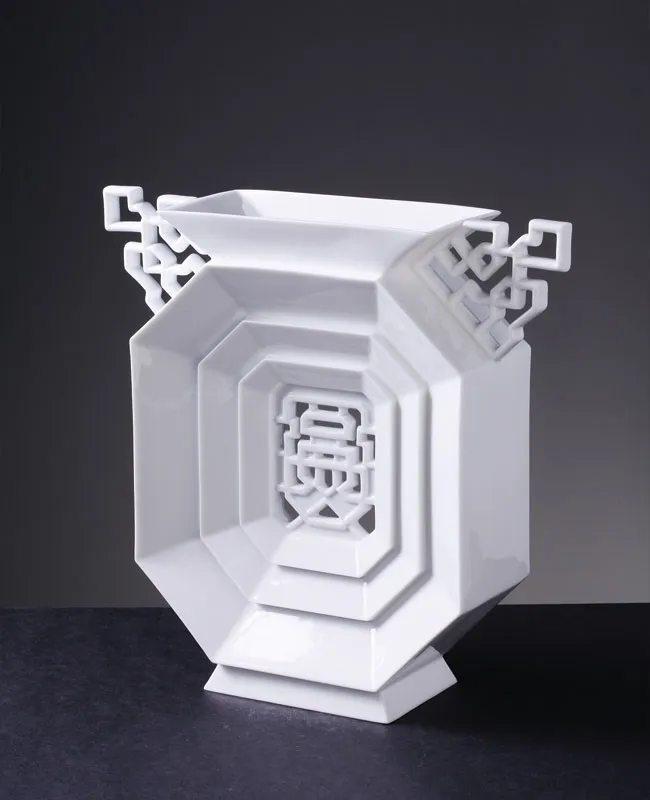
NewChi is his answer to this stagnation. He envisions everyday objects-tableware, vases-not as utilities, but as “contemporary classics.” In pieces like Wealth and Honor, the marriage of the Chinese characters “Fu” (wealth) and “Gui” (honor) is rendered through a design reminiscent of delicate paper cutting, yet solidified in white clay. It is a reclamation of heritage, designed not to live in a museum case, but to breathe in a modern home.
“Making porcelain on the one hand is the practice of aesthetics, and on the other hand is exploring life,” Wang says. The discipline required to manipulate such temperamental material mirrors the discipline of self-cultivation. “Persistence is for a lifetime. Just like making movies, if you don’t persist to the last moment, you will definitely regret it… We often face difficulties. At that time, we must make up our mind, be firm, and never compromise.”
Today, Wang continues to push the boundaries of his medium, now looking toward a radical synthesis of his two great loves: combining glass and porcelain in ways previously unattempted. It is the restless spirit of a director who has found his perfect cast, forever seeking the next scene in the narrative of Chinese art.
Joining Shen Yun in 2007, Angelia Wang (b. Xi'an, China) represents a benchmark in the…
"We're a team." It is a simple phrase, just three words, yet it holds more…
In the high-stakes theater of grand opera, survival requires a bifurcation of the self. For…
They say the second year of marriage is defined by cotton. It sounds simple, almost…
Two decades together is no small feat. It is a milestone that speaks to patience,…
poems The Merchant of Venice Student Edition---PDF and Complete TextThe water in Venice is never…
There is a specific kind of silence that settles in the garden after a loss.…
There is a specific kind of magic that happens when a photographer doesn't just capture…
In the ancient Italian town of Santarcangelo di Romagna, where history clings to the cobblestones…
The Princeton Club of New York, usually a bastion of quiet networking, recently became the…
A decade together is no small feat. It’s ten years of inside jokes, shared silences,…
In the vast and fragmented linguistic landscape of China, the spoken word has always been…
In an art world often preoccupied with jarring intellectualism or the pursuit of hyper-realistic technicality,…
For Joseph Scheier-Dolberg, the Oscar Tang and Agnes Hsu-Tang Associate Curator of Chinese Paintings at…
I still remember watching you when Grandma passed away. I saw how deeply you mourned,…
There is a distinct difference between seeing a moment with your eyes and seeing how…
Clothing has never been merely about protection against the cold. Across five millennia of human…
The first year of marriage is often a whirlwind of emotions. It is a period…
Ralph Waldo Emerson once observed that "Earth laughs in flowers," a poetic sentiment that reverberates…
There is a specific gravity to a poem carried in the pocket. It is different…
Mother’s Day is approaching, and if you are miles away from the woman who raised…
Winter has a way of changing the landscape of our lives, not just the view…
The allure of Japanese art often lies in its masterful negotiation between the void and…
There is a distinct fairy-tale quality to the work of Lison de Caunes, a resonance…
William Wordsworth (1770–1850) remains a titan of English letters, a figure whose life spanned the…
I was thinking today about how much ground we've covered together. You know, between two…
There is a paradoxical nature to porcelain. In its raw state, it is dense earth;…
The sonnet is not merely a form; it is a vessel for concentrated thought. To…
The intersection of heritage craftsmanship and avant-garde installation art often yields the most compelling dialogues…
I've been thinking a lot about the power of visibility lately, especially as we celebrate…