Oil painting of a ballerina in a white tutu resting at the barre
In the realm of contemporary realism, there exists a delicate threshold where the precision of photography dissolves into the subjective warmth of memory. This is the space inhabited by the works of Japanese artist Hiroki Yamamoto. His portraits, primarily of young women, are not merely exercises in technical hyper-realism; they are soft-focus meditations on presence, seemingly suspended in a dreamlike haze that blurs the harsh edges of reality.
Yamamoto’s subjects, often rendered with astonishing lifelike clarity, occupy a world that defies linear chronology. A figure may be absorbed in the quiet act of writing while clad in period dress, while another dons elaborate mechanical headwear suggesting a distant, cybernetic future. Yet, regardless of the era implied by their attire, the atmosphere remains consistent: one of stillness, solitude, and an ethereal luminosity.
What distinguishes Yamamoto’s work from standard photorealism is his unique conceptual approach to the relationship between artist, subject, and viewer. He does not seek a direct, confrontational gaze. Instead, he cultivates a sense of voyeuristic detachment—a quiet observation that feels both intimate and unreachable.
“My paintings don’t show a one-on-one relationship between the model and the artist,” Yamamoto explains, describing his distinct creative stance. “It’s more like the perspective of a potted plant peeking into the room where the model is, or the viewpoint of a film director watching footage in an editing room.”
This philosophy creates a fascinating paradox in his canvas. The viewer is invited to look closely, yet there is an invisible barrier of “distance” deliberately imposed by the artist. It is the distance of a silent witness, allowing the subject to exist in their own private world, unperturbed by the external gaze. This approach, Yamamoto notes, represents his personal way of interacting with others—a guarded but deeply attentive connection.
In his work Repose, this philosophy is physically manifest. The painting depicts a ballet dancer taking a momentary break during practice. Her posture retains the discipline of her art—poised and restrained—yet there is a vulnerability in the moment of rest. The pristine white tutu, likened to swan feathers, catches the soft, subtle light, radiating a purity that feels almost fragile. The viewer observes this moment not as a participant, but as a quiet element of the room, witnessing the beauty of discipline in silence.
Yamamoto’s portfolio is a tapestry where timelines converge. By juxtaposing images of the contemporary, the historical, and the futuristic, he strips away the temporal context to reveal the human constant. Whether the subject is a kimono-clad maiden gazing through a window or a figure adorned with futuristic technology, the underlying humanity remains unchanged.
“I aim to convey the timeless existence of individuals,” the artist states. “Though cultures, technologies, and trends differ from one era to another, people continue to live their daily lives in a similar manner—it’s a wonderful, beautiful notion.”
This sentiment transforms his paintings into an anthropological study of the soul. He suggests that the act of living—the small moments of reading, waiting, or resting—transcends the noise of technological advancement or historical setting.
Born in Chiba, Japan, in 1982, Yamamoto’s journey into the visual arts began as a necessity of expression. As a young child, he struggled with verbal communication, often finding himself isolated. However, a pivotal moment occurred in kindergarten when the principal noticed a remarkable portrait Yamamoto had drawn of his mother.
“When I was alone in the classroom drawing, everyone would gather round to see my artwork,” he recalls. “I realized that drawing could be a form of communication in place of words, and a way to engage with society.”
This early realization—that art could bridge the gap between the self and the world—propelled him through formal education. He refined his skills at Musashino Art University, graduating in 2009 with a focus on oil painting. Since then, his work has been showcased in numerous solo and group exhibitions, earning accolades for a technique that marries the precision of the Old Masters with a modern, cinematic sensibility.
Yamamoto’s technical mastery is perhaps best seen in how he handles light. In works such as Refrain, Aeolian Harp, and In Noema’s Forest, light acts as a secondary subject, defining the emotional temperature of the piece.
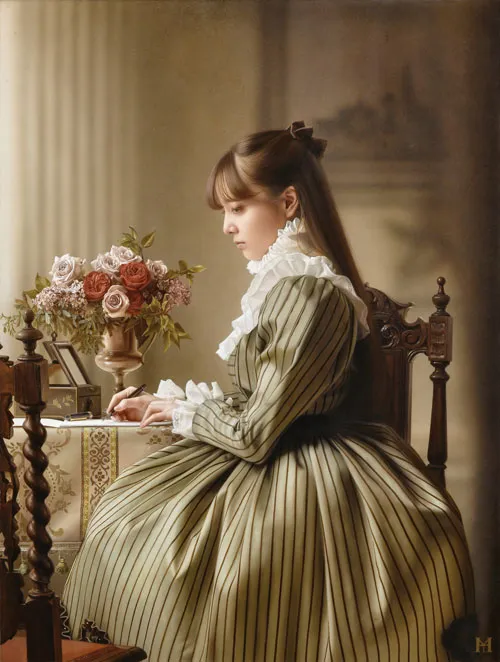
In Refrain, a young girl is depicted sitting at a table, pausing in contemplation while writing. The light source, coming from outside, does not just illuminate the room; it caresses the texture of the delicate lace on her collar and cuffs. It highlights the stillness of the moment—the “refrain” or pause in action that allows for thought.
Through these hyper-realistic yet dreamlike windows, Hiroki Yamamoto offers a sanctuary from the chaotic pace of modern life. He reminds the viewer that regardless of whether we are in the past, present, or future, the quiet dignity of simply “being” remains our most enduring trait.
Joining Shen Yun in 2007, Angelia Wang (b. Xi'an, China) represents a benchmark in the…
"We're a team." It is a simple phrase, just three words, yet it holds more…
In the high-stakes theater of grand opera, survival requires a bifurcation of the self. For…
They say the second year of marriage is defined by cotton. It sounds simple, almost…
Two decades together is no small feat. It is a milestone that speaks to patience,…
poems The Merchant of Venice Student Edition---PDF and Complete TextThe water in Venice is never…
There is a specific kind of silence that settles in the garden after a loss.…
There is a specific kind of magic that happens when a photographer doesn't just capture…
In the ancient Italian town of Santarcangelo di Romagna, where history clings to the cobblestones…
The Princeton Club of New York, usually a bastion of quiet networking, recently became the…
A decade together is no small feat. It’s ten years of inside jokes, shared silences,…
In the vast and fragmented linguistic landscape of China, the spoken word has always been…
In an art world often preoccupied with jarring intellectualism or the pursuit of hyper-realistic technicality,…
For Joseph Scheier-Dolberg, the Oscar Tang and Agnes Hsu-Tang Associate Curator of Chinese Paintings at…
I still remember watching you when Grandma passed away. I saw how deeply you mourned,…
There is a distinct difference between seeing a moment with your eyes and seeing how…
Clothing has never been merely about protection against the cold. Across five millennia of human…
The first year of marriage is often a whirlwind of emotions. It is a period…
Ralph Waldo Emerson once observed that "Earth laughs in flowers," a poetic sentiment that reverberates…
There is a specific gravity to a poem carried in the pocket. It is different…
Mother’s Day is approaching, and if you are miles away from the woman who raised…
Winter has a way of changing the landscape of our lives, not just the view…
The allure of Japanese art often lies in its masterful negotiation between the void and…
There is a distinct fairy-tale quality to the work of Lison de Caunes, a resonance…
William Wordsworth (1770–1850) remains a titan of English letters, a figure whose life spanned the…
I was thinking today about how much ground we've covered together. You know, between two…
There is a paradoxical nature to porcelain. In its raw state, it is dense earth;…
The sonnet is not merely a form; it is a vessel for concentrated thought. To…
The intersection of heritage craftsmanship and avant-garde installation art often yields the most compelling dialogues…
I've been thinking a lot about the power of visibility lately, especially as we celebrate…