Blue and white porcelain platter with Qilin motif and floral border
In the landscape of Chinese art history, the transition from the Yuan (1271–1368) to the Ming (1368–1644) dynasties represents a pivotal shift in aesthetic consciousness. It was a time when the kiln fires of Jingdezhen burned with unprecedented intensity, birthing porcelains that would captivate not only the Imperial Court but the world beyond. Currently, the Asia Society Museum in New York invites viewers into this rarefied atmosphere with Imperial Treasures, an exhibition curated by Susan L. Beningson that functions less as a historical survey and more as a “jewel box”—an intimate confrontation with sheer beauty.
Drawn from the permanent collection of Mr. and Mrs. John D. Rockefeller 3rd, the exhibition showcases approximately 25 masterworks. Unlike their contemporaries, who favored the austere monochromes of the Song dynasty or ancient tomb sculptures, the Rockefellers possessed a distinct eye for the vibrancy of the Ming. They were drawn to the lusciousness of glazes and the narrative power of surface design, amassing a collection that speaks to the sophistication of imperial tastes.
Here, the porcelain vessel is not merely a container, but a canvas where technical mastery meets symbolic language.
The interaction between China and the Islamic world during the Yuan dynasty birthed the iconic blue-and-white aesthetic, a dialogue materialized in this massive Qilin Motif Platter. The central creature—a qilin, the mythical chimera heralding benevolent rule—sits amidst a garden of auspicious flora, including morning glories and melons.
However, the object’s true weight lies in its provenance. It is one of the rare surviving porcelains bearing an inscription in Farsi, marking it as part of the collection of Shah Jahan, the Mughal emperor who commissioned the Taj Mahal. This platter is not just a triumph of Chinese firing; it is a diplomat of the 17th century, traveling from the kilns of Jingdezhen to the courts of India, embodying the fluidity of art across borders.
While cobalt blue defined an era, the mastery of copper oxide presented a far more volatile challenge. This Scarlet Glaze Dish, fired during the Chenghua period (circa 1400s), represents the pinnacle of the potter’s control over heat and chemistry. Known as jihong or “sacrificial red,” this deep, blood-like hue was notoriously difficult to achieve, often requiring multiple firings and precise atmospheric conditions within the kiln.
The color served a solemn purpose. These vessels were utilized in religious ceremonies at the Imperial Altar of the Sun. The shade also carried dynastic weight; the surname of the Ming royal family, “Zhu,” translates to “red,” making this dish a monochromatic emblem of legitimate rule and celestial connection.
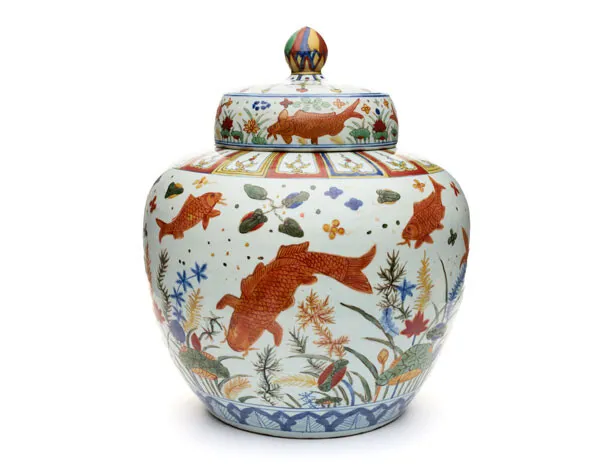
By the 16th century, the restraint of earlier periods gave way to the exuberant wucai (five-color) technique. This Covered Carp Jar is a testament to that shift, where blue underglaze meets the vibrant overglaze enamels of the Jiajing era. The surface becomes a pond, teeming with golden carp navigating through river reeds—a visual metaphor for abundance and academic success.
The addition of the lotus motif creates a dual symbolism: purity rising from the mud, and the continuity of life. The visual density of the piece reflects a courtly taste that had begun to favor dynamism and color over the silent, meditative spaces of the previous centuries.
The Ming aesthetic often functioned as a coded language, where every botanical element carried a wish for the owner. This Floral Patterned Dish from the Zhengde era (1506–1522), acquired by Rockefeller in London in 1962, serves as a permanent garden of fortune. The interior is painted with blooms of peach (longevity), lychee, and pomegranate (fertility), alongside the camellia, which heralds the Lunar New Year.
The fascination with the natural and the supernatural often blurred. This Whimsical Stem Cup, crafted in Jiangxi during the mid-to-late 1400s, draws inspiration from the Shanhai Jing (Classic of Mountains and Seas). The ancient geographical and mythological text enjoyed a revival during this period, influencing artisans to depict fantastical beasts. Here, elephants, fish-dragons, and horses frolic amidst crashing waves, freezing a moment of mythical turbulence into delicate porcelain.
The early 1400s saw the refinement of cobalt painting, creating works like this Decorative Flower Bowl. The deep, sapphire intensity of the underglaze interacts with the white negative space to highlight chrysanthemums and lotus vines. Acquired from the dealer J.T. Tai & Co. in 1962, the piece exemplifies the “heaped and piled” effect, where the cobalt pigment concentrates in certain areas, adding texture and depth to the visual field.
During the Xuande era (1426–1435), artisans began to experiment with texture alongside color. This Symbolic Cobalt Dish features a ground of blue underglaze, but the decoration—camellia blooms and pomegranates—is incised into the clay body. This technique adds a tactile dimension to the visual symbolism of fertility. It is believed that such plates were commissioned specifically for the women of the court, acting as talismans for lineage and family prosperity.
The language of fruit continues in this Painted Ceramic Bowl, a resident of the Rockefeller collection since 1964. The surface is a compendium of desire: peonies for wealth, lotuses for purity, and the crucial lychee. In the phonetic wordplay characteristic of Chinese culture, the lychee symbolizes the birth of a son—a paramount concern for the continuity of ancestral lines.
The Silk Road did not only transport goods; it transported shapes. This Incised Lotus Bottle, dating to the early 15th century, mirrors the metal and glass flask designs prevalent in Iran, Turkey, and Syria. Yet, the execution is quintessentially Chinese.
The vessel employs the anhua or “hidden decoration” technique. To the casual glance, the surface appears smooth; only upon close inspection or when held against the light does the delicate incised lotus medallion reveal itself. This subtlety suggests the object was intended for the Emperor’s personal use, a private pleasure meant to be discovered rather than displayed.
The exhibition concludes its narrative with the ultimate symbol of imperial authority: the five-clawed dragon. This Flaming Pearl Dragon Bowl from the Xuande era captures the mythical beast in pursuit of the flaming pearl of wisdom.
What makes this piece exceptional is the dual use of underglaze copper and cobalt—red and blue—intertwined to create the scene. The dragon, strictly reserved for the Emperor, circles the carinated form of the bowl, asserting power through the durability of fired clay.
As Asia Society Museum Director Yasufumi Nakamori notes, exhibitions like Imperial Treasures allow for a recontextualization of objects. By viewing these ceramics not merely as antiques, but as surviving witnesses to a specific intersection of trade, chemistry, and imperial will, we begin to see the Ming dynasty in a new, more luminous light.
Joining Shen Yun in 2007, Angelia Wang (b. Xi'an, China) represents a benchmark in the…
"We're a team." It is a simple phrase, just three words, yet it holds more…
In the high-stakes theater of grand opera, survival requires a bifurcation of the self. For…
They say the second year of marriage is defined by cotton. It sounds simple, almost…
Two decades together is no small feat. It is a milestone that speaks to patience,…
poems The Merchant of Venice Student Edition---PDF and Complete TextThe water in Venice is never…
There is a specific kind of silence that settles in the garden after a loss.…
There is a specific kind of magic that happens when a photographer doesn't just capture…
In the ancient Italian town of Santarcangelo di Romagna, where history clings to the cobblestones…
The Princeton Club of New York, usually a bastion of quiet networking, recently became the…
A decade together is no small feat. It’s ten years of inside jokes, shared silences,…
In the vast and fragmented linguistic landscape of China, the spoken word has always been…
In an art world often preoccupied with jarring intellectualism or the pursuit of hyper-realistic technicality,…
For Joseph Scheier-Dolberg, the Oscar Tang and Agnes Hsu-Tang Associate Curator of Chinese Paintings at…
I still remember watching you when Grandma passed away. I saw how deeply you mourned,…
There is a distinct difference between seeing a moment with your eyes and seeing how…
Clothing has never been merely about protection against the cold. Across five millennia of human…
The first year of marriage is often a whirlwind of emotions. It is a period…
Ralph Waldo Emerson once observed that "Earth laughs in flowers," a poetic sentiment that reverberates…
There is a specific gravity to a poem carried in the pocket. It is different…
Mother’s Day is approaching, and if you are miles away from the woman who raised…
Winter has a way of changing the landscape of our lives, not just the view…
The allure of Japanese art often lies in its masterful negotiation between the void and…
There is a distinct fairy-tale quality to the work of Lison de Caunes, a resonance…
William Wordsworth (1770–1850) remains a titan of English letters, a figure whose life spanned the…
I was thinking today about how much ground we've covered together. You know, between two…
There is a paradoxical nature to porcelain. In its raw state, it is dense earth;…
The sonnet is not merely a form; it is a vessel for concentrated thought. To…
The intersection of heritage craftsmanship and avant-garde installation art often yields the most compelling dialogues…
I've been thinking a lot about the power of visibility lately, especially as we celebrate…