Norlha yak wool
Luxury is often defined by scarcity, but true rarity lies in the convergence of a hostile environment and a gentle touch. On the Tibetan Plateau, where the air is thin and the winters are unforgiving, the yak survives by growing a coat of dense, insulating fiber. For centuries, this material was viewed through the lens of utility—felted into tents for nomads or woven into rough ropes. It was a fabric of survival, not refinement.
Dechen Yeshi and her mother saw something else in the undercoat of the yak: a potential for softness that rivaled cashmere, hidden beneath the coarse guard hairs. Norlha, their textile atelier, was born not merely to produce fabric, but to translate the resilience of the Himalayas into a tactile language understood by the ateliers of Paris.
The genesis of Norlha began with a tactile curiosity. Yeshi’s mother, a Parisian with an eye for history, had read of the chuba—the traditional Tibetan dress—being fashioned from yak wool. Yet, in the contemporary market, the fiber was absent, dismissed as too difficult to process. Camel hair was too coarse; cashmere was ubiquitous. But the yak, an animal engineered by nature to withstand blizzards at 3,000 meters, possessed a unique “khullu” (down) that offered profound warmth without the weight.
“It’s a really challenging fiber to work with,” Yeshi notes. The fibers are short, requiring meticulous cleaning, de-hairing, and spinning to unlock their potential. The journey from a nomad’s raw harvest to a luxury textile involves overcoming the inherent stubbornness of the material. Once mastered, however, the result is a fabric that breathes—a thermal miracle that feels substantial yet floats against the skin.
Establishing an atelier in a remote Himalayan village required more than just machinery; it required a reimaging of space and time. There was no running water, no reliable electricity, and no paved roads. The infrastructure of modern manufacturing did not exist, so it had to be woven from scratch.
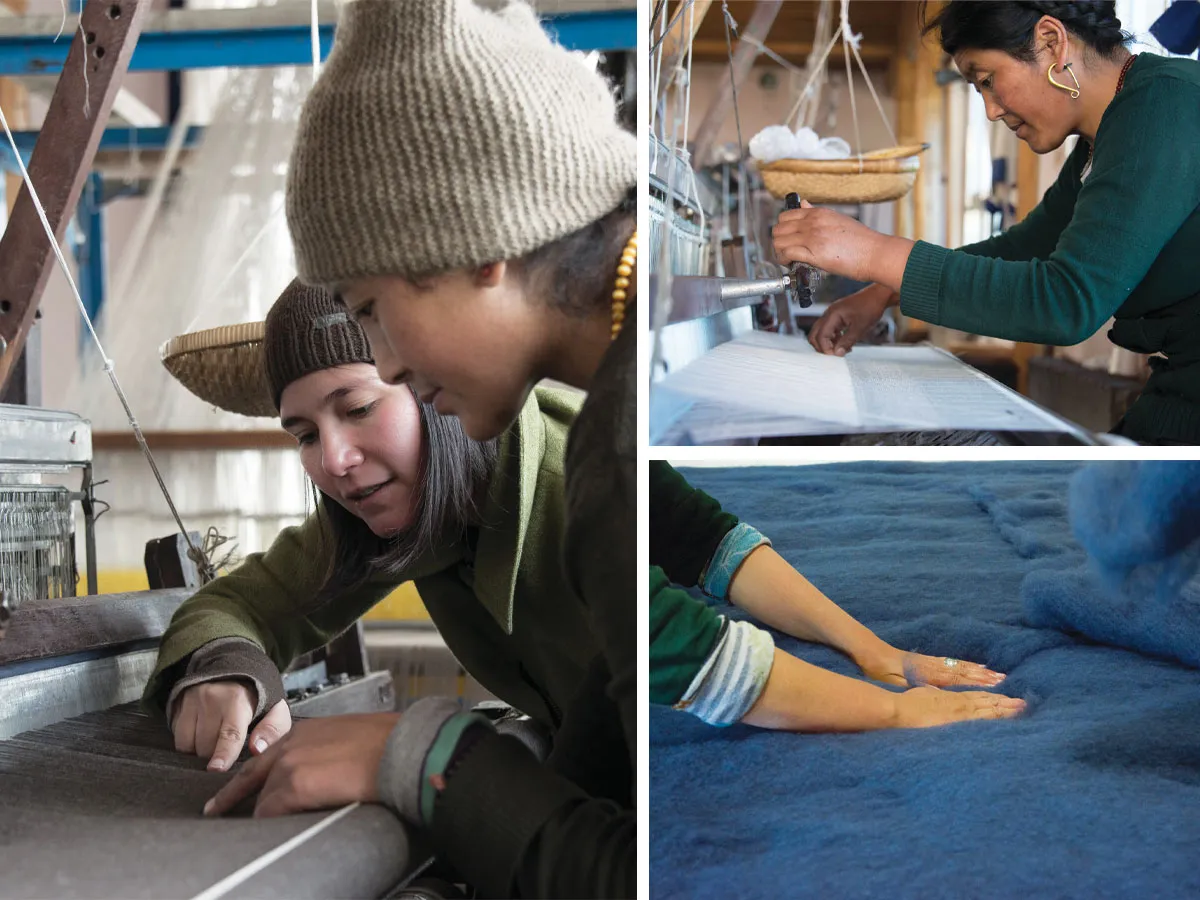
More profound was the shift in perspective required for the artisans. The local nomadic population was accustomed to the vast, open grasslands where “the looms stretched out into the horizon.” Weaving was an outdoor activity, boundless and rough. Norlha had to adapt this expansive spirit into the disciplined, rhythmic precision of an indoor atelier.
[
To bridge this gap, Yeshi and her mother looked to the history of the Industrial Revolution. They imported British shuttle looms—the same sturdy machines that drive the cashmere industry in India and Nepal—and brought them to the high plateau. In 2006, they sent a team of artisans to Cambodia and Nepal for six months of rigorous training. They returned not just with technical skills, but with a new understanding of “quality.”
Norlha introduced a three-step quality control process, a radical departure from the village’s traditional methods. “This kind of quality check makes it so that handmade is not an excuse for badly made,” Yeshi asserts. The result is a textile that retains the soul of the hand but possesses the consistency required by high fashion.
While weaving provided the foundation, Norlha’s experimentation led to a distinct innovation: yak felting. Traditionally, felting in the region was utilitarian, resulting in dense, stiff materials suitable for boots or tents. Norlha sought to refine this ancient technique, blending Tibetan methods with processes learned from Finland.
This hybridization allowed them to create large, continuous pieces of felt that maintained a soft, draped quality previously thought impossible for yak wool. It opened the door to structural fashion—coats, hats, and interior design elements that require body and form. “The uses are endless,” Yeshi observes, noting that this structural capability has made the material a favorite among designers who wish to sculpt with fabric rather than just drape it.
The transition from a remote village to the showrooms of Paris was not linear. When Norlha presented its first collection, the fashion establishment was hesitant. The luxury world is risk-averse, preferring established lineages of silk and cashmere. It took Arnys (now part of Berluti) to take the first leap of faith, ordering one hundred pieces.
However, the 2008 financial crisis reshaped the landscape. As the economy collapsed, the definition of luxury shifted from ostentation to authenticity. “Once the dust settled… people had a different attitude,” Yeshi reflects. The market began to crave narrative, ethics, and origin. The questions changed from “Who are you wearing?” to “Where did this come from?”
This cultural pivot aligned perfectly with Norlha’s ethos. Brands like Hermès, Louis Vuitton, Lanvin, and Visvim began to seek out the “chic, socially-responsible” atelier in Tibet. The harshness of the plateau and the integrity of the process became the ultimate value proposition.
At the core of Norlha is a philosophy rooted in Tibetan Buddhism—not the Buddhism of ritual and ceremony, but of mind training. “It’s not so much about physically being comfortable,” Yeshi explains. “It’s much more about your mental satisfaction of what you’re doing and how you’re using your life.”
This mindset provided the fortitude to endure frozen toothbrushes and the lack of running water in the early years. It also shaped the brand’s approach to commerce. Yeshi, who grew up in the U.S. with a filmmaker’s eye for storytelling, realized that the romanticized view of nomadic life often obscured the harsh reality of poverty. Norlha became a vessel for social change, not through charity, but through the dignity of craft.
Today, as the pressure of the “commodity economy” pushes for lower prices and faster production, Norlha resists. They have turned their focus to the direct relationship with the wearer, bypassing the seasonal churn of fashion weeks to offer something timeless. The goal is to create objects that act as companions—pieces that carry the silence of the plateau and the warmth of the artisan into the chaotic rhythm of modern life.
Joining Shen Yun in 2007, Angelia Wang (b. Xi'an, China) represents a benchmark in the…
"We're a team." It is a simple phrase, just three words, yet it holds more…
In the high-stakes theater of grand opera, survival requires a bifurcation of the self. For…
They say the second year of marriage is defined by cotton. It sounds simple, almost…
Two decades together is no small feat. It is a milestone that speaks to patience,…
poems The Merchant of Venice Student Edition---PDF and Complete TextThe water in Venice is never…
There is a specific kind of silence that settles in the garden after a loss.…
There is a specific kind of magic that happens when a photographer doesn't just capture…
In the ancient Italian town of Santarcangelo di Romagna, where history clings to the cobblestones…
The Princeton Club of New York, usually a bastion of quiet networking, recently became the…
A decade together is no small feat. It’s ten years of inside jokes, shared silences,…
In the vast and fragmented linguistic landscape of China, the spoken word has always been…
In an art world often preoccupied with jarring intellectualism or the pursuit of hyper-realistic technicality,…
For Joseph Scheier-Dolberg, the Oscar Tang and Agnes Hsu-Tang Associate Curator of Chinese Paintings at…
I still remember watching you when Grandma passed away. I saw how deeply you mourned,…
There is a distinct difference between seeing a moment with your eyes and seeing how…
Clothing has never been merely about protection against the cold. Across five millennia of human…
The first year of marriage is often a whirlwind of emotions. It is a period…
Ralph Waldo Emerson once observed that "Earth laughs in flowers," a poetic sentiment that reverberates…
There is a specific gravity to a poem carried in the pocket. It is different…
Mother’s Day is approaching, and if you are miles away from the woman who raised…
Winter has a way of changing the landscape of our lives, not just the view…
The allure of Japanese art often lies in its masterful negotiation between the void and…
There is a distinct fairy-tale quality to the work of Lison de Caunes, a resonance…
William Wordsworth (1770–1850) remains a titan of English letters, a figure whose life spanned the…
I was thinking today about how much ground we've covered together. You know, between two…
There is a paradoxical nature to porcelain. In its raw state, it is dense earth;…
The sonnet is not merely a form; it is a vessel for concentrated thought. To…
The intersection of heritage craftsmanship and avant-garde installation art often yields the most compelling dialogues…
I've been thinking a lot about the power of visibility lately, especially as we celebrate…