Founders Rianna Kounou and Nina Knaudt
“I enjoy discovering something that makes my heart beat just a little faster,” admits Rianna Kounou. It is a sentiment that defines the very pulse of RIANNA + NINA, a brand that exists less as a fashion label and more as a kinetic collage of history, color, and textile archaeology.
The genesis of the brand was serendipitous, occurring in 2013 at a vintage furniture fair. It was there that Kounou, a designer with an innate gravity toward the eclectic, met Nina Knaudt, a luxury strategist with a background at Cartier and Etro. Their connection was immediate—a shared recognition of a vibrancy that the contemporary market lacked. From this meeting emerged a mission not merely to dress the body, but to curate heirlooms capable of traversing generations, a philosophy that has since found patrons in figures as diverse as Madonna, Rihanna, and Jared Leto.
Kounou’s aesthetic sensibility was not learned in a classroom but absorbed through the atmosphere of her childhood in Greece. Raised among theatrical costumes and her parents’ vintage shop in Athens, she developed an intimate understanding of the weight and weave of the past. To her, a garment is never inanimate; it is a repository of stories.
This reverence for the old world forms the structural backbone of the brand’s visual language. When Kounou and Knaudt merged their talents, they did not seek to replicate current trends but to resurrect the ghosts of previous eras. “I grew up exploring the beauty of these past eras,” Kounou reflects. “Discovering the stories and imagining the people who once owned these objects excites me.”
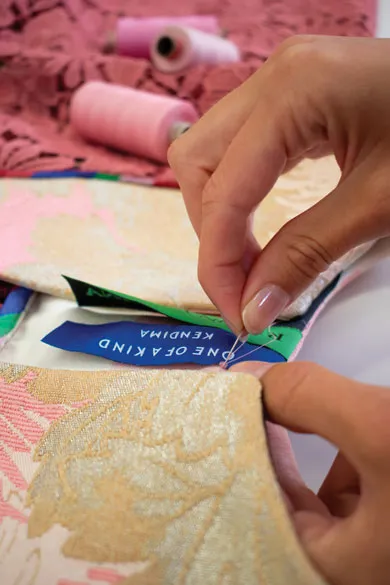
The brand’s signature Volant dresses exemplify this approach. Constructed from vintage silk scarves hand-picked by Kounou, each dress is a singular entity—a “one-of-a-kind” composition that can never be duplicated. Knaudt describes the sensation of wearing these pieces as “putting on a collage of past memories.” It is an act of continuing a narrative that began decades, perhaps centuries, prior.
While the spirit of the brand is nomadic and treasure-seeking, its execution is grounded in the rigorous traditions of European craftsmanship. The brand’s operations span a distinct geography of expertise: the creative chaos of the Berlin atelier, the historic silk mills of Como, and the artisanal workshops of Greece.
When the duo decided to expand into original prints, they turned inevitably to Como, Italy. “What fascinates me about the region is the heritage of its silk production and embroidery that began in the 17th century,” Kounou notes. The choice was not governed by convenience but by a desire for a specific cultural continuity—a quality of touch and luster that only centuries of localized knowledge can produce.
Recently, this dedication to physical presence has manifested in their first flagship store at the Palais Royal in Paris. Yet, the heart of production remains the Berlin atelier, where a small team of master artisans assembles both the unique vintage reworkings and the original prints. It is a slow process, resistant to the acceleration of modern manufacturing.
The process of sourcing materials for RIANNA + NINA resembles a curatorial expedition more than a commercial supply chain. Kounou and Knaudt are “treasure hunters,” driven by the human element behind the artifact. The value of a button or a trim lies not just in its aesthetic, but in the lineage of the hands that made it.
This approach leads them to obscure and magical corners of the industry. On one occasion, a small Italian button factory reached out, inviting them to explore their archives. The resulting pilgrimage allowed the founders to integrate not just the physical buttons into their collection, but the history of the family that manufactured them.
Perhaps the most poignant example of this preservationist ethos is their relationship with Mentis, a historic Greek manufacturer of passementerie—the intricate art of decorative trimming. Once a thriving industry, Mentis is now a rare guardian of this tradition.
“Mentis carries a long tradition of Greek silk production, a heritage we cherish and are proud to be part of,” says Knaudt. Watching artisans operate centuries-old machines creates a tangible link between the modern designs of RIANNA + NINA and the ancestral rhythms of Greek textile art.
Whether scouring antique markets during their travels or collaborating with the last masters of a dying trade, the founders treat every material as a living protagonist. In their hands, vintage is not merely reused; it is recontextualized, allowing the silent stories of the past to speak loudly, in vibrant color, once more.
Joining Shen Yun in 2007, Angelia Wang (b. Xi'an, China) represents a benchmark in the…
"We're a team." It is a simple phrase, just three words, yet it holds more…
In the high-stakes theater of grand opera, survival requires a bifurcation of the self. For…
They say the second year of marriage is defined by cotton. It sounds simple, almost…
Two decades together is no small feat. It is a milestone that speaks to patience,…
poems The Merchant of Venice Student Edition---PDF and Complete TextThe water in Venice is never…
There is a specific kind of silence that settles in the garden after a loss.…
There is a specific kind of magic that happens when a photographer doesn't just capture…
In the ancient Italian town of Santarcangelo di Romagna, where history clings to the cobblestones…
The Princeton Club of New York, usually a bastion of quiet networking, recently became the…
A decade together is no small feat. It’s ten years of inside jokes, shared silences,…
In the vast and fragmented linguistic landscape of China, the spoken word has always been…
In an art world often preoccupied with jarring intellectualism or the pursuit of hyper-realistic technicality,…
For Joseph Scheier-Dolberg, the Oscar Tang and Agnes Hsu-Tang Associate Curator of Chinese Paintings at…
I still remember watching you when Grandma passed away. I saw how deeply you mourned,…
There is a distinct difference between seeing a moment with your eyes and seeing how…
Clothing has never been merely about protection against the cold. Across five millennia of human…
The first year of marriage is often a whirlwind of emotions. It is a period…
Ralph Waldo Emerson once observed that "Earth laughs in flowers," a poetic sentiment that reverberates…
There is a specific gravity to a poem carried in the pocket. It is different…
Mother’s Day is approaching, and if you are miles away from the woman who raised…
Winter has a way of changing the landscape of our lives, not just the view…
The allure of Japanese art often lies in its masterful negotiation between the void and…
There is a distinct fairy-tale quality to the work of Lison de Caunes, a resonance…
William Wordsworth (1770–1850) remains a titan of English letters, a figure whose life spanned the…
I was thinking today about how much ground we've covered together. You know, between two…
There is a paradoxical nature to porcelain. In its raw state, it is dense earth;…
The sonnet is not merely a form; it is a vessel for concentrated thought. To…
The intersection of heritage craftsmanship and avant-garde installation art often yields the most compelling dialogues…
I've been thinking a lot about the power of visibility lately, especially as we celebrate…