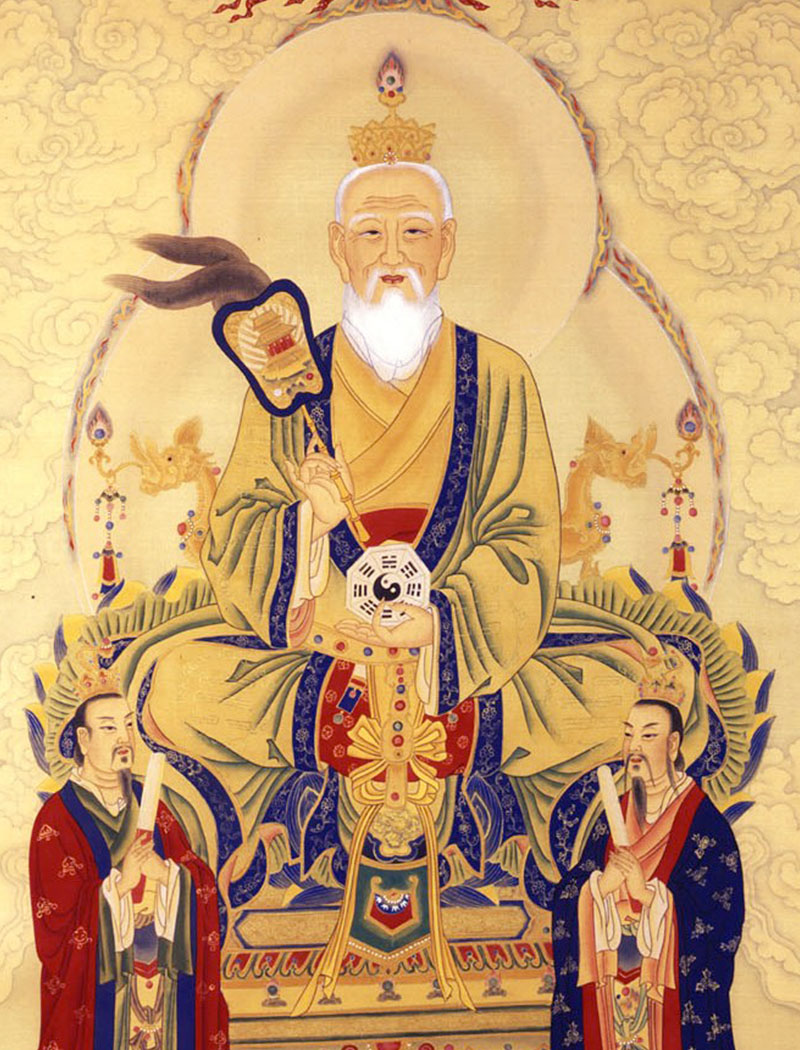
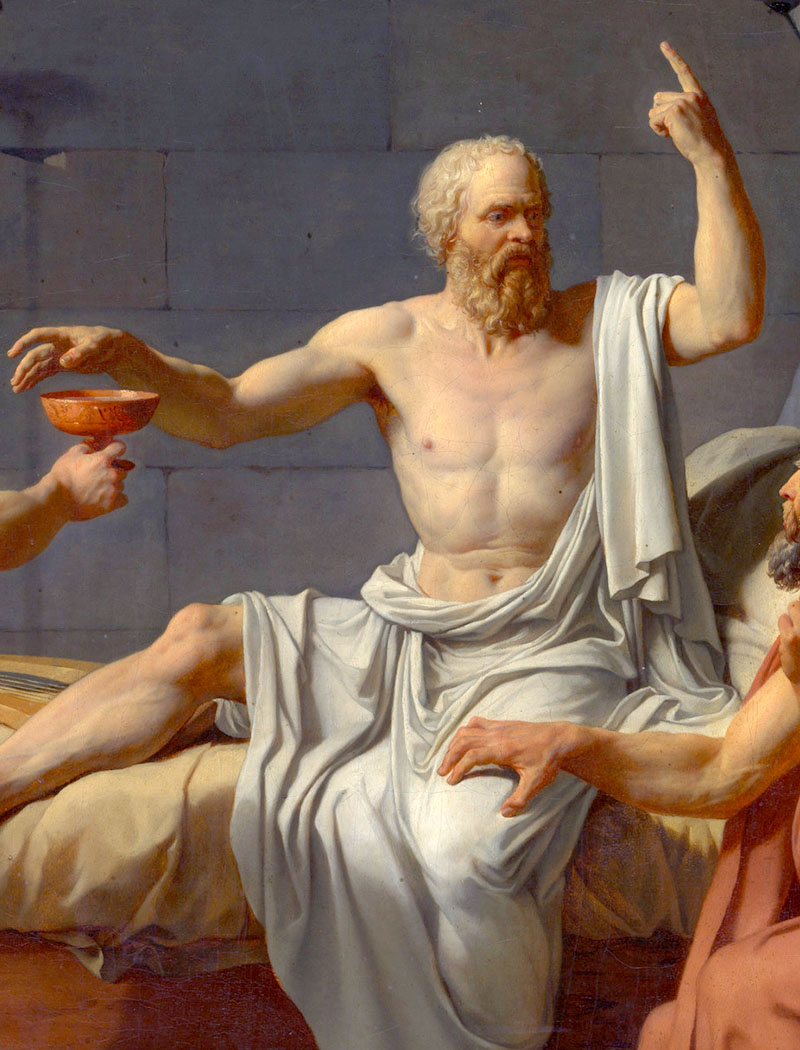
History, when viewed through the lens of wisdom rather than conquest, reveals fascinating synchronicity. In the axial age of antiquity, two monumental figures emerged on opposite ends of the Eurasian continent: Laozi in the twilight of China’s Zhou Dynasty, and Socrates in the golden yet turbulent era of Athens. Though separated by vast geography and language, their intellectual spirits walked parallel paths.
Imagine, for a moment, a suspension of time and space-a metaphysical agora where the dust of Athens mixes with the mists of ancient China. Here, amidst the clamor of a Sino-Greco marketplace, these two sages might meet. Their hypothetical conversation, constructed from the fragments of their recorded teachings, reveals a profound resonance in their views on the human condition.
In this imagined bustling thoroughfare, merchants hawk their wares and pedestrians rush to acquire the latest novelties. Observing the feverish pursuit of material accumulation, the Greek philosopher pauses.
“He is rich who is content with the least,” Socrates observes, watching a laden shopper struggle with their burden. “For contentment is the wealth of nature.”
Beside him, stroking a long white beard, the Old Master from the East nods in quiet recognition. “He who is contented is rich,” Laozi responds.
The cacophony of the market-vendors shouting, coins clinking-rises around them. To the uncultivated ear, it is merely noise. To the sage, it creates a backdrop against which true stillness can be measured.
“Silence is a profound melody for those who can hear it above all the noise,” Socrates remarks with a faint smile.
“When there is silence, one finds the anchor of the universe within oneself,” Laozi concurs.
This journey inward prompts the ultimate philosophical imperative. “Know thyself,” Socrates murmurs, the cornerstone of Western introspection.
Laozi expands the thought, distinguishing between external intelligence and internal wisdom: “Knowing others is to be clever. Knowing yourself is to be enlightened.”
The dialogue is interrupted by a nobleman, a figure draped in fine silks yet shadowed by a visible melancholy. He is a man who possesses everything yet feels possessed by nothingness. Overhearing the sages, he approaches them, seeking the alchemy that turns fortune into happiness.
Laozi sighs, offering a diagnosis that cuts through the nobleman’s dependency on the external world: “If your happiness depends on money, you will never be happy with yourself.”
Socrates offers the remedy, shifting the focus from accumulation to capacity. “The secret of happiness, you see, is not found in seeking more, but in developing the capacity to enjoy less.”
It is a radical inversion of the nobleman’s reality-a revelation that the pursuit of happiness often destroys the very thing it seeks.
Often regarded as the respective patriarchs of Eastern and Western thought, Laozi and Socrates shared a paradoxical relationship with knowledge. They did not claim to hold the keys to the universe; rather, they emphasized the strength found in recognizing one’s limitations.
Their consensus on intellectual humility is striking:
Laozi: “To realize that you do not understand is a virtue; not to realize that you do not understand is a defect.”
Socrates: “The only true wisdom is in knowing you know nothing.”
This humility was not a passive resignation but an active cultivation of the self. Both sages advocated for a stripping away of the ego’s defenses-fear, desire, and pride-to reach a state of self-mastery. Their aesthetics of life favored the minimal.
Laozi: “Manifest plainness, embrace simplicity, reduce selfishness, have few desires.”
Socrates: “The fewer our wants the more we resemble the Gods.”
The practical application of their philosophy requires a shift in directional focus: from the outward judgment of others to the inward examination of the self. Conflict, in their view, is not resolved by correcting the world, but by correcting the lens through which one views it.
The historical timelines of these two luminaries concluded in divergent yet iconic manners.
Around the fourth century B.C.E., as the Zhou Dynasty crumbled into chaos, Laozi chose the path of the recluse. He rode a water buffalo toward the western frontier, intending to vanish into the wilderness. Before his final departure, however, he was asked to record his wisdom. The result was the Tao Te Ching-five thousand characters that would shape Eastern civilization for millennia.
“He who knows does not speak. He who speaks does not know,” Laozi had written, leaving a legacy of profound paradox.
Conversely, in 399 B.C.E., Socrates faced a public execution in Athens. Convicted of impiety and corrupting the youth, he accepted his sentence-death by hemlock-with the same philosophical calm he applied to his life. He left no writings of his own, relying on his disciples to carry his dialectic forward.
“I cannot teach anybody anything. I can only make them think,” Socrates declared.
Though one rode into the mist and the other drank from the cup, both left behind a silence that continues to resonate-a profound melody for those willing to listen.
Joining Shen Yun in 2007, Angelia Wang (b. Xi'an, China) represents a benchmark in the…
"We're a team." It is a simple phrase, just three words, yet it holds more…
In the high-stakes theater of grand opera, survival requires a bifurcation of the self. For…
They say the second year of marriage is defined by cotton. It sounds simple, almost…
Two decades together is no small feat. It is a milestone that speaks to patience,…
poems The Merchant of Venice Student Edition---PDF and Complete TextThe water in Venice is never…
There is a specific kind of silence that settles in the garden after a loss.…
There is a specific kind of magic that happens when a photographer doesn't just capture…
In the ancient Italian town of Santarcangelo di Romagna, where history clings to the cobblestones…
The Princeton Club of New York, usually a bastion of quiet networking, recently became the…
A decade together is no small feat. It’s ten years of inside jokes, shared silences,…
In the vast and fragmented linguistic landscape of China, the spoken word has always been…
In an art world often preoccupied with jarring intellectualism or the pursuit of hyper-realistic technicality,…
For Joseph Scheier-Dolberg, the Oscar Tang and Agnes Hsu-Tang Associate Curator of Chinese Paintings at…
I still remember watching you when Grandma passed away. I saw how deeply you mourned,…
There is a distinct difference between seeing a moment with your eyes and seeing how…
Clothing has never been merely about protection against the cold. Across five millennia of human…
The first year of marriage is often a whirlwind of emotions. It is a period…
Ralph Waldo Emerson once observed that "Earth laughs in flowers," a poetic sentiment that reverberates…
There is a specific gravity to a poem carried in the pocket. It is different…
Mother’s Day is approaching, and if you are miles away from the woman who raised…
Winter has a way of changing the landscape of our lives, not just the view…
The allure of Japanese art often lies in its masterful negotiation between the void and…
There is a distinct fairy-tale quality to the work of Lison de Caunes, a resonance…
William Wordsworth (1770–1850) remains a titan of English letters, a figure whose life spanned the…
I was thinking today about how much ground we've covered together. You know, between two…
There is a paradoxical nature to porcelain. In its raw state, it is dense earth;…
The sonnet is not merely a form; it is a vessel for concentrated thought. To…
The intersection of heritage craftsmanship and avant-garde installation art often yields the most compelling dialogues…
I've been thinking a lot about the power of visibility lately, especially as we celebrate…