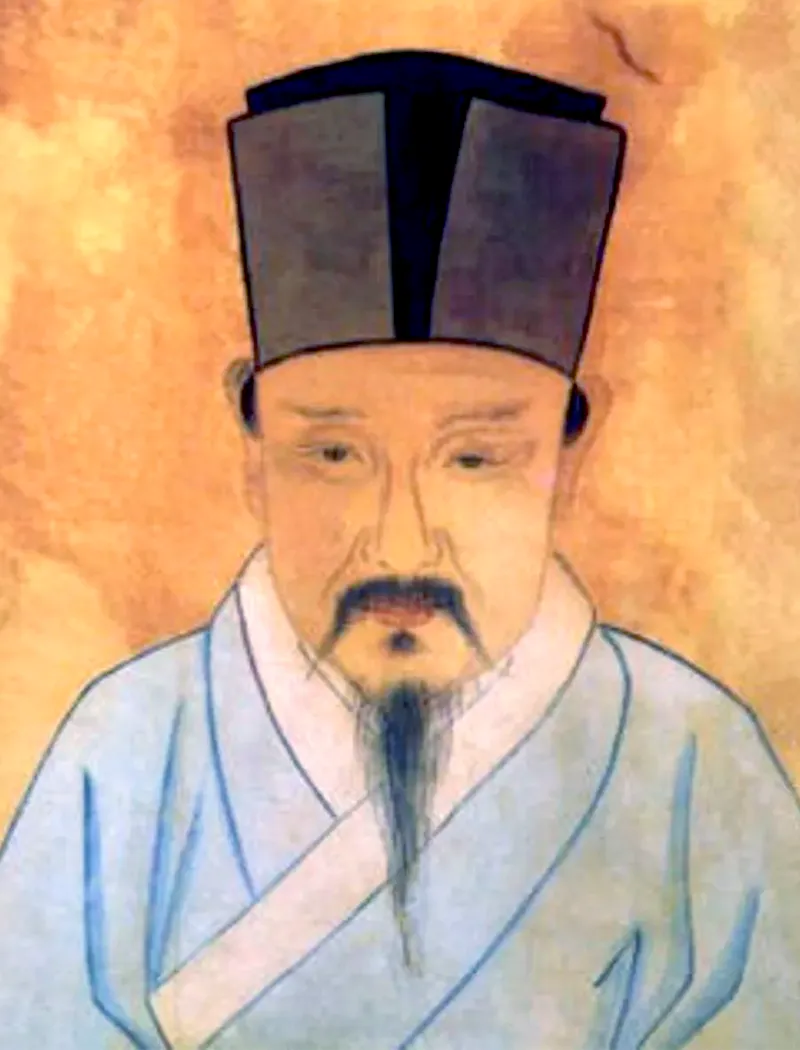
Portrait of Nostradamus
History is often viewed as a linear progression of days and nights, yet to the visionary mind, time appears more like a vast, folding tapestry. Patterns repeat, shadows lengthen, and the echoes of the future reverberate into the past. In the annals of mysticism, two figures stand as colossi on opposite sides of the globe—separated by centuries and culture, yet united by a singular, piercing gaze into the unknown.
Michel de Nostradame in France and Liu Bowen in China were not merely fortune tellers; they were scholars, strategists, and poets who encoded the destiny of nations into riddles. Their legacies suggest that while the languages of East and West differ, the language of fate remains startlingly universal.
In the misty mid-16th century, amidst the stone towers of Salon-de-Provence, Michel de Nostradame—known to the world as Nostradamus—sat in nocturnal meditation. A physician by trade, renowned for treating outbreaks of the bubonic plague in southern France and Italy, he possessed an intimate understanding of human fragility. Yet, his gaze extended far beyond the ailments of the body to the ailments of the epoch.
In 1555, he published The Prophecies, a collection of nearly a thousand quatrains. These were not straightforward declarations but cryptic, lyrical puzzles designed to evade the scrutiny of the Inquisition while preserving their truth for those with the eyes to see. His verses spanned millennia, reaching as far as the year 3797.
One specific vision serves as a chilling testament to his accuracy. In the royal court of Paris, Nostradamus reportedly warned King Henry II against participating in ritual combat. He spoke of a “younger lion” overcoming an “older lion” on the field of battle, piercing his eye through a golden cage.
Three years later, the prophecy manifested with brutal precision. During a jousting match in 1559, the King’s opponent shattered his lance, sending a splinter through the monarch’s visor—the “golden cage”—and into his eye. Henry II succumbed to the infection ten days later, dying exactly as the physician had foreseen. Beyond this regnal tragedy, Nostradamus’s verses are believed by many to have outlined the contours of the French Revolution, the rise of Napoleon and Hitler, the tragedy of September 11, and the persecution of the spiritual practice Falun Gong.
Across the silence of two centuries and the expanse of the Silk Road, a kindred spirit emerged in China. Liu Bowen (born Liu Ji) lived in the 14th century, serving as the chief advisor to Zhu Yuanzhang, the founder of the Ming Dynasty. Much like his French counterpart, Liu was a polymath—a brilliant military strategist, a philosopher, and a poet.
Liu was celebrated not only for his foresight but for his unyielding integrity. In 1348, he famously rejected a bribe from a rebel leader, establishing a reputation for righteousness that would underpin his spiritual authority. His approach to prophecy mirrored the meditative practices of Nostradamus; he sought inspiration in stillness, translating cosmic observations into lyrical riddles.
His most renowned prophetic work, the Pancake Song (Shaobing Ge), derives its name from a legendary encounter with the Emperor. Presented as a dialogue, it is said to have accurately predicted the 1449 Mongol invasion, the Sino-Japanese War, and the fall of dynastic rule leading to the founding of the Republic of China in 1911. Like Nostradamus, Liu authored works on strategy, such as Extraordinary Strategies of a Hundred Battles, proving that his mysticism was grounded in a deep pragmatic understanding of human conflict.
It is in the context of great pestilence that the voices of these two sages seem to harmonize most hauntingly. Nostradamus began his career battling the plague, and some interpretations of his quatrains suggest he foresaw the global pandemics of the modern era.
Similarly, Liu Bowen’s Shaanxi Province Mount Taibai Inscription offers a specific temporal marker for catastrophe. He wrote that a great plague would erupt in the years of the Pig and the Rat. In the cyclical Chinese zodiac, 2019—the dawn of the recent virus—was the Year of the Pig, followed immediately by the Year of the Rat in 2020. Furthermore, Liu pinpointed the geography of distress, warning that “Huguang” province would face great tribulation. Huguang is an ancient administrative region that encompasses modern-day Hubei province and its capital, Wuhan.
Yet, to read these prophets merely as harbingers of doom is to miss the essence of their message. In both the hermetic traditions of the West and the Daoist philosophies of the East, prophecy serves not to terrify, but to instruct.
Liu Bowen’s inscriptions offer a stark dichotomy: wealth is rendered useless in the face of the plague, while moral rectification offers a path to safety. “Regardless of whether you’re rich or poor, if you don’t improve your morals, death will soon be before you,” he warns. The “true treasure” he alludes to is not gold, but high moral values—a sentiment that resonates with the spiritual undercurrents of Nostradamus’s life.
Ultimately, these two visionaries, separated by time and geography, arrive at a shared conclusion. The future is not a fixed script of inevitable suffering, but a reflection of the human heart. They suggest that in the face of rising tides and falling empires, the most powerful protection remains the cultivation of virtue.
Joining Shen Yun in 2007, Angelia Wang (b. Xi'an, China) represents a benchmark in the…
"We're a team." It is a simple phrase, just three words, yet it holds more…
In the high-stakes theater of grand opera, survival requires a bifurcation of the self. For…
They say the second year of marriage is defined by cotton. It sounds simple, almost…
Two decades together is no small feat. It is a milestone that speaks to patience,…
poems The Merchant of Venice Student Edition---PDF and Complete TextThe water in Venice is never…
There is a specific kind of silence that settles in the garden after a loss.…
There is a specific kind of magic that happens when a photographer doesn't just capture…
In the ancient Italian town of Santarcangelo di Romagna, where history clings to the cobblestones…
The Princeton Club of New York, usually a bastion of quiet networking, recently became the…
A decade together is no small feat. It’s ten years of inside jokes, shared silences,…
In the vast and fragmented linguistic landscape of China, the spoken word has always been…
In an art world often preoccupied with jarring intellectualism or the pursuit of hyper-realistic technicality,…
For Joseph Scheier-Dolberg, the Oscar Tang and Agnes Hsu-Tang Associate Curator of Chinese Paintings at…
I still remember watching you when Grandma passed away. I saw how deeply you mourned,…
There is a distinct difference between seeing a moment with your eyes and seeing how…
Clothing has never been merely about protection against the cold. Across five millennia of human…
The first year of marriage is often a whirlwind of emotions. It is a period…
Ralph Waldo Emerson once observed that "Earth laughs in flowers," a poetic sentiment that reverberates…
There is a specific gravity to a poem carried in the pocket. It is different…
Mother’s Day is approaching, and if you are miles away from the woman who raised…
Winter has a way of changing the landscape of our lives, not just the view…
The allure of Japanese art often lies in its masterful negotiation between the void and…
There is a distinct fairy-tale quality to the work of Lison de Caunes, a resonance…
William Wordsworth (1770–1850) remains a titan of English letters, a figure whose life spanned the…
I was thinking today about how much ground we've covered together. You know, between two…
There is a paradoxical nature to porcelain. In its raw state, it is dense earth;…
The sonnet is not merely a form; it is a vessel for concentrated thought. To…
The intersection of heritage craftsmanship and avant-garde installation art often yields the most compelling dialogues…
I've been thinking a lot about the power of visibility lately, especially as we celebrate…