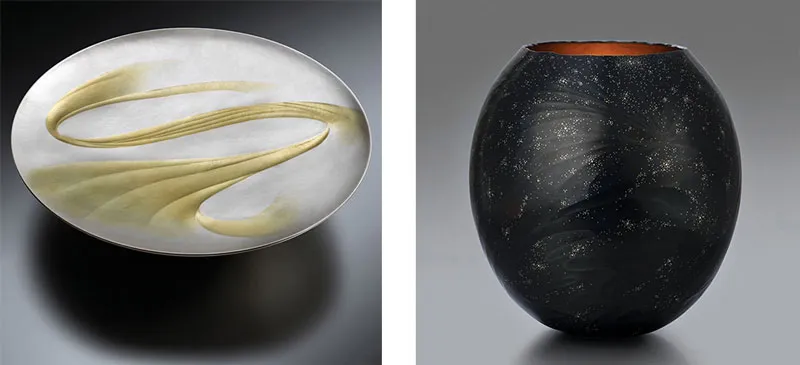
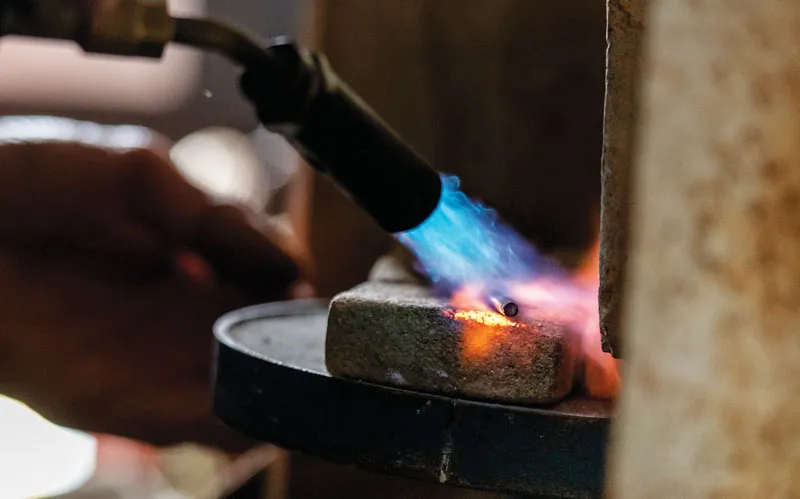
Wayne Meeten works on his piece Wave After Wave, hammering it to the rhythm of his heartbeat. Photo by Andrew Butler.
For the artist, the boundary between the internal landscape of the soul and the external form of the material is often porous. For Wayne Meeten, a master of silver and goldsmithing, this connection was not merely metaphorical—it was a matter of survival. At the age of twenty-nine, Meeten found himself navigating the dark waters of PTSD, bearing physical scars that mirrored a fractured spirit. It was in this state of vulnerability that he discovered a profound truth, not in a studio, but in the silence of a woodland.
Guided by a Tai Chi teacher during a countryside workshop, Meeten was brought before a massive tree, its bark gnarled and interrupted by the passage of time. When asked to observe the tree, Meeten saw only damage. Yet, upon stepping back, the perspective shifted. The teacher offered a reflection that would dismantle Meeten’s shame: the tree was majestic precisely because of its scars, not in spite of them. It was a mirror of the man himself—a “tree of life,” weathered on the surface but holding a quiet, enduring grandeur within.
This revelation functioned as a fulcrum for Meeten’s artistic trajectory. He realized that his previous works, characterized by sharp angles, aggressive edges, and defensive geometries, were unconscious manifestations of his trauma. He had been forging hard shells to protect a raw interior.
The realization initiated a metamorphosis in his design philosophy. The rigid barriers of his metalwork dissolved, replaced by the soft fluidity of the natural world—rivers, waterfalls, and the organic asymmetry of life. Meeten began to approach the anvil not just as a craftsman, but as a practitioner of the Dao.
“Yin is soft, yang is hard, in the centre is the Dao,” Meeten observes. The rhythmic act of silversmithing—the hammering, filing, and annealing—became an extension of his Tai Chi practice. It is a meditation in motion, where the creative solution arises from finding the positive within the negative space.
Meeten’s reverence for the material was forged long before his philosophical awakening. His journey began at sixteen in an antique jewelry workshop, a setting that exposed him to the tension between art and commerce. A pivotal moment occurred when he was tasked with repairing an exquisite Art Deco piece by a master craftsman. His employer, seeing more value in the raw commodities than the artistry, ordered it scrapped.
The incident left an indelible mark on Meeten, driving him away from the commercial commodification of jewelry and toward the sanctity of artisanship. He pursued formal training under tutors associated with houses like Cartier and Garrard, eventually discovering Mokume Gane—a rare, ancient Japanese metalworking technique originally used to forge Samurai swords. The term translates to “wood grain metal,” a method that layers mixed metals to create distinctive, organic patterns akin to natural wood.
To master this art, Meeten understood he had to go to the source. He dedicated two years to learning Japanese before applying to art schools across Japan. The path was not without its ironies; his first rejection letter informed him he had applied to an all-girls school. Yet, his persistence remained unyielding. He wrote directly to Norio Tamagawa, a figure so revered in the craft that he holds the title of Living National Treasure.
Meeten was eventually accepted into the Tokyo University of Fine Arts and Music. In Japan, the cultural approach to craft stood in stark contrast to Western efficiency. He learned that in the hierarchy of creation, time is subservient to quality.
The Japanese philosophy eschews shortcuts. There is a deliberate rejection of grinders and machinery designed solely for speed. Instead, the artisan is encouraged to become one with the tool and the material. “If you’re one with the material and one with your tools, you know exactly at what stage you are,” Meeten explains. “One can sense and feel the piece growing into shape.”
The culmination of Meeten’s apprenticeship in Japan was marked by a quiet revelation typical of the Eastern master-student tradition. After a year of rigorous, solitary study, Meeten prepared to leave, believing his attempts to contact the legendary Norio Tamagawa had gone unanswered.
It was then that a professor revealed the truth: Tamagawa had been watching all along. The university had been providing the master with updates on Meeten’s progress for a year. The silence was not a rejection, but a period of observation to test the student’s dedication. Having proven his patience and respect for the craft, Meeten was finally invited to meet the master.
Today, works such as Dance In The Night Sky—which pays homage to the Aurora Borealis—stand as testaments to this journey. They are not merely objects of gold and silver, but physical narratives of a man who learned to hammer the rhythm of his own heartbeat into the metal, turning scars into a majestic, flowing grain.
Joining Shen Yun in 2007, Angelia Wang (b. Xi'an, China) represents a benchmark in the…
"We're a team." It is a simple phrase, just three words, yet it holds more…
In the high-stakes theater of grand opera, survival requires a bifurcation of the self. For…
They say the second year of marriage is defined by cotton. It sounds simple, almost…
Two decades together is no small feat. It is a milestone that speaks to patience,…
poems The Merchant of Venice Student Edition---PDF and Complete TextThe water in Venice is never…
There is a specific kind of silence that settles in the garden after a loss.…
There is a specific kind of magic that happens when a photographer doesn't just capture…
In the ancient Italian town of Santarcangelo di Romagna, where history clings to the cobblestones…
The Princeton Club of New York, usually a bastion of quiet networking, recently became the…
A decade together is no small feat. It’s ten years of inside jokes, shared silences,…
In the vast and fragmented linguistic landscape of China, the spoken word has always been…
In an art world often preoccupied with jarring intellectualism or the pursuit of hyper-realistic technicality,…
For Joseph Scheier-Dolberg, the Oscar Tang and Agnes Hsu-Tang Associate Curator of Chinese Paintings at…
I still remember watching you when Grandma passed away. I saw how deeply you mourned,…
There is a distinct difference between seeing a moment with your eyes and seeing how…
Clothing has never been merely about protection against the cold. Across five millennia of human…
The first year of marriage is often a whirlwind of emotions. It is a period…
Ralph Waldo Emerson once observed that "Earth laughs in flowers," a poetic sentiment that reverberates…
There is a specific gravity to a poem carried in the pocket. It is different…
Mother’s Day is approaching, and if you are miles away from the woman who raised…
Winter has a way of changing the landscape of our lives, not just the view…
The allure of Japanese art often lies in its masterful negotiation between the void and…
There is a distinct fairy-tale quality to the work of Lison de Caunes, a resonance…
William Wordsworth (1770–1850) remains a titan of English letters, a figure whose life spanned the…
I was thinking today about how much ground we've covered together. You know, between two…
There is a paradoxical nature to porcelain. In its raw state, it is dense earth;…
The sonnet is not merely a form; it is a vessel for concentrated thought. To…
The intersection of heritage craftsmanship and avant-garde installation art often yields the most compelling dialogues…
I've been thinking a lot about the power of visibility lately, especially as we celebrate…