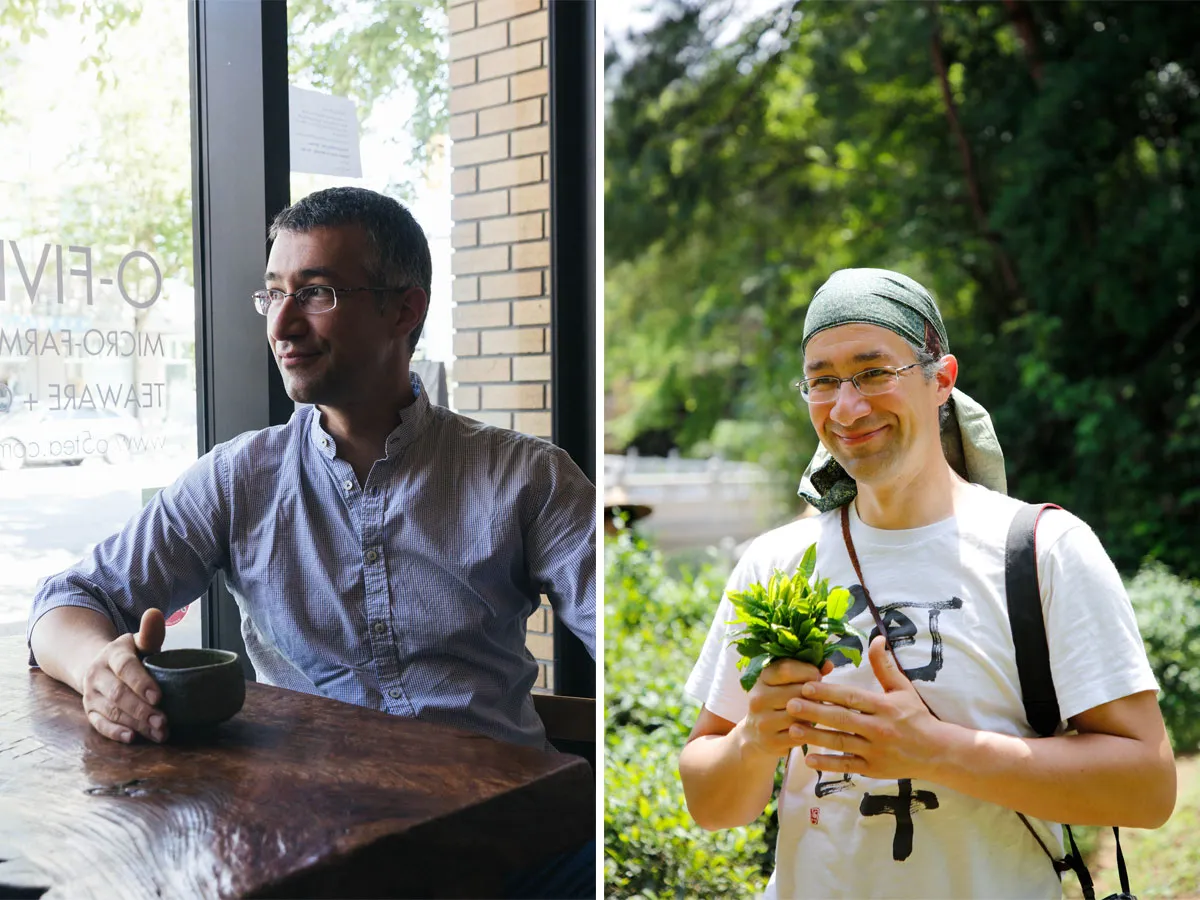
Pedro Villalon standing amidst a tea plantation with a contemplative expression
In the sprawling urban tapestry of Mexico City, the rhythm of life is often dictated by the clink of glass and the aroma of roasted beans. Here, the day begins with the sharp jolt of coffee and drifts into the amber warmth of tequila, whiskey, or beer as the sun descends. For Pedro Villalon, this was the gustatory soundtrack of his youth—a world vibrant with spirits but entirely devoid of the silent, meditative complexity of tea.
“Mine was a non-tea background,” Villalon admits, reflecting on a life that once revolved around chemical engineering and the high-gloss world of advertising. Yet, destiny often moves in quiet currents. In 2007, his corporate path led him to Guangzhou to manage a shampoo account, a mundane assignment that would inadvertently open the gates to a sensory awakening. It was not a boardroom, but a mist-laden mountain, that would dismantle the engineer and reconstruct him as a hunter of rare essences.
The metamorphosis occurred halfway up a mountain near Ban Bo Lao Zhai, in the Nannuo Shan region of Yunnan Province. While hiking, Villalon encountered a figure that seemed to blur the lines between his past and present. A man approached him carrying an axe—a sight that might instill fear in the uninitiated, yet Villalon felt a strange resonance.
The man, Yang Si, belonged to the Hani ethnic minority. His features—darker skin and distinct bone structure—bore a striking resemblance to the people of Villalon’s own Mexican homeland. “He asked me if I had eaten,” Villalon recalls. The simplicity of the question bridged the cultural chasm instantly. What began as a lunch invitation evolved into a three-day immersion into a way of life that felt like a memory of home.
In the haze of the morning mist, amidst a dwelling lacking running water or chimneys, life revolved around the hearth. They cooked over open fires and spoke a fragmented language of Mandarin and gesture. It was here that Villalon discovered Yang Si was a tea maker, guarding a stash of 20 kilograms of green pu’er.
“They were big sacks, really beautiful leaves,” Villalon describes. This was not the dust of teabags; it was a living entity, rich and untamed. In an act of impulsive reverence, he bought it all. The ad executive vanished; the tea hunter was born.
For the past decade, through his Vancouver-based sanctuary, O5 Rare Tea Bar, Villalon has approached tea not merely as a beverage, but as a map of the world. He speaks of the “terroir of tea”—a concept usually reserved for wine, encompassing the soil, the microclimate, and the ecology. But Villalon expands this definition to include the human spirit infused into the leaf.
His journeys have taken him to the remote Qiao Ban village in Zhejiang, near the Yellow Mountain. Inaccessible by car, the village demands a pilgrimage on foot. Here, the terroir is defined by the vitality of its elders. Villalon speaks with awe of his friend Zhan Zhifang’s father-in-law, a man in his 80s who navigates the steep ascents with the agility of youth.
“The reward for climbing up is the tea—a delicious brew with notes of cacao and oak,” Villalon notes. In these high altitudes, labels like ‘organic’ are redundant; the purity of the air and the soil renders the chemical world obsolete.
In the lakeside county of ChangXing, the tea hunter’s path intersected with imperial history. This region is hallowed ground for tea devotees, the former residence of Lu Yu, the sage who penned The Classic of Tea in the 8th century. Here, Villalon met Lily Wenhua Zhang, a custodian of tradition who owns two mountains of protected forest and a museum dedicated to the ancient master.
Zhang’s craft is an act of resurrection. She produces Zisun (purple bamboo shoot tea), a cultivar once researched and revered by Lu Yu himself. “She can craft tea that almost nobody makes in China,” Villalon explains. The leaves are processed into the shape of coins, reviving a Tang Dynasty aesthetic. The flavor profile—notes of honey and sugar peas—speaks of a sophistication that has survived over a millennium.
The brewing technique here mirrors the Korean ddok cha, a reminder of the ancient cultural exchanges that flowed through the tea routes. It is a testament to tea as a living artifact, a consumable piece of history that connects the drinker to the emperors and poets of the past.
Villalon’s quest is also one of kinetic energy. In Yunnan, he immersed himself in the Poshui Jie (Water-Splashing Festival), marking the Dai New Year. Amidst the boat races and the chaotic joy of water fights, he found a moment of stillness with Lu Zhi Ming, a master whose knowledge of pu’er is absolute.
Crossing borders, the journey turned rugged in the Phongsaly Province of Laos. Here, tea returns to its primal state. Villalon recounts plucking leaves from trees that towered over him—wild, ancient giants distinct from the manicured bushes of commercial estates. “Laos shares a border with China, and they make pu’er too, but you can’t call it that because the name is origin-protected,” he explains.
The terroir here is raw and unpolished. A 24-hour journey in a pickup truck through “terrible roads” revealed a landscape worthy of National Geographic. It is a place where the tea tastes of the wild earth, and where the luxury of a cold beer on a dusty roadside creates a perfect counterpoint to the hot brew.
Perhaps the most surreal chapter in Villalon’s atlas is located in the shadow of the Villarrica volcano in Chile. The geography of Chile, slender and long, curiously mimics the form of an unfurled tea leaf, yet it is not a traditional tea land.
The existence of Salus Chile, the southernmost tea plantation in the world, is a narrative of resilience. Born from the aftermath of the Chernobyl disaster in 1986, the land was purchased by a German pharmaceutical company seeking uncontaminated soil for herbs. They experimented with tea, aided by the cool climate and sloping terrain. The result is a garden of lush, organic plants thriving in the Southern Hemisphere—a botanical anomaly that produces a cup as clean and crisp as the Andean air.
From the trendy districts of Shibuya, Tokyo, where he recently opened a pop-up, to the remote firesides of the Hani people, Pedro Villalon remains a conduit for stories. “Our tea has stories,” he asserts. “It’s like buying craft beer from a guy with cool tattoos.”
The comparison is apt. Villalon has stripped tea of its stuffy, Victorian associations and returned it to its roots: elemental, agricultural, and deeply human. Whether sourced from a tree in Laos or a historic garden in ChangXing, each leaf carries the fingerprint of the person who picked it. For the engineer-turned-hunter, the perfect cup is not just about flavor; it is about that initial spark of connection—the moment a stranger with an axe invites you home, and the world suddenly becomes larger, and warmer.
Joining Shen Yun in 2007, Angelia Wang (b. Xi'an, China) represents a benchmark in the…
"We're a team." It is a simple phrase, just three words, yet it holds more…
In the high-stakes theater of grand opera, survival requires a bifurcation of the self. For…
They say the second year of marriage is defined by cotton. It sounds simple, almost…
Two decades together is no small feat. It is a milestone that speaks to patience,…
poems The Merchant of Venice Student Edition---PDF and Complete TextThe water in Venice is never…
There is a specific kind of silence that settles in the garden after a loss.…
There is a specific kind of magic that happens when a photographer doesn't just capture…
In the ancient Italian town of Santarcangelo di Romagna, where history clings to the cobblestones…
The Princeton Club of New York, usually a bastion of quiet networking, recently became the…
A decade together is no small feat. It’s ten years of inside jokes, shared silences,…
In the vast and fragmented linguistic landscape of China, the spoken word has always been…
In an art world often preoccupied with jarring intellectualism or the pursuit of hyper-realistic technicality,…
For Joseph Scheier-Dolberg, the Oscar Tang and Agnes Hsu-Tang Associate Curator of Chinese Paintings at…
I still remember watching you when Grandma passed away. I saw how deeply you mourned,…
There is a distinct difference between seeing a moment with your eyes and seeing how…
Clothing has never been merely about protection against the cold. Across five millennia of human…
The first year of marriage is often a whirlwind of emotions. It is a period…
Ralph Waldo Emerson once observed that "Earth laughs in flowers," a poetic sentiment that reverberates…
There is a specific gravity to a poem carried in the pocket. It is different…
Mother’s Day is approaching, and if you are miles away from the woman who raised…
Winter has a way of changing the landscape of our lives, not just the view…
The allure of Japanese art often lies in its masterful negotiation between the void and…
There is a distinct fairy-tale quality to the work of Lison de Caunes, a resonance…
William Wordsworth (1770–1850) remains a titan of English letters, a figure whose life spanned the…
I was thinking today about how much ground we've covered together. You know, between two…
There is a paradoxical nature to porcelain. In its raw state, it is dense earth;…
The sonnet is not merely a form; it is a vessel for concentrated thought. To…
The intersection of heritage craftsmanship and avant-garde installation art often yields the most compelling dialogues…
I've been thinking a lot about the power of visibility lately, especially as we celebrate…