Detailed micromosaic jewelry piece by Sicis featuring floral motifs
Italy has long functioned less as a mere geographical location and more as a continuous, living workshop. Since the Etruscan experiments of 700 BC, through the imperial grandeur of Rome and the technical explosions of the Renaissance, the peninsula has been a crucible where raw material is transmuted into cultural memory.
In the realm of high jewelry, this legacy is not static. It is a dialogue between the weight of history and the lightness of innovation. The Italian jewel is rarely just an accessory; it is a miniature architecture, a wearable sculpture that carries the DNA of its makers. From the revival of eighteenth-century mosaics to the suspension of precious stones in fluid, these five houses illustrate how the Italian artisan continues to manipulate light, gold, and stone into art.
Based in Milan, Sicis (est. 2013) approaches jewelry not through the lens of the goldsmith, but through the eye of the mosaicist. Their work is a resurrection of the eighteenth-century Roman micromosaic tradition—a painstaking discipline that bridges the gap between masonry and painting.
The technique begins with the creation of the raw material itself. Artisans melt Venetian enamel or glass paste mixed with diamond dust, pulling the molten substance into impossibly thin rods. These rods are then fractured into thousands of micro-tiles, or tesserae.
What distinguishes Sicis is the use of malmischiati, a method of mixing pigments within the molten glass to achieve a gradient that mimics the stroke of a paintbrush. When the artisans place these tiles by hand to form three-dimensional motifs, the result is not a rigid grid, but a fluid, vibrating image. It is a pointillist painting rendered in glass and diamond, requiring a patience that seems almost defiant in the modern age.
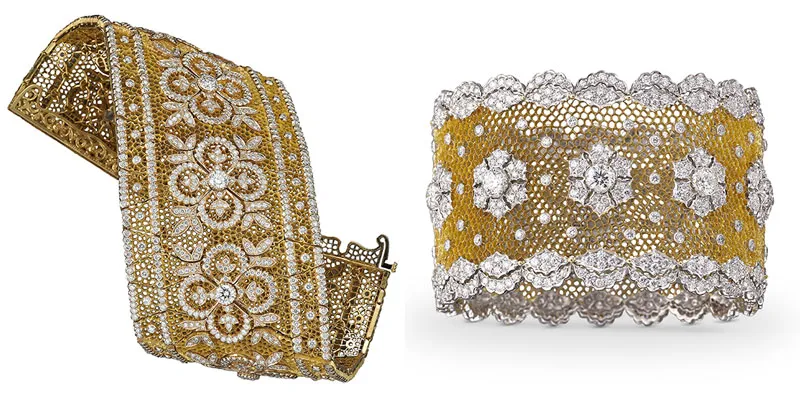
If Sicis turns glass into paint, Buccellati (est. 1919) turns metal into fabric. Founded in Milan, the house is renowned for a stylistic paradox: gold that possesses the visual weightlessness of silk and lace.
This effect is achieved through the “Tulle” technique, a hallmark of the brand’s rigorous craftsmanship. The process is reductive and perilous; artisans bore countless microscopic holes into sheets of fine gold. The remaining metal forms a honeycomb mesh, a “knit-like” structure that allows light to permeate the piece rather than just reflect off it.
The aesthetic is unapologetically Renaissance. By employing ancient surface treatments—engraving, chiseling, and hammering—the metal loses its cold, industrial hardness and gains a satin finish. Whether in their openwork Lace earrings or the textile-inspired Silk cuffs, the gold appears to drape and fold, deceiving the eye into believing the rigid is pliable.
In Torre del Greco, the narrative shifts from gold to organic matter. This coastal town is the spiritual and practical home of shell cameo engraving, a tradition Cameo Italiano (est. 1957) has preserved through the lineage of the de Luca family.
Unlike the additive processes of casting or setting stones, cameo work is subtractive sculpture. It relies entirely on the irregularities of nature. The master engraver must read the shell—usually a sardonyx or cornelian—to understand its layers of color and depth before the first cut is made.
The artisan traces a design and carves away the background, leaving the relief in white against the darker under-layer of the shell. Because no two shells share the exact same curvature or pigmentation, standardization is impossible. Each piece remains a singular study in patience, a tiny bas-relief that carries the specific hand of its carver.
While others look to the past for technique, Dreamboule (est. 2018) looks to the laboratory. Situated in Milan’s Brera district, the brand introduces a kinetic element to the static world of fine jewelry, blending goldsmithing with the mechanics of watchmaking and the chemistry of alchemy.
The defining feature of a Dreamboule piece is the sapphire glass dome. Beneath this scratch-resistant arch lies a “magic solution”—a fluid of specific density that allows the interior scene to move in a dreamlike slow motion.
Inside this suspended environment, elements of gold, diamonds, rubies, and even black lava stone float freely. Constructing a single ring involves over 18 distinct procedures and 240 hours of assembly. It is a conceptual leap, turning the ring into a contained world, a portable terrarium of precious materials that reacts to the wearer’s movements.
Vhernier (est. 1984 in Valenza) represents the modernist evolution of the Italian goldsmith. Here, the focus moves away from ornate detail toward volume, geometry, and the architectural play of optics.
The house is celebrated for its Trasparenze technique, a method that redefines how color is perceived in jewelry. Rather than exposing a colored gemstone directly to the surface, Vhernier superimposes a layer of pure, sculpted rock crystal over opaque stones like jade, lapis, or turquoise.
The crystal acts as a lens, amplifying the color and giving the piece a deep, aquatic luminosity that seems to emanate from within. Complementing this is the “Eyeliner pavé” technique, where stones of varying sizes are set into rhodium-plated gold with such precision that the metal disappears, leaving only a seamless curve of light. It is an engineering feat as much as an artistic one, stripping away the superfluous to reveal the essence of the form.
Joining Shen Yun in 2007, Angelia Wang (b. Xi'an, China) represents a benchmark in the…
"We're a team." It is a simple phrase, just three words, yet it holds more…
In the high-stakes theater of grand opera, survival requires a bifurcation of the self. For…
They say the second year of marriage is defined by cotton. It sounds simple, almost…
Two decades together is no small feat. It is a milestone that speaks to patience,…
poems The Merchant of Venice Student Edition---PDF and Complete TextThe water in Venice is never…
There is a specific kind of silence that settles in the garden after a loss.…
There is a specific kind of magic that happens when a photographer doesn't just capture…
In the ancient Italian town of Santarcangelo di Romagna, where history clings to the cobblestones…
The Princeton Club of New York, usually a bastion of quiet networking, recently became the…
A decade together is no small feat. It’s ten years of inside jokes, shared silences,…
In the vast and fragmented linguistic landscape of China, the spoken word has always been…
In an art world often preoccupied with jarring intellectualism or the pursuit of hyper-realistic technicality,…
For Joseph Scheier-Dolberg, the Oscar Tang and Agnes Hsu-Tang Associate Curator of Chinese Paintings at…
I still remember watching you when Grandma passed away. I saw how deeply you mourned,…
There is a distinct difference between seeing a moment with your eyes and seeing how…
Clothing has never been merely about protection against the cold. Across five millennia of human…
The first year of marriage is often a whirlwind of emotions. It is a period…
Ralph Waldo Emerson once observed that "Earth laughs in flowers," a poetic sentiment that reverberates…
There is a specific gravity to a poem carried in the pocket. It is different…
Mother’s Day is approaching, and if you are miles away from the woman who raised…
Winter has a way of changing the landscape of our lives, not just the view…
The allure of Japanese art often lies in its masterful negotiation between the void and…
There is a distinct fairy-tale quality to the work of Lison de Caunes, a resonance…
William Wordsworth (1770–1850) remains a titan of English letters, a figure whose life spanned the…
I was thinking today about how much ground we've covered together. You know, between two…
There is a paradoxical nature to porcelain. In its raw state, it is dense earth;…
The sonnet is not merely a form; it is a vessel for concentrated thought. To…
The intersection of heritage craftsmanship and avant-garde installation art often yields the most compelling dialogues…
I've been thinking a lot about the power of visibility lately, especially as we celebrate…