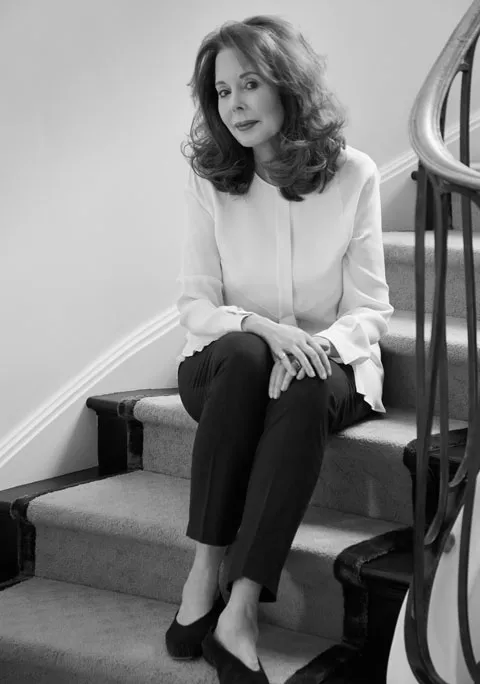
Maria Hummer-Tuttle. Photo by Miguel Flores-Vianna
To enter the residence of Maria Hummer-Tuttle is to step into a space where the concept of decoration is secondary to the act of storytelling. It is not merely a home; it is a landscape of memory, where objects are not defined by their market value or aesthetic trend, but by their ability to hold time, emotion, and narrative weight. Each item serves as a silent custodian of a milestone, a lesson learned, or a fragment of history that refuses to be forgotten.
This curatorial philosophy—where the domestic space becomes a sanctuary for the meaningful rather than just the beautiful—is rooted in a profound understanding of perspective. It is a lesson Hummer-Tuttle absorbed during a trip where she acquired a centuries-old fossil. The purchase itself was modest, yet the seller’s advice resonated with the weight of an ancient proverb: “You should always have in your house something that’s more than 1,000 years old because it puts so much in perspective.”
That advice transformed from a philosophical abstract into a tangible reality when wildfires threatened Los Angeles, forcing Hummer-Tuttle to evacuate her home. In the urgency of the moment, the hierarchy of “value” was instantly rewritten. Standing by her front door, she did not reach for practical necessities like clothing or identification. Instead, she gathered the irreplaceable: old photographs, the drawings of her grandchildren, small works of art, and that very fossil.
In the aftermath, as the immediate danger passed and the winds shifted, Hummer-Tuttle reflected on the pile of objects she had instinctively saved. It was a collection devoid of utility but overflowing with humanity. “What lay there was a pile of objects,” she observed, noting the absence of a passport or a purse. “I found that really interesting at the time, as I was putting everything back.”
This hurried exercise in preservation became a pivotal moment of introspection. It forced a re-examination of the items she and her husband have accumulated over a lifetime—a collection now documented in her volume, Objects of Desire. The incident highlighted a fundamental truth about collecting: we do not possess objects merely to own them, but to anchor ourselves against the flow of time.
The interiors curated by Hummer-Tuttle are characterized by a sophisticated interplay between the ancient and the modern, creating a visual dialogue that transcends chronological boundaries. The collection does not adhere to a single rigid style; rather, it thrives on the tension and harmony between disparate elements.
One can observe a quiet conversation between a 1925 brass centerpiece goblet by Wiener Werkstätte artist Josef Hofmann and a small brass snail, discovered by Hummer-Tuttle in a drawer at P.E. Guerin, America’s oldest decorative hardware manufacturer. The geometric precision of the Viennese Secessionist piece finds a whimsical counterpoint in the organic form of the snail, bridging the gap between high design and accidental discovery.
Elsewhere, the gravitas of history is palpable. A pottery horse tomb figure from the Tang dynasty (618–907 A.D.) stands in solemn proximity to La Bicocca, a painting by the German neo-expressionist Anselm Kiefer. The juxtaposition is striking: the ancient funerary object, created to serve in the afterlife, confronts the textured, often heavy materiality of Kiefer’s modern work. Nearby, two terracotta female dancers from the Han Dynasty (206 B.C.–220 A.D.) capture a moment of fluid movement frozen in clay for millennia.
These arrangements suggest that art is not static. When a Tang dynasty horse is placed before a contemporary canvas, both objects change. The ancient gains a new immediacy, and the modern acquires a deep ancestral root.
Hummer-Tuttle’s approach to these objects is informed by her long-standing role as a patron of the arts. A former lawyer and chair of the Board of Trustees of the J. Paul Getty Trust, she possesses a disciplined eye refined by years of civic and cultural service. Yet, Objects of Desire reveals a side of stewardship that is deeply personal rather than institutional.
The collection is less about the acquisition of status symbols and more about the accumulation of touchstones. Whether it is a stone bearing the imprint of prehistoric life or a child’s drawing saved from a fire, each piece is a vessel. In the end, Hummer-Tuttle’s home suggests that the things we desire are actually reflections of who we are, and more importantly, who we wish to remember.
Joining Shen Yun in 2007, Angelia Wang (b. Xi'an, China) represents a benchmark in the…
"We're a team." It is a simple phrase, just three words, yet it holds more…
In the high-stakes theater of grand opera, survival requires a bifurcation of the self. For…
They say the second year of marriage is defined by cotton. It sounds simple, almost…
Two decades together is no small feat. It is a milestone that speaks to patience,…
poems The Merchant of Venice Student Edition---PDF and Complete TextThe water in Venice is never…
There is a specific kind of silence that settles in the garden after a loss.…
There is a specific kind of magic that happens when a photographer doesn't just capture…
In the ancient Italian town of Santarcangelo di Romagna, where history clings to the cobblestones…
The Princeton Club of New York, usually a bastion of quiet networking, recently became the…
A decade together is no small feat. It’s ten years of inside jokes, shared silences,…
In the vast and fragmented linguistic landscape of China, the spoken word has always been…
In an art world often preoccupied with jarring intellectualism or the pursuit of hyper-realistic technicality,…
For Joseph Scheier-Dolberg, the Oscar Tang and Agnes Hsu-Tang Associate Curator of Chinese Paintings at…
I still remember watching you when Grandma passed away. I saw how deeply you mourned,…
There is a distinct difference between seeing a moment with your eyes and seeing how…
Clothing has never been merely about protection against the cold. Across five millennia of human…
The first year of marriage is often a whirlwind of emotions. It is a period…
Ralph Waldo Emerson once observed that "Earth laughs in flowers," a poetic sentiment that reverberates…
There is a specific gravity to a poem carried in the pocket. It is different…
Mother’s Day is approaching, and if you are miles away from the woman who raised…
Winter has a way of changing the landscape of our lives, not just the view…
The allure of Japanese art often lies in its masterful negotiation between the void and…
There is a distinct fairy-tale quality to the work of Lison de Caunes, a resonance…
William Wordsworth (1770–1850) remains a titan of English letters, a figure whose life spanned the…
I was thinking today about how much ground we've covered together. You know, between two…
There is a paradoxical nature to porcelain. In its raw state, it is dense earth;…
The sonnet is not merely a form; it is a vessel for concentrated thought. To…
The intersection of heritage craftsmanship and avant-garde installation art often yields the most compelling dialogues…
I've been thinking a lot about the power of visibility lately, especially as we celebrate…