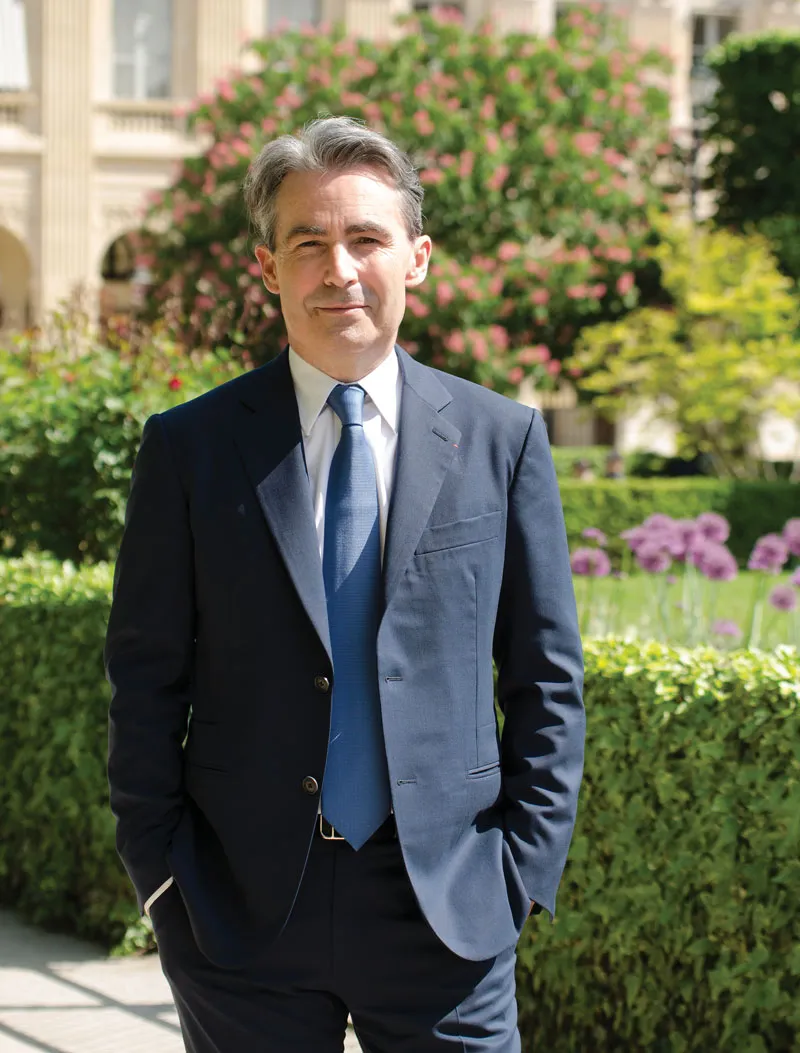
Jérôme de Lavergnolle, CEO of Cristallerie Royale de Saint-Louis, started working with the famed crystal maker in 2010, but he feels its centuries-long legacy behind him. Photography by Gaëlle Didillon
In the dense, wooded embrace of the Vosges mountains, close to the German border, time seems to move differently. Here, in the village of Saint-Louis-lès-Bitche—a hamlet of merely 600 souls—lies a legacy that predates the modern definition of luxury. This is the home of the Münzthal glassworks, established in 1586, later bestowed the title Cristallerie Royale de Saint-Louis by King Louis XV. It is the oldest crystal manufacturer in continental Europe, a place where the alchemy of sand, fire, and human breath has continued uninterrupted for over four centuries.
To understand Saint-Louis is to understand the landscape that birthed it. The manufactory has remained rooted in this specific soil for 432 years for elemental reasons: the local sand rich in silica, the river water for cooling, and the endless forests providing wood to feed the voracious furnaces. While the world outside accelerates, the rhythm here is dictated by the kiln and the cooling rack.
Jérôme de Lavergnolle, the CEO since 2010, views this weight of history not as an anchor, but as a foundation. “One must understand and learn the past, not to repeat the past but to imagine the future,” he notes. It is a sentiment that permeates the walls of the atelier, where seventh-generation artisans work alongside new apprentices, maintaining a lineage of dexterity that no machine can replicate.
Entering the manufactory is a visceral experience, a sensory collision of temperature and sound. The facility is bifurcated into two distinct worlds: the hot and the cold. The journey begins in the hot workshop, a place of organized chaos and primal energy. Here, the furnaces roar 24 hours a day, maintaining a terrifying 1,450 degrees Celsius.
The atmosphere is one of intensity. There is the clanking of metal, the roar of gas boosters, and the shouting of commands. Yet, amidst this cacophony, there is a sublime grace. The artisans work in teams, moving with a synchronized fluidity that de Lavergnolle likens to a ballet.
“When they use their pipe to take the crystal in the furnace, their left hand is approximately at 50 centimetres from this source of temperature,” de Lavergnolle observes. The danger is palpable, yet the movements are precise. The molten matter is gathered, blown, twirled, and shaped before it solidifies. It is a dance of timing and intuition, where a fraction of a second or a slight variation in breath can ruin a masterpiece. This “hot” phase is where the soul of the object is born, forged in fire and sweat.
If the hot workshop is the heart of Saint-Louis, the cold workshop is its mind. Stepping from one to the other is like traversing seasons. The roaring heat vanishes, replaced by a clinical, hushed concentration. The lighting shifts to a stark white, essential for the intricate work of cutting, engraving, gilding, and polishing.
“You don’t need to speak, so you are very focused on what you’re doing,” explains de Lavergnolle. Here, the rough crystal forms are transformed into jewels. The artisans use acid etching to create frost-like textures or apply 24-karat gold motifs with steady hands. Wheel engraving, in particular, requires a delicacy that borders on meditation.
The training required to reach this level of competency is immense. It takes ten years for a Saint-Louis artisan to be considered fully skilled. The knowledge is not found in textbooks; it is transferred through observation and repetition—the “hand of the man” repeating the same gesture day after day until it becomes instinct. This commitment to manual mastery creates a natural barrier to imitation; competitors may analyze the chemical formula, but they cannot easily replicate the centuries of muscle memory embedded in the workforce.
The output of these workshops often finds itself at the intersection of history and diplomacy. The crystal of Saint-Louis has long adorned the tables of royalty, serving as silent witnesses to shifting political tides. A poignant example of this is the “Tommy” collection.
In 1938, on the eve of another global conflict, the President of France hosted King George VI at a banquet in Versailles. The King, struck by the exquisite glassware, inquired about the collection. It was revealed that the pattern had been named “Tommy”—the affectionate nickname for the British soldiers who had fought to save France during the First World War.
“It was a way to pay tribute to them,” de Lavergnolle recounts. The collection remains an icon of the house, celebrating its 90th anniversary recently. It stands as a testament to the brand’s ability to weave narrative and gratitude into the very facets of their crystal.
Beyond the clarity of its diamond cuts, Saint-Louis is revered as a master of color. While many crystal makers shy away from complex palettes due to the technical risks, Saint-Louis embraces them. The manufactory utilizes over 15 distinct hues, including amethyst, chartreuse, sky blue, and red.
Creating colored crystal is a chemical tightrope walk. Different metallic oxides are added to the sand and potash, each affecting the material’s expansion rate. “If you don’t respect this temperature of expansion, the risk is that you break your piece when you cut it,” notes de Lavergnolle.
The house is particularly famous for its double- and triple-layering technique. Instead of painting the surface, which yields a flat and fading finish, Saint-Louis artisans fuse a thin layer of colored crystal over a clear core during the blowing process. When the crystal is later cut, the clear base is revealed beneath the color, creating a depth and optical play that is impossible to achieve through surface decoration.
Despite its profound respect for tradition, Saint-Louis refuses to be a museum piece. “If you always look behind you, you’re just dead,” asserts de Lavergnolle. The survival of the brand depends on its ability to belong to its time. This involves inviting contemporary designers to reinterpret the house’s codes.
The Folia collection is one such bridge between eras. It incorporates wood alongside crystal, a nod to the surrounding forests that have fueled the furnaces for centuries. But it was the collaboration with Dutch designer Kiki van Eijk for the Matrice collection that truly visualized the cycle of rebirth.
During a visit to the factory, van Eijk ventured into the basement, where she found thousands of old cast-iron molds resting on shelves. To the uninitiated, they might have looked like industrial debris; to de Lavergnolle, they looked like “dead bodies.” To van Eijk, they were a source of light.
She conceived a lamp that mimics the shape of the mold itself. However, instead of opaque iron, the form is rendered in luminous crystal. “You open it, and the more you open, the more the lamp is shining,” describes de Lavergnolle. It is a poetic inversion: the tool that once shaped the crystal has now become the crystal itself, a “lovely object” that shines with the memory of its own creation.
Ultimately, the magic of Saint-Louis lies not in the silica or the kilns, but in the community that tends to them. In this snowy, isolated village, the manufactory is the cultural and economic heartbeat. It is a place where medals of labor are awarded to those who have served for 40 years—a lifetime dedicated to the pursuit of transparency and light.
De Lavergnolle recalls being snowed in during his first visit, trapped in the “middle of nowhere.” Yet, in that isolation, he found a warmth that rivaled the furnaces. He witnessed a pride that transcended mere employment. “When you work with someone who is passionate about his work… you are very excited to join the company life.”
It is this passion that keeps the fires burning in the Vosges, ensuring that the spirit of Saint-Louis—elegant, fragile, and enduring—continues to illuminate the world.
Joining Shen Yun in 2007, Angelia Wang (b. Xi'an, China) represents a benchmark in the…
"We're a team." It is a simple phrase, just three words, yet it holds more…
In the high-stakes theater of grand opera, survival requires a bifurcation of the self. For…
They say the second year of marriage is defined by cotton. It sounds simple, almost…
Two decades together is no small feat. It is a milestone that speaks to patience,…
poems The Merchant of Venice Student Edition---PDF and Complete TextThe water in Venice is never…
There is a specific kind of silence that settles in the garden after a loss.…
There is a specific kind of magic that happens when a photographer doesn't just capture…
In the ancient Italian town of Santarcangelo di Romagna, where history clings to the cobblestones…
The Princeton Club of New York, usually a bastion of quiet networking, recently became the…
A decade together is no small feat. It’s ten years of inside jokes, shared silences,…
In the vast and fragmented linguistic landscape of China, the spoken word has always been…
In an art world often preoccupied with jarring intellectualism or the pursuit of hyper-realistic technicality,…
For Joseph Scheier-Dolberg, the Oscar Tang and Agnes Hsu-Tang Associate Curator of Chinese Paintings at…
I still remember watching you when Grandma passed away. I saw how deeply you mourned,…
There is a distinct difference between seeing a moment with your eyes and seeing how…
Clothing has never been merely about protection against the cold. Across five millennia of human…
The first year of marriage is often a whirlwind of emotions. It is a period…
Ralph Waldo Emerson once observed that "Earth laughs in flowers," a poetic sentiment that reverberates…
There is a specific gravity to a poem carried in the pocket. It is different…
Mother’s Day is approaching, and if you are miles away from the woman who raised…
Winter has a way of changing the landscape of our lives, not just the view…
The allure of Japanese art often lies in its masterful negotiation between the void and…
There is a distinct fairy-tale quality to the work of Lison de Caunes, a resonance…
William Wordsworth (1770–1850) remains a titan of English letters, a figure whose life spanned the…
I was thinking today about how much ground we've covered together. You know, between two…
There is a paradoxical nature to porcelain. In its raw state, it is dense earth;…
The sonnet is not merely a form; it is a vessel for concentrated thought. To…
The intersection of heritage craftsmanship and avant-garde installation art often yields the most compelling dialogues…
I've been thinking a lot about the power of visibility lately, especially as we celebrate…