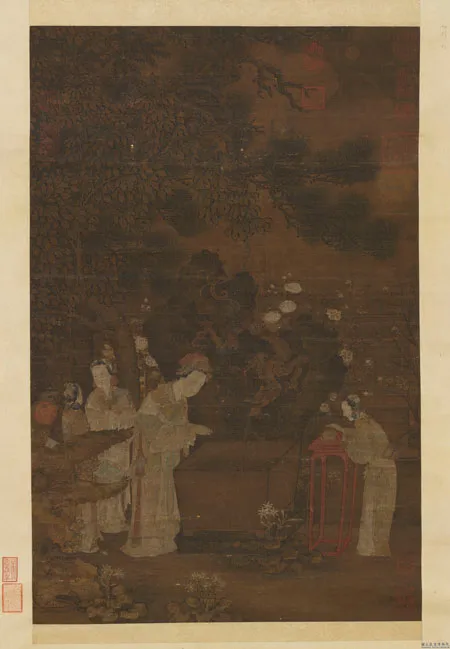
A stylized artistic representation of the full moon rising over a traditional landscape
When the crisp air of the eighth lunar month settles and the night sky deepens, the gaze of an entire culture turns upward. On the 15th day—falling on September 17 in 2024—the moon reaches its fullest conceptual state, marking the Mid-Autumn Festival. While often celebrated as a time for harvest thanksgiving and family reunions, the festival carries a profound aesthetic weight. It is a moment when the celestial body becomes a mirror for the human soul, a silent witness to our history, and the primary muse of Chinese poetic tradition.
To sit beneath this luminescence is to participate in a ritual of contemplation. The moon is not merely a satellite; it is a symbol of peace, prosperity, and the tender complexities of relationships. Through the lens of ancient poetry, the act of moon-gazing transforms into a dialogue between the finite human experience and the infinite rhythms of nature.
In the philosophy of the East, beauty and fullness often carry a warning of their own inevitable decline. The glowing disc in the sky serves as a celestial reminder of the Taoist principle of balance.
The Book of Changes (I Ching) captures this cyclical truth with stark clarity:
“When the Sun rises to the peak then it’s time to fall;
When the moon is full then it’s time to reduce.”
(日中則昃,月盈則食)
These lines suggest that the zenith of any endeavor contains the seeds of its retreat. It is a lesson in modesty and self-preservation: when one stands at the height of success, wisdom dictates a step back to avoid a precipitous fall.
History offers parallels to this ancient sentiment, transcending cultural boundaries. One might look to the example of George Washington in the West. Following the victory of the American colonies, amidst the temptation of absolute power, he declined the mantle of a king. By resigning at the peak of his military glory and entrusting power to Congress, he secured a legacy of democratic values—a move that echoes the ancient wisdom of knowing when to withdraw to preserve the greater whole.
Beneath the moonlight, the heart is often stirred by the contrast between the perfect sphere above and the imperfect nature of human life. The Song Dynasty poet Su Shi offered perhaps the most poignant meditation on this dissonance.
“We all have joys and sorrows, partings and reunions.
The moon is bright or dim; there are waxings and wanings.
Nothing in this world is ever perfect.”
(人有悲歡離合,月有陰晴圓缺,此事古難全)
Su Shi’s verses are a consolation rather than a lament. By acknowledging that joy and sorrow are as natural as the waxing and waning of the moon, we find resilience. The poem urges a gentle acceptance of impermanence, suggesting that the fleeting nature of our desires and pursuits is simply the norm of existence. In this acceptance, there is liberation; one learns to be cautious in glory and hopeful in loss.
While Su Shi looked to the sky to understand human emotion, the philosopher and poet Wang Yangming looked inward, proposing that the true source of light resides not in the heavens, but in the human heart.
Mid-Autumn Festival
“With a bright moon in my heart never waning,
Through the ages, we’ll enjoy it round and bright.
The moon’s glory embraces the rivers and land,
To please the heart is not only the autumn moonlight.”
(吾心自有光明月,千古團圓永無缺。山河大地擁清輝,賞心何必中秋節。)
Here, the moon becomes a metaphor for an unshakeable inner state. Wang Yangming suggests that external circumstances—the ebb and flow of fortune—are secondary to one’s internal disposition. If the heart possesses its own “bright moon,” a clarity of conscience and spirit, then the world remains illuminated regardless of the darkness outside. It is a call to cultivate an inner joy that is sovereign, independent of the shifting tides of life.
The visual dominance of the full moon also serves as a unifying anchor. When physical proximity is impossible, the shared sky becomes the meeting ground for separated souls. Zhang Jiuling’s poetry immortalizes this sentiment of connection through separation.
“The moon, grown full now over the sea,
Brightening the whole of heaven,
We, far away from each other,
are cherishing this moment together now”
(海上升明月,天涯共此時)
The vastness of the sea and the sky emphasizes the physical distance, yet the singular presence of the moon collapses that space. The knowledge that a loved one is bathed in the same silver light offers a profound, quiet consolation—a spiritual reunion that transcends geography.
Finally, the moon stands as the only constant in the long narrative of human civilization. It has watched over generations, unchanged, while the people below it cycle through birth and death. Li Bai, the Tang Dynasty master, captured this temporal vertigo in his musings on Lunar Cleansing.
“People today can’t see the moon of yore;
The moon today did light people before.”
(今人不见古时月,今月曾经照古人。)
These lines evoke a sense of humility and continuity. Individual lives are transitory, flashing briefly into existence, yet the human experience—our wishes, desires, and questions—remains remarkably consistent across millennia. The moon that illuminates our modern celebrations is the same orb that lit the feasts of the ancients. It invites us to ponder the eternal questions that have always accompanied humankind: the mystery of our origins and the destination of our journey.
Joining Shen Yun in 2007, Angelia Wang (b. Xi'an, China) represents a benchmark in the…
"We're a team." It is a simple phrase, just three words, yet it holds more…
In the high-stakes theater of grand opera, survival requires a bifurcation of the self. For…
They say the second year of marriage is defined by cotton. It sounds simple, almost…
Two decades together is no small feat. It is a milestone that speaks to patience,…
poems The Merchant of Venice Student Edition---PDF and Complete TextThe water in Venice is never…
There is a specific kind of silence that settles in the garden after a loss.…
There is a specific kind of magic that happens when a photographer doesn't just capture…
In the ancient Italian town of Santarcangelo di Romagna, where history clings to the cobblestones…
The Princeton Club of New York, usually a bastion of quiet networking, recently became the…
A decade together is no small feat. It’s ten years of inside jokes, shared silences,…
In the vast and fragmented linguistic landscape of China, the spoken word has always been…
In an art world often preoccupied with jarring intellectualism or the pursuit of hyper-realistic technicality,…
For Joseph Scheier-Dolberg, the Oscar Tang and Agnes Hsu-Tang Associate Curator of Chinese Paintings at…
I still remember watching you when Grandma passed away. I saw how deeply you mourned,…
There is a distinct difference between seeing a moment with your eyes and seeing how…
Clothing has never been merely about protection against the cold. Across five millennia of human…
The first year of marriage is often a whirlwind of emotions. It is a period…
Ralph Waldo Emerson once observed that "Earth laughs in flowers," a poetic sentiment that reverberates…
There is a specific gravity to a poem carried in the pocket. It is different…
Mother’s Day is approaching, and if you are miles away from the woman who raised…
Winter has a way of changing the landscape of our lives, not just the view…
The allure of Japanese art often lies in its masterful negotiation between the void and…
There is a distinct fairy-tale quality to the work of Lison de Caunes, a resonance…
William Wordsworth (1770–1850) remains a titan of English letters, a figure whose life spanned the…
I was thinking today about how much ground we've covered together. You know, between two…
There is a paradoxical nature to porcelain. In its raw state, it is dense earth;…
The sonnet is not merely a form; it is a vessel for concentrated thought. To…
The intersection of heritage craftsmanship and avant-garde installation art often yields the most compelling dialogues…
I've been thinking a lot about the power of visibility lately, especially as we celebrate…