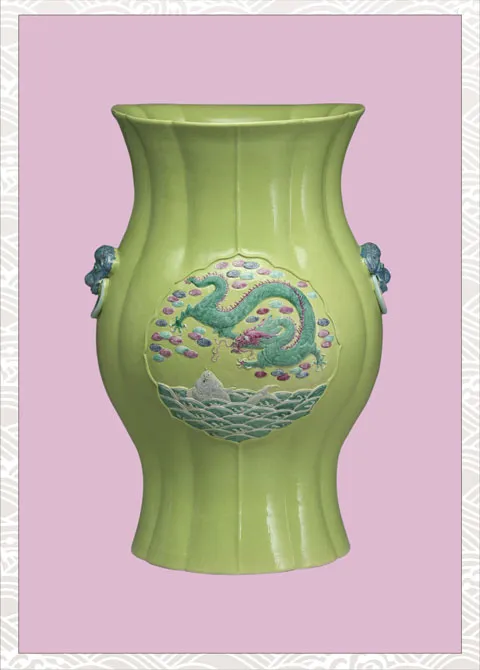
Green-glazed vase with Dragon Pattern, Qing Dynasty, Guangxu period
In the grammar of ancient Chinese aesthetics, color was never merely decorative; it was a manifestation of cosmic breath. The visual poetry of the world-the blush of fragrant peach blossoms trembling in a spring breeze, the rain-washed azure of a summer sky, the golden rustle of autumn barley, and the inky charcoal of winter mountains-formed a spectrum deeply tied to the elements. These hues were not static; they were markers of time, cycling through the year to evoke specific energies and moods.
This reverence for the natural world’s palette transcended the landscape, finding its way into the material culture of daily life. From the glazes of imperial porcelain to the intricate weaves of turquoise and purple silks, and the red and green tiles of palace architecture, the colors of the seasons became a language of design. Today, that dialogue continues. The symbiosis between nature’s hues and human craftsmanship remains a potent source of inspiration, bridging the gap between centuries-old artifacts and contemporary interiors.
The transition from winter to spring is often defined by a tentative, vibrant freshness. It is a time when the earth softens, and the first shoots break the soil. This specific energy is captured with remarkable clarity in the porcelain of the late Qing Dynasty. A prime example is the green-glazed vase with a Dragon Pattern from the Guangxu period, currently housed in the National Taiwan Museum.
Here, the artisan has utilized a lime-green glaze that feels alive-reminiscent of new leaves stretching their soft tips toward the sun. It is not a heavy, forest green, but a translucent, light-filled hue that suggests beginning and growth. Complemented by lavender-tinged pinks, the vessel evokes a mystical, enchanted landscape, where the solidity of the dragon motif is softened by the whimsy of the surrounding clouds.
This interplay of verdant greens and soft florals translates seamlessly into modern living spaces. The aesthetic logic of the Guangxu vase-balancing the vibrancy of lime with the soothing touch of pale purple-enlivens a room without overwhelming it. It brings the “sweetness” of springtime indoors, creating environments that feel simultaneously restful and rejuvenating.
The legacy of these nature-based palettes is evident in the work of contemporary designers who treat interior spaces as canvases for organic expression. Whether through hand-painted wallpapers or curated textiles, the goal remains the same: to dissolve the boundary between the built environment and the natural world.
Designers like Marie-Caroline Willms and Katie Ridder utilize these historical color pairings to create depth. By anchoring a room with the fresh greens seen in the Qing artifacts and layering them with botanical motifs, they achieve a sense of timeless elegance. The intricate de Gournay wallpapers, often painted on Xuan paper, mirror the detailed brushwork of ancient ceramics, turning walls into immersive gardens.
In these spaces, color functions as atmosphere. A room layered with these hues does not just look like a garden; it feels like one. The sunlight interacting with these fabrics and paints mimics the play of light on leaves and petals, proving that the ancient observation of the seasons is as relevant in a modern penthouse as it was in an imperial court.
As the seasons shift, the palette intensifies. Summer brings with it the heat of the sun and the cooling contrast of the sea. This dynamic duality is masterfully preserved in the ceramics of the Qianlong period, a high point in the technical history of Chinese porcelain.
The yellow-glazed vase with fencai (famille rose) enamels serves as a visual anchor for this season. The background is a striking, imperial yellow-symbolizing the earth and the sun-while the motifs are rendered in electric blues. This combination is not subtle; it is energetic and rhythmic, mimicking the sensation of golden sands and waves rolling ashore.
The fencai technique allows for a gradation of color that adds three-dimensionality to the surface, making the blue motifs appear to float against the yellow ground. In an interior design context, this high-contrast pairing of sunshine yellow and beachy blues creates a harmonious yet stimulating environment, capturing the vibrant, life-affirming spirit of high summer.
Joining Shen Yun in 2007, Angelia Wang (b. Xi'an, China) represents a benchmark in the…
"We're a team." It is a simple phrase, just three words, yet it holds more…
In the high-stakes theater of grand opera, survival requires a bifurcation of the self. For…
They say the second year of marriage is defined by cotton. It sounds simple, almost…
Two decades together is no small feat. It is a milestone that speaks to patience,…
poems The Merchant of Venice Student Edition---PDF and Complete TextThe water in Venice is never…
There is a specific kind of silence that settles in the garden after a loss.…
There is a specific kind of magic that happens when a photographer doesn't just capture…
In the ancient Italian town of Santarcangelo di Romagna, where history clings to the cobblestones…
The Princeton Club of New York, usually a bastion of quiet networking, recently became the…
A decade together is no small feat. It’s ten years of inside jokes, shared silences,…
In the vast and fragmented linguistic landscape of China, the spoken word has always been…
In an art world often preoccupied with jarring intellectualism or the pursuit of hyper-realistic technicality,…
For Joseph Scheier-Dolberg, the Oscar Tang and Agnes Hsu-Tang Associate Curator of Chinese Paintings at…
I still remember watching you when Grandma passed away. I saw how deeply you mourned,…
There is a distinct difference between seeing a moment with your eyes and seeing how…
Clothing has never been merely about protection against the cold. Across five millennia of human…
The first year of marriage is often a whirlwind of emotions. It is a period…
Ralph Waldo Emerson once observed that "Earth laughs in flowers," a poetic sentiment that reverberates…
There is a specific gravity to a poem carried in the pocket. It is different…
Mother’s Day is approaching, and if you are miles away from the woman who raised…
Winter has a way of changing the landscape of our lives, not just the view…
The allure of Japanese art often lies in its masterful negotiation between the void and…
There is a distinct fairy-tale quality to the work of Lison de Caunes, a resonance…
William Wordsworth (1770–1850) remains a titan of English letters, a figure whose life spanned the…
I was thinking today about how much ground we've covered together. You know, between two…
There is a paradoxical nature to porcelain. In its raw state, it is dense earth;…
The sonnet is not merely a form; it is a vessel for concentrated thought. To…
The intersection of heritage craftsmanship and avant-garde installation art often yields the most compelling dialogues…
I've been thinking a lot about the power of visibility lately, especially as we celebrate…