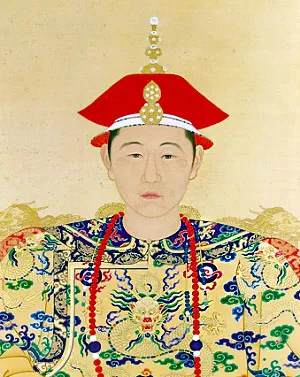
Left: Zhuge Liang. Right: Capturing arrows with boats. Illustration by Jinxie Zhong (金协中)
History, when viewed through the lens of the performing arts, often transcends mere chronology. It becomes a study of human nature, a tableau where the rise and fall of dynasties are dictated not just by military might, but by the subtle currents of the human spirit. The classical Chinese canon, spanning five millennia, offers a rich repository of such narratives—stories that New York-based Shen Yun Performing Arts has translated into the kinetic language of dance and music.
Within these performative histories lies a distinct aesthetic of leadership. It is not the loud, brash command of modern caricature, but a quiet, interior force rooted in the philosophies of Buddhism, Daoism, and Confucianism. Here, we examine the artistic and philosophical contours of five historical archetypes, observing how their specific virtues—wisdom, patience, humility, loyalty, and tolerance—shaped the visual and spiritual landscape of a civilization.
In the visual vocabulary of the Three Kingdoms era (220–280 C.E.), the figure of Zhuge Liang stands as the embodiment of intellectual elegance. He represents the Daoist ideal that the soft can overcome the hard, and that true power lies in understanding the rhythm of the universe rather than opposing it.
The celebrated episode “Capturing Arrows with Boats of Straw” serves as a masterclass in this philosophy. Faced with a demand from jealous allies to produce 100,000 arrows in ten days—an impossibility by conventional standards—Zhuge Liang did not turn to manufacturing. Instead, he turned to nature.
Navigating through a heavy fog with boats manned by straw dummies, he invited the enemy’s attack. The resulting visual is striking: thousands of arrows piercing the straw, “borrowed” from the enemy to be used against them. This is not merely a military tactic; it is an artistic maneuvering of perception. Zhuge Liang’s leadership was defined by a tranquility that allowed him to see the fog not as a hindrance, but as a canvas. In the silence of that river, he demonstrated that the most effective weapon is a calm mind that can harmonize with the elements.
While Zhuge Liang utilized the environment, Emperor Kangxi utilized time. Ascending the throne of the Qing Dynasty as a child in the mid-17th century, Kangxi’s narrative is a study in patience and the deceptive appearance of innocence.
The young emperor faced Aobai, a decorated but tyrannical general who viewed the child monarch as a puppet. Aobai’s arrogance was visual and performative—he dared to wear the golden robes reserved solely for the Emperor, a treasonous appropriation of imperial symbolism.
Kangxi’s response was a long-form choreography of survival. He did not strike immediately. Instead, he gathered a retinue of young guards, disguising their martial training as boyish sport. To the observer, it looked like play; in reality, it was the forging of a weapon. When the moment of confrontation arrived, the “game” ended instantly. The swift detention of Aobai by these young warriors marked the transition from a regency of fear to a golden age of governance. Kangxi’s legacy suggests that true authority often wears a mask of mildness, waiting for the precise moment when preparation meets opportunity.
In the grand tapestry of the Three Kingdoms, warlord Liu Bei offers a contrasting texture to the brilliant strategists and mighty emperors. His power was not derived from a lofty position, but from his connection to the earth and the people upon it. His guiding principle was Yi (righteousness), a magnetic quality that drew talent to him.
The visual iconography of Liu Bei is often defined by his brotherhood with the warriors Zhang Fei and Guan Yu, and his respectful solicitation of Zhuge Liang. There is a profound aesthetic in the image of a warlord humbling himself to seek the counsel of a sage living in a cottage. It reverses the typical vertical hierarchy of power. By lowering himself, Liu Bei created a basin that collected the wisdom and strength of the era’s greatest minds. This narrative thread posits that the foundation of an empire is not stone, but the intangible bond of character that inspires absolute devotion.
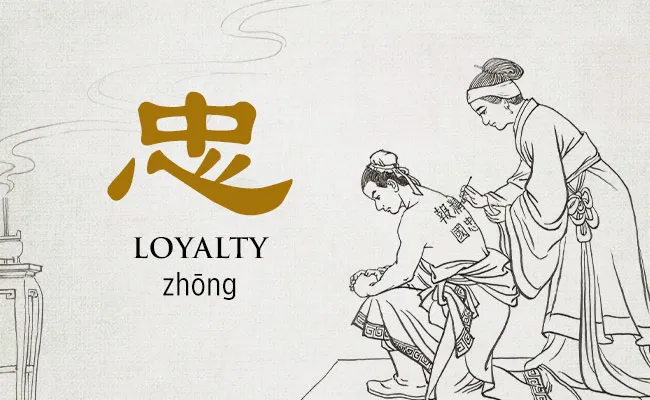
Few images in Chinese history are as evocative as the tattoo on the back of General Yue Fei. He stands as the tragic hero of the Song Dynasty, a figure caught in the tension between Xiao (filial piety) and Zhong (loyalty to the country).
The narrative reaches its emotional zenith when Yue Fei’s mother, resolving her son’s dilemma between caring for her and defending the realm, tattoos four characters onto his skin: jing zhong bao guo—”serve the country loyally.”
This act transformed the abstract concept of loyalty into a physical reality, etched into the body itself. Yue Fei’s subsequent career—caring for his soldiers as family, personally tending to their wounds, and achieving miraculous victories against overwhelming odds—radiated from this central vow. In the artistic rendering of his life, loyalty is not a fleeting emotion but a permanent mark, a solemn contract that binds the leader to his cause even unto death.
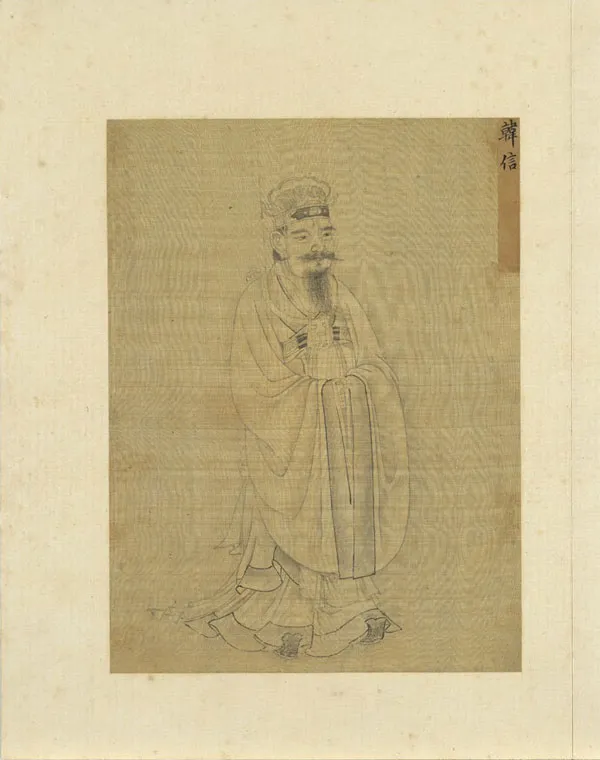
Perhaps the most counter-intuitive form of strength is found in the story of Han Xin, a general of the Han Dynasty. His defining moment involves no bloodshed, but rather a profound stillness.
As a young martial artist, Han Xin was challenged by a street ruffian to either kill him or crawl between his legs. The visual tension here is palpable: a skilled warrior with a sword at his hip, facing a supreme humiliation.
Han Xin chose to crawl. This image—the future general lowering himself to the ground—is not a depiction of cowardice, but of “Great Forbearance.” It highlights an internal vastness capable of swallowing insult without rippling. Han Xin understood that his sword was meant for shaping the destiny of China, not for petty street brawls. This extreme tolerance, the ability to endure the unbearable for the sake of a higher ambition, is portrayed as the ultimate martial art—where the victory is won internally long before the battle begins.
Joining Shen Yun in 2007, Angelia Wang (b. Xi'an, China) represents a benchmark in the…
"We're a team." It is a simple phrase, just three words, yet it holds more…
In the high-stakes theater of grand opera, survival requires a bifurcation of the self. For…
They say the second year of marriage is defined by cotton. It sounds simple, almost…
Two decades together is no small feat. It is a milestone that speaks to patience,…
poems The Merchant of Venice Student Edition---PDF and Complete TextThe water in Venice is never…
There is a specific kind of silence that settles in the garden after a loss.…
There is a specific kind of magic that happens when a photographer doesn't just capture…
In the ancient Italian town of Santarcangelo di Romagna, where history clings to the cobblestones…
The Princeton Club of New York, usually a bastion of quiet networking, recently became the…
A decade together is no small feat. It’s ten years of inside jokes, shared silences,…
In the vast and fragmented linguistic landscape of China, the spoken word has always been…
In an art world often preoccupied with jarring intellectualism or the pursuit of hyper-realistic technicality,…
For Joseph Scheier-Dolberg, the Oscar Tang and Agnes Hsu-Tang Associate Curator of Chinese Paintings at…
I still remember watching you when Grandma passed away. I saw how deeply you mourned,…
There is a distinct difference between seeing a moment with your eyes and seeing how…
Clothing has never been merely about protection against the cold. Across five millennia of human…
The first year of marriage is often a whirlwind of emotions. It is a period…
Ralph Waldo Emerson once observed that "Earth laughs in flowers," a poetic sentiment that reverberates…
There is a specific gravity to a poem carried in the pocket. It is different…
Mother’s Day is approaching, and if you are miles away from the woman who raised…
Winter has a way of changing the landscape of our lives, not just the view…
The allure of Japanese art often lies in its masterful negotiation between the void and…
There is a distinct fairy-tale quality to the work of Lison de Caunes, a resonance…
William Wordsworth (1770–1850) remains a titan of English letters, a figure whose life spanned the…
I was thinking today about how much ground we've covered together. You know, between two…
There is a paradoxical nature to porcelain. In its raw state, it is dense earth;…
The sonnet is not merely a form; it is a vessel for concentrated thought. To…
The intersection of heritage craftsmanship and avant-garde installation art often yields the most compelling dialogues…
I've been thinking a lot about the power of visibility lately, especially as we celebrate…