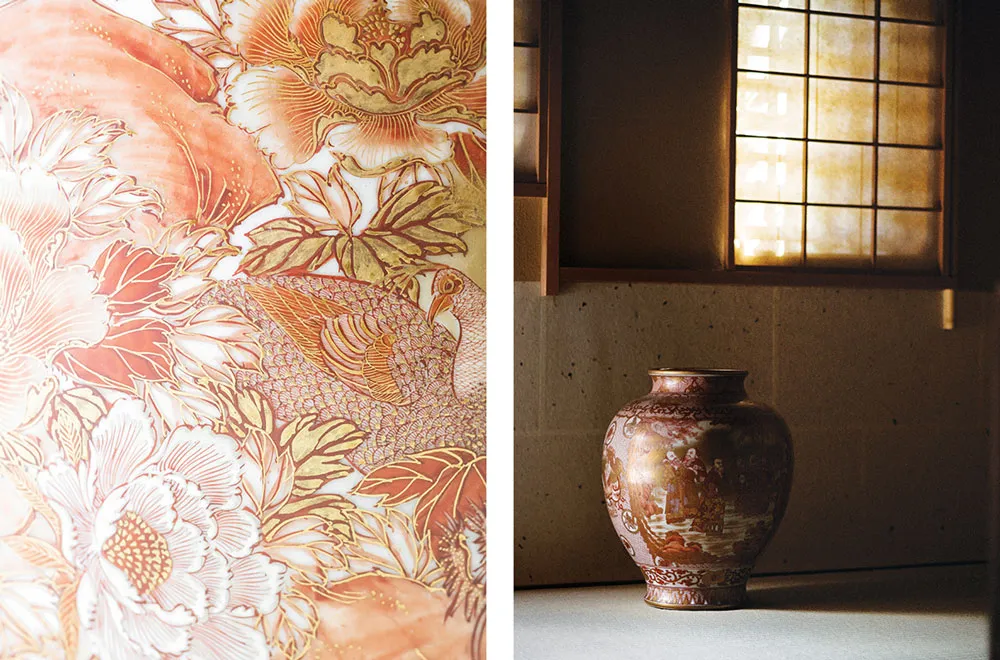
Jar with a sarasa (calico) design by Minori showing intricate gold detailing
“Beauty is the end goal—the target. But you can’t just pursue beauty; there are many different intentions and steps to get there.”
For Yoshita Minori, these words are not merely a philosophy but a methodology forged in fire. As the third-generation custodian of the Kinzangama Kiln, Minori’s life has been an oscillation between the fragile and the eternal. In the world of Japanese ceramics, where the pursuit of perfection is often a silent, solitary pilgrimage, Minori’s path led him to capture light itself, burying it beneath layers of glass to create a depth that defies the flatness of porcelain.
The story of Kinzangama is not just one of clay and kiln, but of resilience against the backdrop of a changing Japan, where the scarcity of the post-war era forced a re-evaluation of what it means to create.
The artistic lineage of the Yoshita family dates back to the Meiji era, a time when Kutani-yaki—the vibrant, overglazed porcelain of Ishikawa prefecture—was Japan’s premier export. Minori’s grandfather, Yoshita Shosaku, founded the Kinzangama Kiln in 1906, establishing a reputation for luxurious woodblock prints and decorative gold techniques that mirrored the opulence of the times.
However, when Minori returned from studying art in Europe in 1951 to take the helm, the landscape had shifted drastically. Post-World War II Japan was in economic recession. Materials were scarce; even wood to fire the kilns was a luxury. The era of mass production was faltering, and the necessity of the moment birthed a new vision.
Minori realized that if resources were limited, every piece had to be significant. He abandoned the commercial mass-production model in favor of a singular pursuit: the creation of “one-of-a-kind” works. This was a return to the essence of the Arts and Crafts movement—a rejection of the industrial for the intimate, handmade soul of the object. It was in this crucible of adversity that he began to refine the ancient techniques of Kutani, seeking a beauty so profound it could restore not just a kiln, but a cultural identity.
Japanese ceramics have long utilized gold, typically applied as overglaze decoration. While visually striking, this method left the precious metal exposed and fragile. In the mid-20th century, a technique known as Yuri-kinsai emerged, allowing artisans to seal gold leaf between layers of glaze. Yet, this method had a significant limitation: it was restricted to geometric patterns, unable to capture the organic fluidity of nature.
Minori refused to accept this rigidity. He sought to make gold flow like water or curve like a flower stem. To achieve this, he looked sideways to another tradition: Kirikane, a decorative technique used in Buddhist art involving the cutting of gold leaf.
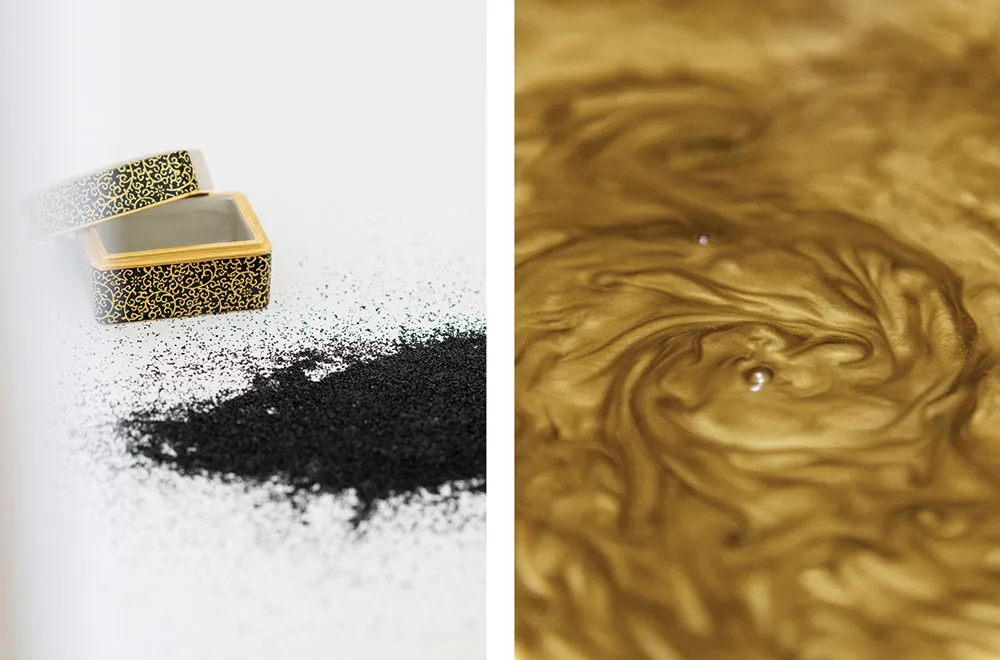
The process was excruciatingly delicate. Minori experimented with placing gold leaf on deer skin—a material providing the perfect resistance—and cutting it with a bamboo knife. To manipulate the microscopic leaves without tearing them, he used thin paper and tweezers, developing a method to shape the gold into birds, butterflies, and intricate floral motifs.
“I’ve made many mistakes developing this method,” Minori reflects. “It took me a long time to master it.”
It took five years of relentless trial and error to perfect the technique. The result was a manipulation of depth where gold leaves of varying thicknesses were suspended in the glaze, creating a three-dimensional luminosity. This mastery transformed the porcelain surface into a deep, glowing window, earning Minori the designation of a National Living Treasure in 2001.
Tradition in Japan is rarely a static inheritance; it is a conversation, sometimes heated, between the past and the future. When Minori’s son, Yukio, prepared to succeed his father, the kiln faced a new kind of friction.
“I wanted to change everything,” Yukio admits. To the younger eye, his father’s highly intricate, labor-intensive work felt outdated. Yukio was captivated by modernism—avant-garde shapes and minimalist aesthetics that seemed to speak to a new era.
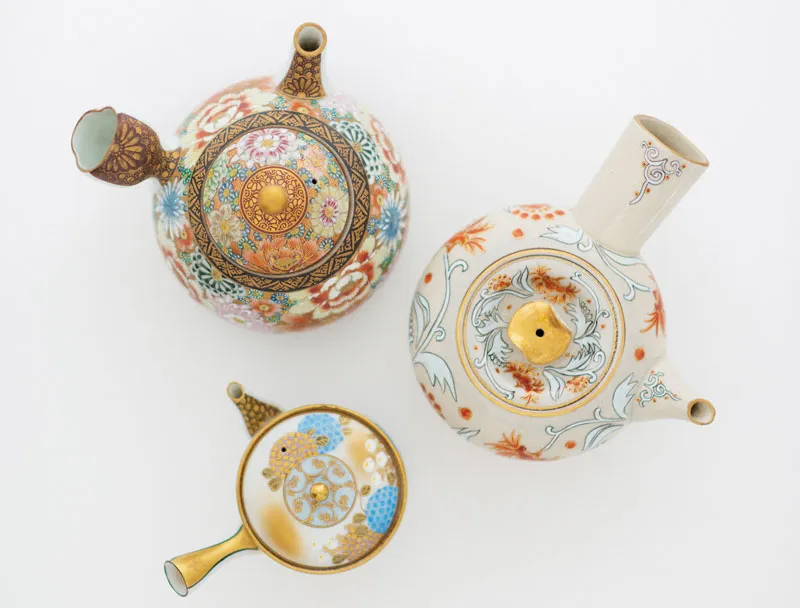
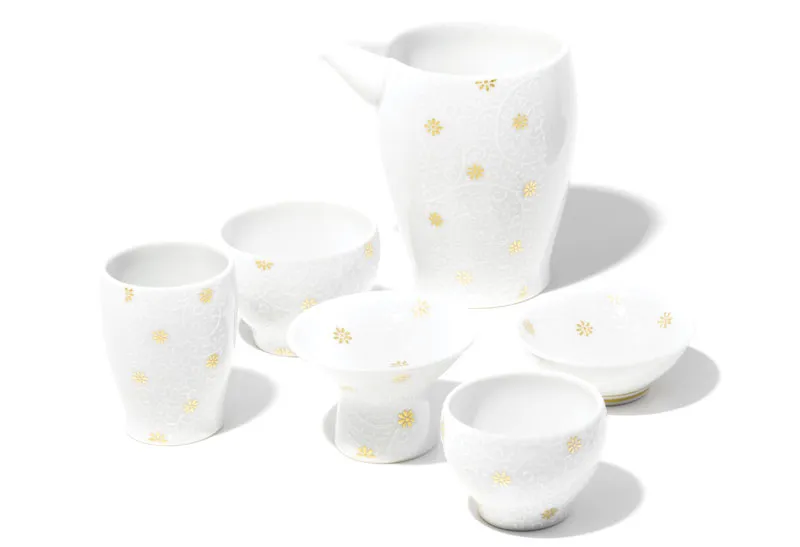
Yet, the kiln has a way of tempering rebellion into refinement. As Yukio strove to advance his own craft, specifically in Kinrande (gold decoration on multi-colored glaze), he found himself circling back to the classical roots he once critiqued. The evolution was not a capitulation, but a synthesis. Yukio began to introduce a softer, watercolor-like palette to the porcelain, allowing the gold to interact with color in a way that was both historic and refreshingly contemporary.
“I still have the desire to do something new, but the new creative things should also have roots in history,” Yukio observes. The survival of Kutani-yaki, he realized, lay not in preserving ashes, but in keeping the fire alit with new expressions.
Today, the Kinzangama Kiln stands as a testament to this dual commitment: the preservation of a difficult, tedious past and the brave embrace of innovation. The gold on their wares does not merely glitter; it glows with the weight of history and the lightness of mastery.
Even at the age of 90, Yoshita Minori embodies the true spirit of the shokunin (artisan). For him, the designation of “Living Treasure” was never a retirement, but a milestone on a longer journey. “I’m still learning,” he asserts, looking toward the kiln with the same intensity as he did decades ago. “My best work is yet to come.”
Joining Shen Yun in 2007, Angelia Wang (b. Xi'an, China) represents a benchmark in the…
"We're a team." It is a simple phrase, just three words, yet it holds more…
In the high-stakes theater of grand opera, survival requires a bifurcation of the self. For…
They say the second year of marriage is defined by cotton. It sounds simple, almost…
Two decades together is no small feat. It is a milestone that speaks to patience,…
poems The Merchant of Venice Student Edition---PDF and Complete TextThe water in Venice is never…
There is a specific kind of silence that settles in the garden after a loss.…
There is a specific kind of magic that happens when a photographer doesn't just capture…
In the ancient Italian town of Santarcangelo di Romagna, where history clings to the cobblestones…
The Princeton Club of New York, usually a bastion of quiet networking, recently became the…
A decade together is no small feat. It’s ten years of inside jokes, shared silences,…
In the vast and fragmented linguistic landscape of China, the spoken word has always been…
In an art world often preoccupied with jarring intellectualism or the pursuit of hyper-realistic technicality,…
For Joseph Scheier-Dolberg, the Oscar Tang and Agnes Hsu-Tang Associate Curator of Chinese Paintings at…
I still remember watching you when Grandma passed away. I saw how deeply you mourned,…
There is a distinct difference between seeing a moment with your eyes and seeing how…
Clothing has never been merely about protection against the cold. Across five millennia of human…
The first year of marriage is often a whirlwind of emotions. It is a period…
Ralph Waldo Emerson once observed that "Earth laughs in flowers," a poetic sentiment that reverberates…
There is a specific gravity to a poem carried in the pocket. It is different…
Mother’s Day is approaching, and if you are miles away from the woman who raised…
Winter has a way of changing the landscape of our lives, not just the view…
The allure of Japanese art often lies in its masterful negotiation between the void and…
There is a distinct fairy-tale quality to the work of Lison de Caunes, a resonance…
William Wordsworth (1770–1850) remains a titan of English letters, a figure whose life spanned the…
I was thinking today about how much ground we've covered together. You know, between two…
There is a paradoxical nature to porcelain. In its raw state, it is dense earth;…
The sonnet is not merely a form; it is a vessel for concentrated thought. To…
The intersection of heritage craftsmanship and avant-garde installation art often yields the most compelling dialogues…
I've been thinking a lot about the power of visibility lately, especially as we celebrate…