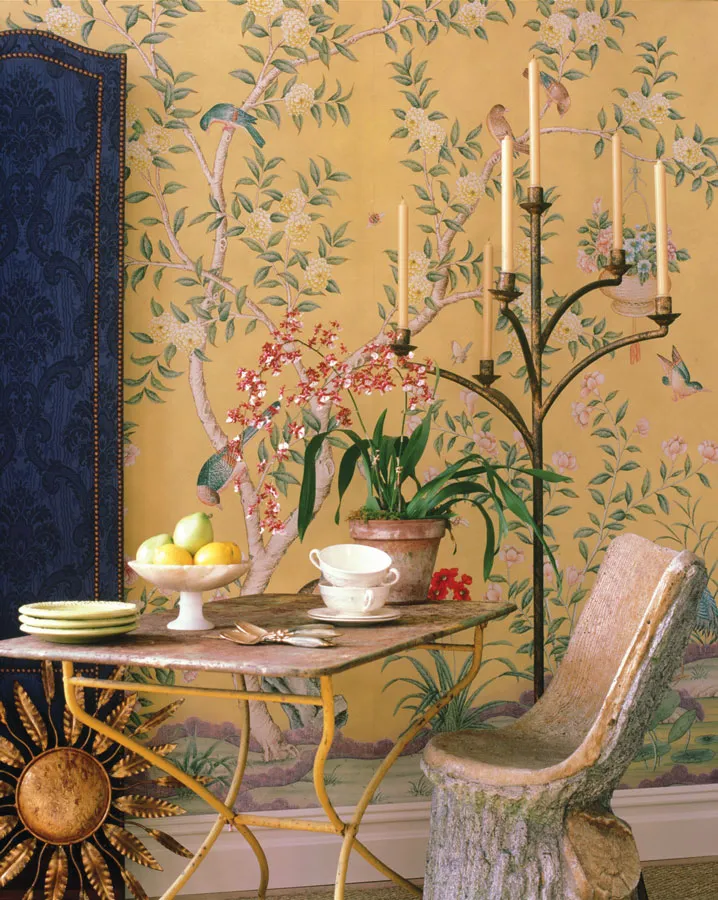
Chinese wallpaper from gracie
For centuries, the West has gazed Eastward with a specific kind of longing, translating the vast, complex reality of China into a dreamscape known as Chinoiserie. This aesthetic—a European interpretation of Asian artistic traditions—flourished in the 17th and 18th centuries, filling aristocratic manors with silk, porcelain, and the delicate grace of hand-painted wallpapers. It was a world where perspective was flattened into elegance, and nature was tamed into eternal spring.
Today, this dialogue between East and West continues through Gracie, a New York-based institution that has become synonymous with this exquisite form of wallcovering. Founded in 1898 by Charles R. Gracie, the company did not merely import goods; it curated an atmosphere. By the 1930s, they had established a niche that persists to this day: transforming interior spaces into immersive, hand-painted sanctuaries that echo the “languorous” beauty of traditional Chinese painting.
The allure of these works lies in their ability to crystallize fleeting moments of nature—the arc of a pheasant’s wing, the droop of a peony—and render them with a succinct power. “Each one is a unique work of art,” observes Jennifer Gracie, the fourth-generation heir to the family business. “The replicas based on 17th and 18th-century antique wallpapers are at the highest standards.”
The history of Gracie is not just one of commerce, but of a deep, resilient partnership with artisans across the ocean. The company’s relationship with a specific Chinese studio began decades ago, initiated after Jennifer Gracie’s great-grandfather saw samples brought back by a friend. The quality was unmistakable, leading to a collaboration that has spanned nearly a century and is still managed by the same family in China today.
This continuity, however, was maintained against the backdrop of profound historical turbulence. Following the political shifts in China in 1949, the production of such “bourgeois” luxury items became dangerous. In a poignant act of preservation, the studio’s artisans buried their stock of wallpapers to protect them from destruction. These rolls of painted silk and paper remained hidden in the earth until the political climate shifted and the studio could resume operations, eventually relocating the craft’s lineage through Taiwan before reconnecting with the global market.
It is a testament to the durability of this art form that it survived suppression to bloom again. What was once the exclusive purview of 18th-century European high society has been preserved through this transatlantic lineage, allowing modern interiors to hold a piece of history that was almost lost.
The creation of a Gracie wallpaper is an exercise in patience and rigorous discipline, far removed from the speed of modern digital printing. The studio employs dozens of accomplished artisans, yet the path to mastery is slow. The training process creates a fascinating anchor for understanding the value of these works: it begins with the repetition of the simplest elements.
“They start practicing very simple things, like a leaf,” Jennifer Gracie explains. “When I was at our studio in August, there was a new artist painting leaves. There were 50 leaves she had practiced, on one piece of paper, to make sure that she had the shape, the veining, and the colouration and shading all correct.”
This meticulous attention to detail ensures that when a client views a completed tableau—replete with peacocks, phoenixes, and pomegranates symbolizing good luck—the effect is one of seamless organic life. The scenes of tea cultivation or pottery making are not mere patterns; they are narrative vignettes, executed with a brushwork that breathes.
Over the decades, the demand for these designs has shifted, reflecting the changing tastes of the collector. For the first fifty years, the focus was on “standards”—classic motifs that adhered strictly to historical precedents. The 1970s and 80s introduced a wave of customization, which eventually evolved into “extreme customization,” where clients sought to control every element of the composition.
However, there is a delicate balance between personalization and the integrity of the composition. Jennifer Gracie often advises a step back from the urge to micromanage. “I try to steer clients away from worrying about the placement of every bird and butterfly,” she notes. “It seems overwhelming now, but when they sit in their room and it’s finished, they’re going to love it, and absolutely not going to say ‘I wished that that butterfly had been three inches higher.’”
In recent years, the aesthetic has expanded to include modern iterations with simplified palettes, stripping away the density of the antique styles to reveal a starker, more contemporary elegance. Yet, the core essence remains unchanged. Whether in a dense, multi-colored landscape or a monochrome study, the work continues to celebrate the harmonious placement of man within nature.
In these painted worlds, creeklets run, mountains sweep into the mist, and the grandeur of the natural world is held in a state of suspended animation. It is a visual philosophy that values esteem and respect for the environment, translating ancient wisdom into a living, breathing backdrop for contemporary life.
Joining Shen Yun in 2007, Angelia Wang (b. Xi'an, China) represents a benchmark in the…
"We're a team." It is a simple phrase, just three words, yet it holds more…
In the high-stakes theater of grand opera, survival requires a bifurcation of the self. For…
They say the second year of marriage is defined by cotton. It sounds simple, almost…
Two decades together is no small feat. It is a milestone that speaks to patience,…
poems The Merchant of Venice Student Edition---PDF and Complete TextThe water in Venice is never…
There is a specific kind of silence that settles in the garden after a loss.…
There is a specific kind of magic that happens when a photographer doesn't just capture…
In the ancient Italian town of Santarcangelo di Romagna, where history clings to the cobblestones…
The Princeton Club of New York, usually a bastion of quiet networking, recently became the…
A decade together is no small feat. It’s ten years of inside jokes, shared silences,…
In the vast and fragmented linguistic landscape of China, the spoken word has always been…
In an art world often preoccupied with jarring intellectualism or the pursuit of hyper-realistic technicality,…
For Joseph Scheier-Dolberg, the Oscar Tang and Agnes Hsu-Tang Associate Curator of Chinese Paintings at…
I still remember watching you when Grandma passed away. I saw how deeply you mourned,…
There is a distinct difference between seeing a moment with your eyes and seeing how…
Clothing has never been merely about protection against the cold. Across five millennia of human…
The first year of marriage is often a whirlwind of emotions. It is a period…
Ralph Waldo Emerson once observed that "Earth laughs in flowers," a poetic sentiment that reverberates…
There is a specific gravity to a poem carried in the pocket. It is different…
Mother’s Day is approaching, and if you are miles away from the woman who raised…
Winter has a way of changing the landscape of our lives, not just the view…
The allure of Japanese art often lies in its masterful negotiation between the void and…
There is a distinct fairy-tale quality to the work of Lison de Caunes, a resonance…
William Wordsworth (1770–1850) remains a titan of English letters, a figure whose life spanned the…
I was thinking today about how much ground we've covered together. You know, between two…
There is a paradoxical nature to porcelain. In its raw state, it is dense earth;…
The sonnet is not merely a form; it is a vessel for concentrated thought. To…
The intersection of heritage craftsmanship and avant-garde installation art often yields the most compelling dialogues…
I've been thinking a lot about the power of visibility lately, especially as we celebrate…