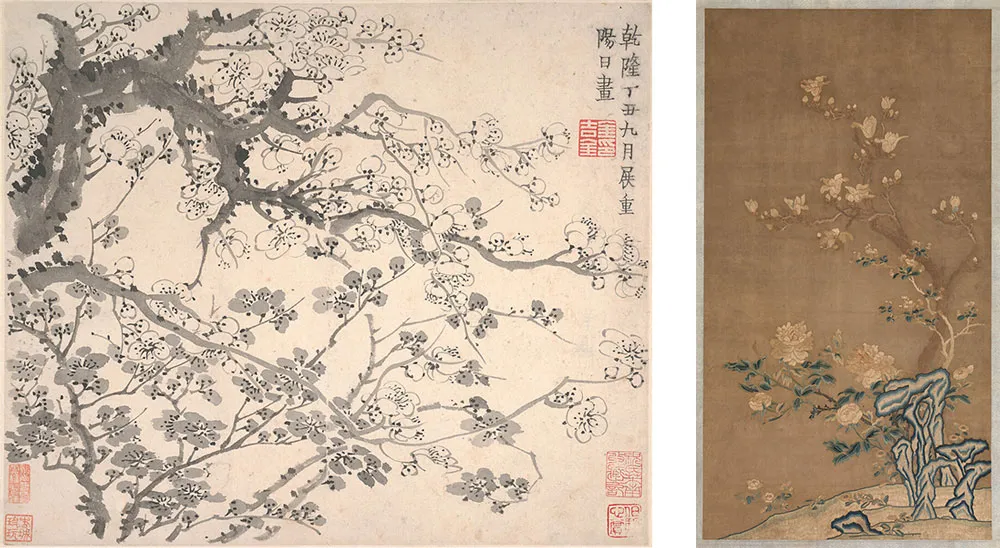
Noble Virtues: Nature as Symbol in Chinese Art exhibition at the Met Museum
In the canon of Chinese art history, nature has never been merely a subject of observation; it is a mirror for the human spirit. A branch of pine is not simply wood and needle, but a testament to longevity; a blooming plum is not just a flower, but a declaration of resilience against the winter chill. This profound entanglement of botany and philosophy forms the curatorial heart of Noble Virtues: Nature as Symbol in Chinese Art, an exhibition at The Metropolitan Museum of Art that invites viewers to read paintings as they would a moral text.
Orchestrated by Joseph Scheier-Dolberg, the Oscar Tang and Agnes Hsu-Tang Associate Curator of Chinese Paintings, the exhibition draws from The Met’s vast holdings to illuminate the genre of huaniaohua (bird-and-flower painting). Yet, the scope here transcends taxonomical categorization. By assembling over one hundred works spanning centuries—including painting, calligraphy, and decorative arts—Scheier-Dolberg constructs a visual dialogue where the natural world serves as a vocabulary for human character.
The exhibition opens with a powerful emphasis on bamboo, a motif that commands two full galleries and spans dynasties of artistic interpretation. In the ink-wash tradition, bamboo is revered not for its beauty, but for its structural integrity. It is one of the few plants that bends before the storm but rarely breaks, springing back when the winds subside.
Scheier-Dolberg notes the essential symbolism that has resonated through generations of scholars and officials: “Bamboo is hardy; it can withstand adversity. That’s the key symbolism of bamboo that people would identify with—even during difficult times, it’s able to grow and survive.”
However, the metaphor extends inward. The anatomy of the bamboo—a tough exterior protecting a hollow interior—is interpreted as the ideal state of the human mind. The “hollow heart” (xu) represents humility, the absence of prejudice, and the capacity to accept new ideas while maintaining emotional stability. In works ranging from the 14th to the 18th centuries, artists utilize the flexibility of the brush to mimic the plant itself, creating leaves that seem to rustle and stems that stand firm against the white void of the paper.
Beyond the bamboo groves, the exhibition expands into the wider garden of Chinese symbolism, specifically the “Four Gentlemen” (Si Junzi). This artistic grouping—comprising the plum blossom, orchid, bamboo, and chrysanthemum—represents the four seasons and the virtues of the ideal Confucian scholar.
The plum blossom, celebrated in the Douglas Dillon Galleries, holds a particular poignancy. Blooming amidst the snow while other plants remain dormant, it signifies righteousness, bravery, and hope in the face of desolation. The contrast of delicate, pale petals against the harshness of twisted, dark branches offers a visual study in perseverance.
Complementing the flora are the fauna of myth and reality. The exhibition weaves in depictions of cranes and phoenixes—creatures that carry heavy symbolic loads of longevity, immortality, and imperial grace. In these works, the specificity of the animal is less important than the auspicious energy it imparts to the viewer. A panel featuring five phoenixes is not a study of ornithology, but an invocation of benevolence and harmony.
There is a subtle, material poetry to the exhibition’s logistics that mirrors its subject matter. The works on display, primarily ink on paper or silk, are inherently fragile and highly sensitive to light. Like the seasons they depict, their presence is fleeting. The Met’s conservation protocols dictate that these pieces can only be exposed for a few months at a time before returning to the darkness of the archives for rest.
This rotation ensures that Noble Virtues is not a static monument but a living, breathing entity. The curator’s decision to bring these specific pieces into the light allows for a rare communion with the past—a moment to witness how masters like Li Kan, Shitao, and Jin Nong translated the silent ethics of nature into the enduring language of ink.
While the physical exhibition concludes on January 29, 2023, the collection remains a testament to a civilization that looked at a simple reed or a flying bird and saw, in their forms, a blueprint for how to live a noble life. The works continue to reside in The Met’s collection, accessible digitally, waiting for their next season to bloom in the galleries.
Joining Shen Yun in 2007, Angelia Wang (b. Xi'an, China) represents a benchmark in the…
"We're a team." It is a simple phrase, just three words, yet it holds more…
In the high-stakes theater of grand opera, survival requires a bifurcation of the self. For…
They say the second year of marriage is defined by cotton. It sounds simple, almost…
Two decades together is no small feat. It is a milestone that speaks to patience,…
poems The Merchant of Venice Student Edition---PDF and Complete TextThe water in Venice is never…
There is a specific kind of silence that settles in the garden after a loss.…
There is a specific kind of magic that happens when a photographer doesn't just capture…
In the ancient Italian town of Santarcangelo di Romagna, where history clings to the cobblestones…
The Princeton Club of New York, usually a bastion of quiet networking, recently became the…
A decade together is no small feat. It’s ten years of inside jokes, shared silences,…
In the vast and fragmented linguistic landscape of China, the spoken word has always been…
In an art world often preoccupied with jarring intellectualism or the pursuit of hyper-realistic technicality,…
For Joseph Scheier-Dolberg, the Oscar Tang and Agnes Hsu-Tang Associate Curator of Chinese Paintings at…
I still remember watching you when Grandma passed away. I saw how deeply you mourned,…
There is a distinct difference between seeing a moment with your eyes and seeing how…
Clothing has never been merely about protection against the cold. Across five millennia of human…
The first year of marriage is often a whirlwind of emotions. It is a period…
Ralph Waldo Emerson once observed that "Earth laughs in flowers," a poetic sentiment that reverberates…
There is a specific gravity to a poem carried in the pocket. It is different…
Mother’s Day is approaching, and if you are miles away from the woman who raised…
Winter has a way of changing the landscape of our lives, not just the view…
The allure of Japanese art often lies in its masterful negotiation between the void and…
There is a distinct fairy-tale quality to the work of Lison de Caunes, a resonance…
William Wordsworth (1770–1850) remains a titan of English letters, a figure whose life spanned the…
I was thinking today about how much ground we've covered together. You know, between two…
There is a paradoxical nature to porcelain. In its raw state, it is dense earth;…
The sonnet is not merely a form; it is a vessel for concentrated thought. To…
The intersection of heritage craftsmanship and avant-garde installation art often yields the most compelling dialogues…
I've been thinking a lot about the power of visibility lately, especially as we celebrate…