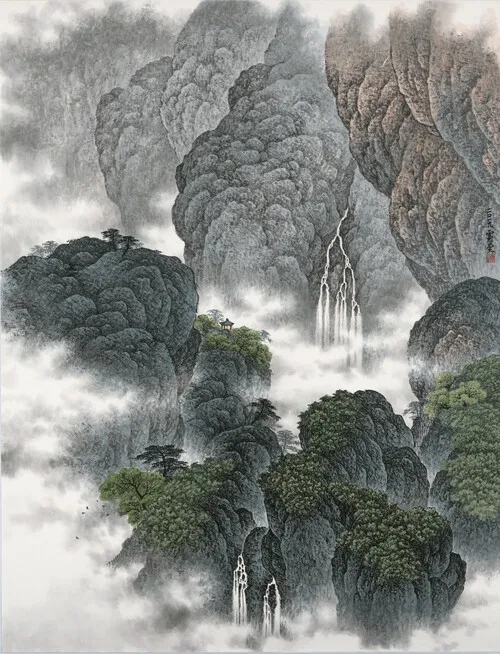
Hou Xiantang’s 'A Majestic Vista' features distant mountains commanding attention with a cascading waterfall and wandering clouds.
To enter the studio of Taiwanese painter Hou Xiantang is to step across a threshold of time. Tucked away in a secluded alley amidst the kinetic energy of Taipei, the space offers a stark, almost physical contrast to the urban clamour outside. It is approaching noon, yet here, the light seems to pause. The aroma of brewing tea hangs in the air, rousing the familiar warmth of visiting an old friend, but also signaling a shift in consciousness—a preparation for the journey into the mountains he creates.
Hou’s landscapes are not merely depictions of geography; they are constructed sanctuaries. His towering peaks and cascading waters radiate a profound mystique, utilizing exaggerated scales to dwarf the human observer. In this disproportion, a sense of liberation emerges. The viewer is drawn into an idyllic seclusion, a mental space where the frantic noise of the contemporary world dissolves into the mist of high-altitude silence.
Traditional Chinese culture has long held the spirit of reclusion in high regard, viewing it not as an act of escapism, but as a deliberate engagement with the self. Since ancient times, the scholar-artist has moved with unhurried poise, embodying an existence where contentment is found in inner reflection and a harmonious communion with the universe. For these academics, solitude is distinct from loneliness; it is a cherished retreat, a necessary condition for the mind to expand without the compression of societal influence.
As one immerses themselves in Hou’s mountainous realms, the sensation is akin to residing alongside these ancient recluses. The paintings invite a participatory viewing: one can envision resting beneath the shade of a pine, savouring tea, or navigating the peaks with uninhibited joy. It is a visual manifestation of the Taoist ideal—a return to a state of simplicity and truth.
Aesthetically, the allure of Hou’s landscapes lies in his virtuoso command of texture. He employs a groundbreaking brush technique known as yànzì cùn, or the “M-shape stroke.” While rooted in the lineage of traditional Chinese brushwork, Hou’s adaptation creates a unique vibration across the paper.
Historically, masters have defined eras through their strokes. The Yuan Dynasty’s Huang Gongwang used the “Hemp Stroke” to render the soft, lush terraces of the Dwelling in the Fuchun Mountains. Zhao Mengfu excelled in the “Lotus Stroke,” mimicking the undulation of ranges. The Northern Song luminary Fan Kuan employed the “Rain Stroke” to capture the sheer weight and verticality of cliffs. Hou enters this dialogue with his M-stroke, a versatile tool that can be jagged and robust to portray imposing crags, or soft and rhythmic to illustrate verdant slopes. Layer upon layer, these strokes impart a surreal, oscillating quality to his mountains, bringing the stone to life.
Yet, equally important to the ink is the absence of it. In Hou’s compositions, the cascading waterfalls, serene streams, and drifting clouds are not painted with white pigment. They are the result of liubai—leaving the paper untouched.
This technique demands a rigorous discipline. Unlike oil painting, where layers can conceal errors, ink offers no opacity and no retraction. There is no “white ink” to fix a mistake; the light must be planned before the first drop of darkness touches the surface. Once the brush connects with the paper, the bond is permanent. A single misstep can mar the entire composition, forcing the artist to begin anew. It is a high-stakes meditation, requiring absolute clarity of mind.
While the mountains provide the grand structure, it is the detail that breathes life into Hou’s world. His trees, in particular, stand out for their vibrancy, diverging from the more generalized foliage seen in many post-Song Dynasty artworks. For Hou, trees are not decorative filler; they are silent companions in the reclusive life.
He painstakingly outlines and colors each leaf, capturing the transition from the tender green buds of spring to the fiery reds of autumn. The brushwork traces the growth of the branches as if the artist is reminiscing about shared moments with them. This deep symbiosis mirrors the unity with nature discussed by the philosopher Zhuang Zi in On the Equalization of Things—the artist infusing his own spirit into the wood and water, becoming intertwined with every element.
Stepping into these paintings is an act of spiritual travel. The vexations of the external world fade, replaced by a narrative of serenity. We recognize scenes that resonate with a dormant part of the psyche: ascending paths flanked by cypresses and willows, pausing at pavilions nestled in the mist, or watching a small boat bob on cerulean waves, its destination unknown.
In Hou’s ink wash universe, the ecosystem is complete. Deer quench their thirst by the streams, cranes dance with the wind, and even formidable tigers exude a gentle presence within the vista. These are not scenes of conflict, but of balance.
Today, Hou Xiantang paints not for fame, but to carve out sanctuaries for the soul through the relentless refinement of his craft. He yearns for a world of stillness where the spirit can roam free of life’s trappings. Through his art, he extends an invitation to kindred souls: to revel in the moonlit breeze, to savour tea infused with spring water, and to joyfully lose themselves in a moment that exists beyond the constraints of time.
Joining Shen Yun in 2007, Angelia Wang (b. Xi'an, China) represents a benchmark in the…
"We're a team." It is a simple phrase, just three words, yet it holds more…
In the high-stakes theater of grand opera, survival requires a bifurcation of the self. For…
They say the second year of marriage is defined by cotton. It sounds simple, almost…
Two decades together is no small feat. It is a milestone that speaks to patience,…
poems The Merchant of Venice Student Edition---PDF and Complete TextThe water in Venice is never…
There is a specific kind of silence that settles in the garden after a loss.…
There is a specific kind of magic that happens when a photographer doesn't just capture…
In the ancient Italian town of Santarcangelo di Romagna, where history clings to the cobblestones…
The Princeton Club of New York, usually a bastion of quiet networking, recently became the…
A decade together is no small feat. It’s ten years of inside jokes, shared silences,…
In the vast and fragmented linguistic landscape of China, the spoken word has always been…
In an art world often preoccupied with jarring intellectualism or the pursuit of hyper-realistic technicality,…
For Joseph Scheier-Dolberg, the Oscar Tang and Agnes Hsu-Tang Associate Curator of Chinese Paintings at…
I still remember watching you when Grandma passed away. I saw how deeply you mourned,…
There is a distinct difference between seeing a moment with your eyes and seeing how…
Clothing has never been merely about protection against the cold. Across five millennia of human…
The first year of marriage is often a whirlwind of emotions. It is a period…
Ralph Waldo Emerson once observed that "Earth laughs in flowers," a poetic sentiment that reverberates…
There is a specific gravity to a poem carried in the pocket. It is different…
Mother’s Day is approaching, and if you are miles away from the woman who raised…
Winter has a way of changing the landscape of our lives, not just the view…
The allure of Japanese art often lies in its masterful negotiation between the void and…
There is a distinct fairy-tale quality to the work of Lison de Caunes, a resonance…
William Wordsworth (1770–1850) remains a titan of English letters, a figure whose life spanned the…
I was thinking today about how much ground we've covered together. You know, between two…
There is a paradoxical nature to porcelain. In its raw state, it is dense earth;…
The sonnet is not merely a form; it is a vessel for concentrated thought. To…
The intersection of heritage craftsmanship and avant-garde installation art often yields the most compelling dialogues…
I've been thinking a lot about the power of visibility lately, especially as we celebrate…