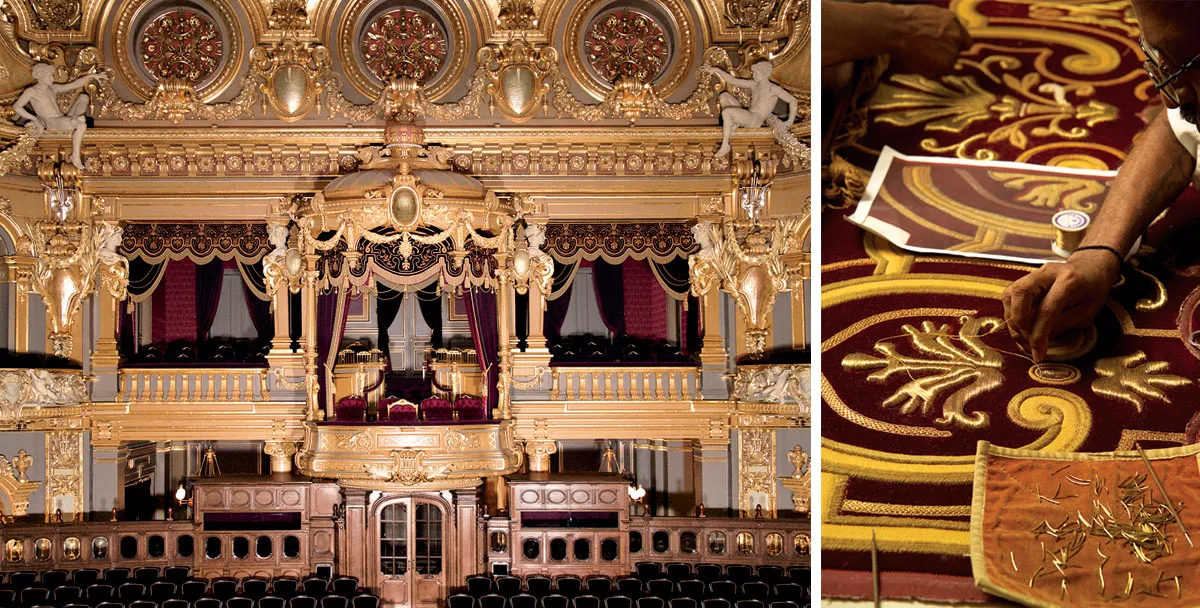
Left: Lesage Interieurs crafted these beautiful neo-Louis XV pelmets of the Prince Lodge Opera Garnier of Monte Carlo. Right: The identical reproduction of the extravagant décor in Opera Garnier of Monte Carlo. Photo courtesy of MONTE-CARLO Société des Bains de Mer; Photo courtesy of Lesage Interieurs
France and India, separated by thousands of miles and distinct cultural rhythms, find a profound convergence in the delicate loop of a thread. It is a bond woven not merely by commerce, but by a shared reverence for the tactile arts. At the center of this dialogue stands Jean-François Lesage, heir to the legendary Parisian embroidery dynasty and founder of Lesage Interieurs. He is not simply a businessman, but a custodian of a vanishing language, weaving the past into the present to ensure that the human touch remains a defining pillar of luxury.
To Lesage, the needle is an instrument of expression equal to the brush or the pen. The art of embroidery transcends mere decoration; it is a medium of storytelling that allows a space to articulate its own soul. “Embroidery has no limits,” Lesage observes. “It is as free as painting, drawing, or writing. It has always been a way to singularize a room, to give it its own expression.”
In the high-speed cadence of the modern world, this art form demands a pause—a recalibration of value where luxury is defined by the time and emotion invested in its creation. Whether crafting neo-Louis XV pelmets for the Prince Lodge at the Opera Garnier in Monte Carlo or collaborating with iconic fashion houses like Chanel and Balmain, the philosophy remains constant: true luxury speaks directly to the senses.
Lesage’s workshop is situated far from the gray skies of Paris, in the vibrant heat of Chennai, India. This location is not a matter of convenience, but of historical resonance. Chennai is the city of the descendants of the East India Company embroiderers, a place where the lineage of the craft remains unbroken. Lesage notes a profound connection in the tools themselves—the needle and the hook—which bridge French and Indian traditions, both of which find their distant origins in Persia. The techniques are shared; only the designs diverge.
“The human hand thinks with its eyes, its heart, its knowledge accumulated since millenaries, its emotions. It sublimes a material in a transcendental manner,” Lesage reflects.
In Chennai, Lesage found a rhythm of life that mirrored the patience required for his art. It is a city where time is still accorded to human connection, a vital ingredient for craftsmanship that cannot be rushed. “Like in France, the Indian culture has evolved for more than 3,000 years in an uninterrupted manner,” he explains. “The variety and the richness of the Indian craftsmanship, as much as French, celebrates first what human hands can achieve in a joyful manner. Beauty comes first.”
The standard maintained at Lesage Interieurs is exacting. The preservation of this heritage requires more than just manual dexterity; it demands an intellectual engagement with history. To enter this elite circle of artisans, a craftsman must navigate a vast ocean of archival knowledge, mastering 7,000 interior samples and 75,000 fashion samples spanning from the 15th to the 20th centuries.
This rigorous training ensures that the embroiderers do not merely copy, but understand the structural grammar of ancient techniques. “It has been a long training for the embroiderers to analyze the ancient techniques and master each style without any concessions,” Lesage notes. By internalizing this vast technical vocabulary, the artisans gain the fluidity to adapt to any design challenge, effectively speaking a language of stitches that has been refined over centuries.
The depth of this expertise is perhaps best illustrated by the atelier’s formidable undertaking: the recreation of the red silk velvet embroidery for one of Emperor Napoleon’s official thrones. This project was not merely a commission but, as Lesage describes it, “an archaeological adventure.”
With no physical prototype remaining, the team had to reconstruct reality from a two-dimensional oil painting of the Emperor. The process involved a forensic analysis of proportions—using the painted height of Napoleon to calculate the dimensions of the throne’s motifs. To ensure absolute historical fidelity, they cross-referenced the painted ornamentation with surviving works by Napoleon’s architects and ornamentalists.
The result of the Napoleon project was a triumph of resurrection—hundreds of hours of needlework utilizing techniques identical to those of the First Empire. The laurel wreaths, bees, monograms, and thunderbolts were not just symbols of power, but evidence of a craft that refuses to die.
For Jean-François Lesage, this work is an act of cultural guardianship. He views the preservation of ancient embroidery as maintaining “a dictionary of rare, beautiful words.” By keeping these techniques in circulation, he prevents the dilution of knowledge, ensuring that contemporary embroidery remains rich and nuanced. “The final work should be incredibly alive, playing with the light,” he concludes. “It’s a joy, a pleasure. It’s a part of myself.”
Joining Shen Yun in 2007, Angelia Wang (b. Xi'an, China) represents a benchmark in the…
"We're a team." It is a simple phrase, just three words, yet it holds more…
In the high-stakes theater of grand opera, survival requires a bifurcation of the self. For…
They say the second year of marriage is defined by cotton. It sounds simple, almost…
Two decades together is no small feat. It is a milestone that speaks to patience,…
poems The Merchant of Venice Student Edition---PDF and Complete TextThe water in Venice is never…
There is a specific kind of silence that settles in the garden after a loss.…
There is a specific kind of magic that happens when a photographer doesn't just capture…
In the ancient Italian town of Santarcangelo di Romagna, where history clings to the cobblestones…
The Princeton Club of New York, usually a bastion of quiet networking, recently became the…
A decade together is no small feat. It’s ten years of inside jokes, shared silences,…
In the vast and fragmented linguistic landscape of China, the spoken word has always been…
In an art world often preoccupied with jarring intellectualism or the pursuit of hyper-realistic technicality,…
For Joseph Scheier-Dolberg, the Oscar Tang and Agnes Hsu-Tang Associate Curator of Chinese Paintings at…
I still remember watching you when Grandma passed away. I saw how deeply you mourned,…
There is a distinct difference between seeing a moment with your eyes and seeing how…
Clothing has never been merely about protection against the cold. Across five millennia of human…
The first year of marriage is often a whirlwind of emotions. It is a period…
Ralph Waldo Emerson once observed that "Earth laughs in flowers," a poetic sentiment that reverberates…
There is a specific gravity to a poem carried in the pocket. It is different…
Mother’s Day is approaching, and if you are miles away from the woman who raised…
Winter has a way of changing the landscape of our lives, not just the view…
The allure of Japanese art often lies in its masterful negotiation between the void and…
There is a distinct fairy-tale quality to the work of Lison de Caunes, a resonance…
William Wordsworth (1770–1850) remains a titan of English letters, a figure whose life spanned the…
I was thinking today about how much ground we've covered together. You know, between two…
There is a paradoxical nature to porcelain. In its raw state, it is dense earth;…
The sonnet is not merely a form; it is a vessel for concentrated thought. To…
The intersection of heritage craftsmanship and avant-garde installation art often yields the most compelling dialogues…
I've been thinking a lot about the power of visibility lately, especially as we celebrate…