Yasufumi Nakamori
There are moments in a life that act as a sharp intake of breath—a rupture between who one was and who one must become. For Yasufumi Nakamori, the Director of the Asia Society Museum in New York, that moment arrived on the morning of September 11, 2001. Standing outside the Marriott Hotel, caught between the looming towers of the World Trade Center, he waited for a shuttle to Newark for a flight to Tokyo. The subsequent explosion and the debris raining onto the street shattered not just the silence of the morning, but the trajectory of his career.
Until that day, Nakamori had followed the pragmatic path of a corporate lawyer, navigating the high-stakes legal landscapes of New York and Tokyo—a career chosen to satisfy the expectations of a father who viewed art as a pastime, not a profession. But the fragility of existence, laid bare in seconds, demanded a reckoning. Within six months, the law firm was left behind. He traded financial security for a curatorial internship at the MIT List Visual Arts Center, eventually moving through the Whitney Museum of American Art and Tate, guided solely by the realization that life is too transient to be spent on anything other than one’s true calling.
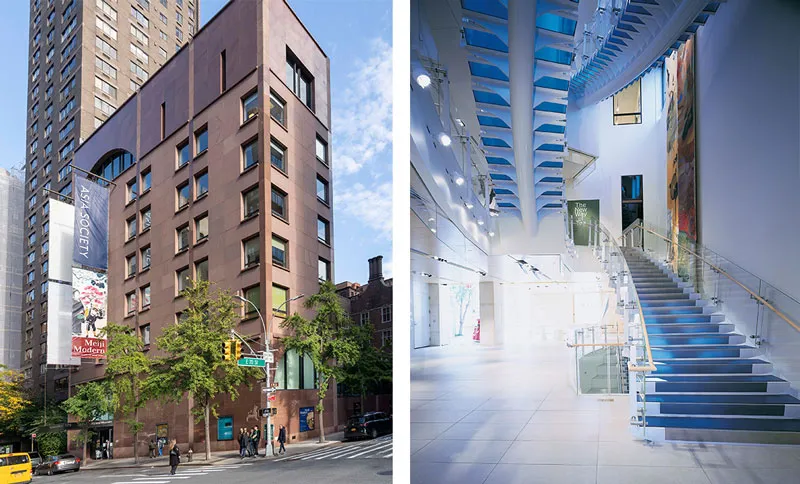
This profound shift from the rigid structures of law to the fluid, interpretive world of art now defines his leadership at the Asia Society Museum. Nakamori does not view the institution merely as a repository for the John D. Rockefeller 3rd collection of pre-modern objects, though it serves as a custodian for these treasures dating back to the 11th century BCE. Instead, he envisions the museum as a living entity, a “transnational” space where the concept of Asia transcends national borders to embrace the global diaspora.
His curatorial philosophy rests on three pillars: art, society, and interpretation. It is a method of contextualization, looking at how historical roots inform contemporary sensibilities. Under his direction, the museum seeks to dissolve the artificial separation between the ancient and the avant-garde, allowing the voices of the past to speak clearly to the complexities of the present.
This dialogue between eras is most evident in the museum’s forthcoming programming. Nakamori is particularly focused on how diasporic artists navigate their identity—a journey of reclamation and re-imagination. A prime example is the preparation for a solo exhibition of Martin Wong, scheduled for autumn 2025. Wong, a Chinese-American painter active in the vibrant art scenes of San Francisco and New York during the 1980s and 90s, occupied a unique interstitial space.
Growing up without the Chinese language, Wong’s work became a quest to reconstruct his heritage. He painted the architecture, people, and landscapes of a culture he belonged to by blood but observed from a distance, blending these motifs with the grit of American urban life. Nakamori highlights Wong’s fascination with calligraphy, noting how the artist transformed English poetry into horizontal, calligraphic forms—an abstraction of language that bridges two worlds.
The conversation continues in the spring of 2025, where the museum will invite three distinct contemporary voices—Howardena Pindell, Byron Kim, and Rina Banerjee—to engage directly with the Rockefeller collection. This initiative is an act of artistic alchemy. Pindell, an African American artist with deep ties to Japan and India; Kim, a Korean American painter; and Banerjee, born in India and migrating via the UK to the US, will each select pre-modern objects to inspire new creations. It is a curatorial gesture that refuses to let history sit silent in a glass case, instead forcing it to interact with modern perspectives on race, migration, and identity.
Currently, the museum is breaking ground with Maḏayin: Eight Decades of Aboriginal Australian Bark Painting from Yirrkala. Running through early January 2025, this is a landmark event—the first major exhibition of its kind to tour the United States and the first in New York in two decades dedicated solely to Aboriginal Australian art.
The exhibition features nearly 80 paintings, drawing heavily from the Kluge-Ruhe Aboriginal Art Collection, established by John Kluge after he was inspired by the Asia Society’s own 1988 presentation of Aboriginal art. What makes Maḏayin profound is its curation by the Yolŋu people themselves. The works showcase miny’tji—sacred designs that are far more than aesthetic patterns; they are visual manifestations of the connection between clan, land, and cosmos. By presenting these 33 newly commissioned pieces alongside historical works, the museum honors an artistic lineage that is both ancient and urgently contemporary.
Nakamori’s vision is ultimately one of connectivity. Whether exploring the abstraction of calligraphy across Asian history or highlighting the tea culture that bridges East and West, he seeks points of entry for every visitor. His approach is deeply informed by the power of the visual image to bear witness—a lesson he took from Minamata, the seminal photography book by W. Eugene Smith and Aileen M. Smith. The book’s haunting documentation of mercury poisoning in a Japanese fishing village demonstrated to Nakamori that art, when executed with dignity and beauty, is not just a reflection of society but a mechanism for justice. It is this synthesis of aesthetic wonder and social conscience that he now brings to the heart of New York.
Joining Shen Yun in 2007, Angelia Wang (b. Xi'an, China) represents a benchmark in the…
"We're a team." It is a simple phrase, just three words, yet it holds more…
In the high-stakes theater of grand opera, survival requires a bifurcation of the self. For…
They say the second year of marriage is defined by cotton. It sounds simple, almost…
Two decades together is no small feat. It is a milestone that speaks to patience,…
poems The Merchant of Venice Student Edition---PDF and Complete TextThe water in Venice is never…
There is a specific kind of silence that settles in the garden after a loss.…
There is a specific kind of magic that happens when a photographer doesn't just capture…
In the ancient Italian town of Santarcangelo di Romagna, where history clings to the cobblestones…
The Princeton Club of New York, usually a bastion of quiet networking, recently became the…
A decade together is no small feat. It’s ten years of inside jokes, shared silences,…
In the vast and fragmented linguistic landscape of China, the spoken word has always been…
In an art world often preoccupied with jarring intellectualism or the pursuit of hyper-realistic technicality,…
For Joseph Scheier-Dolberg, the Oscar Tang and Agnes Hsu-Tang Associate Curator of Chinese Paintings at…
I still remember watching you when Grandma passed away. I saw how deeply you mourned,…
There is a distinct difference between seeing a moment with your eyes and seeing how…
Clothing has never been merely about protection against the cold. Across five millennia of human…
The first year of marriage is often a whirlwind of emotions. It is a period…
Ralph Waldo Emerson once observed that "Earth laughs in flowers," a poetic sentiment that reverberates…
There is a specific gravity to a poem carried in the pocket. It is different…
Mother’s Day is approaching, and if you are miles away from the woman who raised…
Winter has a way of changing the landscape of our lives, not just the view…
The allure of Japanese art often lies in its masterful negotiation between the void and…
There is a distinct fairy-tale quality to the work of Lison de Caunes, a resonance…
William Wordsworth (1770–1850) remains a titan of English letters, a figure whose life spanned the…
I was thinking today about how much ground we've covered together. You know, between two…
There is a paradoxical nature to porcelain. In its raw state, it is dense earth;…
The sonnet is not merely a form; it is a vessel for concentrated thought. To…
The intersection of heritage craftsmanship and avant-garde installation art often yields the most compelling dialogues…
I've been thinking a lot about the power of visibility lately, especially as we celebrate…