High in the mist-laden valleys of Vietnam’s Lam Dong Province, where pine forests curb the horizon and the air carries a perennial chill, Da Lat—often called the “City of Eternal Spring”—harbors a sanctuary of silence and color. This is the XQ Historical Village, a space that functions less like a workshop and more like a suspended memory, where a community of female artisans preserves the ancient discipline of hand embroidery, elevating it from craft to a philosophical way of life.
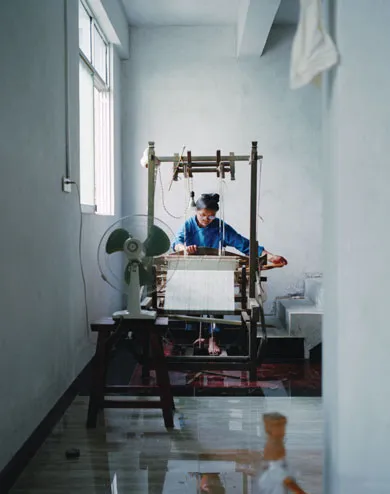
Stepping into the village is akin to entering a curated pause in time. The architecture borrows from the heritage of the region, housing a quiet workforce dedicated to the tambour frame. The artisans, dressed in the flowing, traditional ao dai, do not merely sew; they perform a rhythmic dance of patience. Their movements are deliberate, their focus absolute, as fine needles guide silk threads through fabric to manifest images of startling intricacy.
Female artisans in traditional ao dai working on embroidery frames in Da Lat
The artistry here is defined by a pursuit of hyper-realism that rivals photography and oil painting. Through the meticulous layering of silk, the artisans achieve a depth of field and texture that flat pigments often struggle to capture. The subjects range from the grandeur of world leaders to the quiet, ephemeral beauty of blooming flora and the mist-covered bamboo forests of the Vietnamese countryside.
However, it is in the portrayal of the human condition that the technique finds its most profound expression. In the piece titled Aging, the medium of silk transcends its decorative origins to become a study of time itself. The portrait depicts an elderly woman, her face a map of weathered wrinkles and age spots. The eyes, rendered with a specific luminosity, hold a poignant weight, suggesting a lifetime of unseen narratives.
Embroidered portrait titled Aging showing detailed wrinkles and expressive eyes
The technical mastery required to render such realism involves thousands of stitches, varying in length, density, and hue to mimic the organic irregularities of skin or the play of light on a surface. This attention to organic detail extends to the animal kingdom as well.
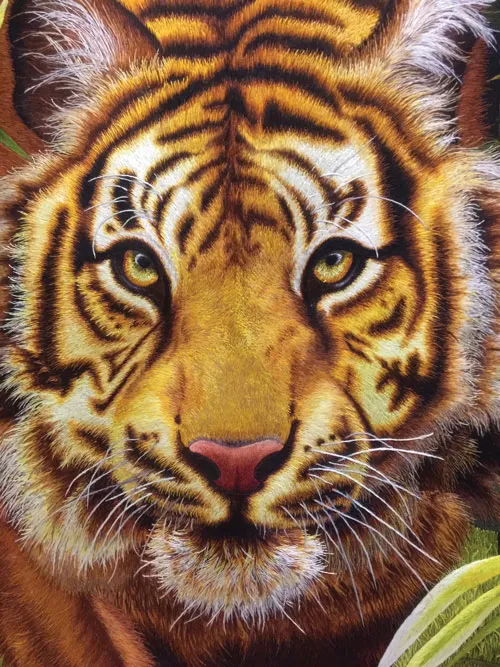
In their depictions of wildlife, such as the tiger, the embroidery ceases to be a static image and becomes kinetic. The artisans utilize the natural sheen of the silk thread to replicate the texture of fur. On the tiger’s coat, the interplay of orange-yellow and black threads follows the biological direction of hair growth, creating a flow that suggests muscle and movement beneath the surface. The result is a creature that appears ready to prowl from the frame, a testament to the artisan’s observation of the natural world.
Detailed embroidery of a tiger face showing realistic fur texture and direction
The XQ Historical Village was founded not merely to produce art, but to safeguard and evolve the tradition of Vietnamese hand embroidery. Under the guidance of co-founder Vo Van Quan, the collective views their work through a lens of cultural introspection. The act of embroidery is reframed as a linguistic tool—a silent voice for women to articulate their interior landscapes.
“Embroidery has become a means for Vietnamese women to find their voice, allowing them to share their beliefs and emotions through their creations,” Vo Van Quan observes. Within this context, XQ serves as a vehicle for a deeper search for beauty—not just the aesthetic beauty of the final image, but the beauty found within the self, the heritage of the home country, and the quiet connections woven between the makers.

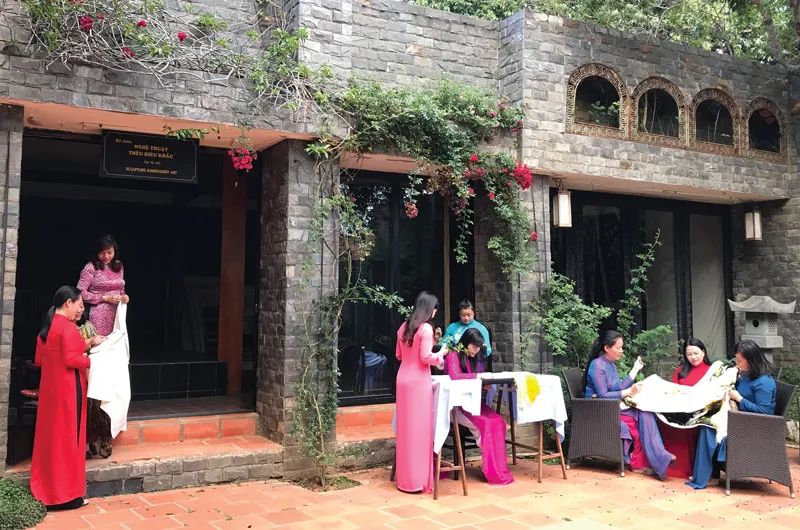 Female artisans in traditional ao dai working on embroidery frames in Da Lat
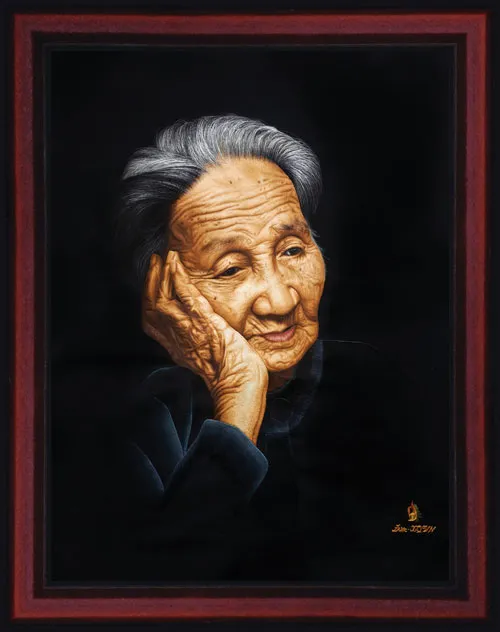 Embroidered portrait titled Aging showing detailed wrinkles and expressive eyes
 Detailed embroidery of a tiger face showing realistic fur texture and direction