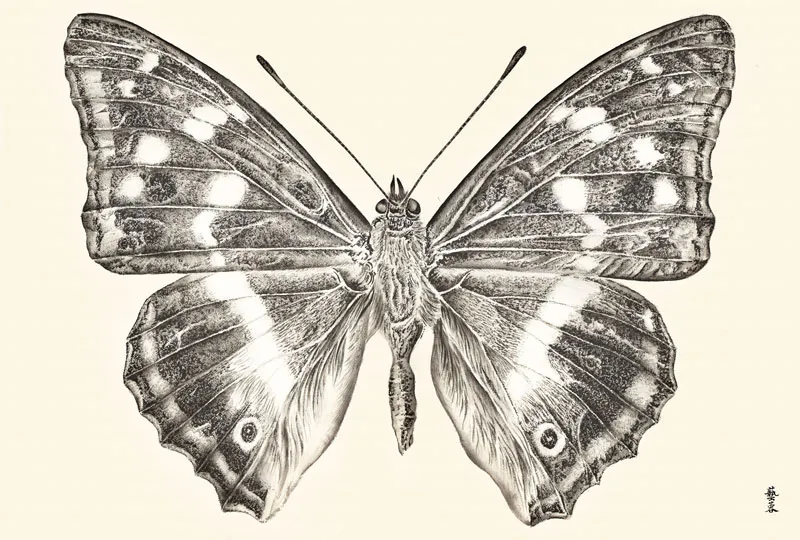
Detailed ink painting of a blooming peony showing delicate layers of petals and subtle shading
In the monochrome world of Yirong Zhang, a flower is never merely a botanical study; it is a meditation on existence. Her ink wash paintings, stripped of vibrant pigments, reveal a paradox central to Eastern aesthetics: within the limitations of black and white lies a boundless spectrum of texture, light, and spirit.
Her works occupy a liminal space between eras and geographies. While they are deeply rooted in the ink traditions of the Song and Yuan dynasties-revering the philosophical weight of the void-they also converse with Western artistic sensibilities. Through a mastery of shading and volume reminiscent of classical sketching, Zhang renders the delicate veins of a petal or the fragile wing of a butterfly with a tactile realism that transcends simple abstraction.
“For me, painting is a pure art form,” Zhang observes. “Like a flower blooming, it follows the season and comes naturally.” This philosophy of organic emergence has resonated globally; since 2011, her work has been exhibited internationally and acquired by institutions such as the Houston Museum of Fine Arts. Yet, the tranquility visible on paper is the result of a rigorous intellectual and technical journey.
The Tang Dynasty poet and painter Wang Wei once famously declared, “Ink painting requires the most advanced skills.” This assertion underscores the difficulty of the medium: without color to distract or decorate, the artist must rely entirely on the nuance of the stroke and the density of the ink.
Zhang accepts this challenge by exploring the “five colors of ink”-a concept where water and soot, mixed in varying degrees, produce a range of tonalities capable of suggesting all earthly colors. In her hands, the absence of hue becomes a invitation for the viewer’s imagination. By manipulating the wetness and speed of the brush, she creates distinct textures that imply the softness of a bloom or the crispness of a leaf, constructing extraordinary worlds that surpass physical experience.
This approach creates a direct channel between the artwork and the observer. Zhang deliberately avoids over-stylization in favor of purity. “I hope that the viewer can directly experience the work, not just be attracted by the drawing technique,” she explains. “The purer it is, the more likely it is to achieve this effect.”
Central to this purity is spirituality. Traditional Chinese painting is rarely about the mere act of depiction; it is a conduit for Qi (vital energy) and a method of cultivation. For Zhang, the process is a path toward inner peace, a sentiment she transfers to the silk and paper, allowing the viewer to pause and find stillness amidst the noise of contemporary life.
Zhang’s artistic lineage is traced back to the rugged landscapes of Shaanxi Province, a cradle of Chinese civilization. Her childhood was steeped in the grandeur of religious art; her father and grandfather were sculptors who built statues in temples across northern Shaanxi.
“I studied Chinese painting with my father since I was a child, training with traditional methods,” Zhang recalls. “I also followed him to paint murals in monasteries and Taoist temples.” These early experiences with monumental scale and sacred subjects planted the seeds for her later work, yet her path was not linear.
Rather than immediately pursuing a fine arts degree, Zhang chose to study literature at both the undergraduate and graduate levels. This intellectual detour proved essential to her artistic maturity. “A person’s literacy comes from the constant pursuit of knowledge,” she reflects. “The more you learn, the more you enrich yourself, and the humbler you become.”
The study of literature provided her with a broader philosophical context. It instilled a sense of humility before the “grand universe,” a perspective that prevents art from becoming egocentric. When she eventually returned to painting, it was not just as a craftsman, but as a scholar-artist in the literati tradition, where the image is an extension of the mind. “I really love painting from the bottom of my heart,” she affirms, marking her return to the easel as a destiny fulfilled.
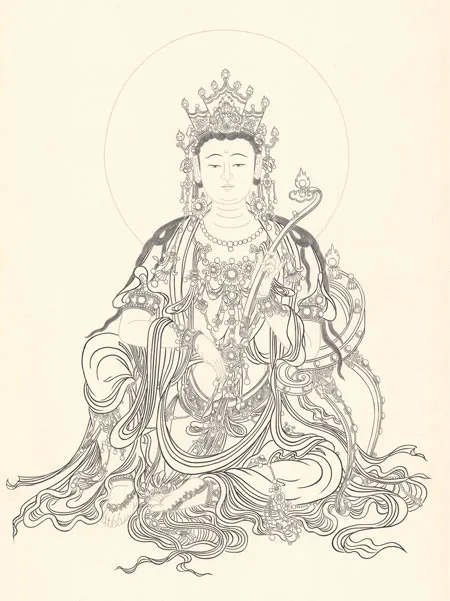
The culmination of Zhang’s technical skill and historical reverence is perhaps best exemplified by her restoration work. In 2017, she accepted an invitation from the Xing Hua Temple in Gaoping, Shaanxi Province, to recreate Shakyamuni’s Teachings, the only surviving mural from the Northern Song Dynasty at that location.
The project was a massive undertaking, physically and mentally. The work, executed on silk and measuring 200 × 260 cm, required months of unwavering concentration. Because the original mural had suffered significant damage over the millennium, Zhang could not simply copy what was there. She became a researcher, delving into the archives of Song Dynasty costumes, architectural standards, and religious iconography to reconstruct the missing history.
Painting on silk is an unforgiving process; unlike paper, which allows for some degree of correction, silk absorbs ink instantly and permanently. “There was no room for mistakes,” Zhang notes. The challenge lay in using lines of varying density and thickness to differentiate the myriad figures-Buddhas, Bodhisattvas, monks, and disciples-while maintaining a cohesive spiritual atmosphere.
The result is a work of immense complexity, where every fold of clothing and every strand of jewelry is rendered with meticulous precision. Through this grueling process, Zhang felt a metaphysical collapse of time. “After a few months of painting, I felt a connection beyond time and space with the artist who made the murals thousands of years ago,” she says.
Her recreation of Shakyamuni’s Teachings is more than a restoration; it is a tribute to the anonymity and greatness of ancient artisans. In the quiet precision of her lines, Yirong Zhang continues a conversation that began centuries ago, proving that ink, though fluid, can carve a legacy as enduring as stone.
Joining Shen Yun in 2007, Angelia Wang (b. Xi'an, China) represents a benchmark in the…
"We're a team." It is a simple phrase, just three words, yet it holds more…
In the high-stakes theater of grand opera, survival requires a bifurcation of the self. For…
They say the second year of marriage is defined by cotton. It sounds simple, almost…
Two decades together is no small feat. It is a milestone that speaks to patience,…
poems The Merchant of Venice Student Edition---PDF and Complete TextThe water in Venice is never…
There is a specific kind of silence that settles in the garden after a loss.…
There is a specific kind of magic that happens when a photographer doesn't just capture…
In the ancient Italian town of Santarcangelo di Romagna, where history clings to the cobblestones…
The Princeton Club of New York, usually a bastion of quiet networking, recently became the…
A decade together is no small feat. It’s ten years of inside jokes, shared silences,…
In the vast and fragmented linguistic landscape of China, the spoken word has always been…
In an art world often preoccupied with jarring intellectualism or the pursuit of hyper-realistic technicality,…
For Joseph Scheier-Dolberg, the Oscar Tang and Agnes Hsu-Tang Associate Curator of Chinese Paintings at…
I still remember watching you when Grandma passed away. I saw how deeply you mourned,…
There is a distinct difference between seeing a moment with your eyes and seeing how…
Clothing has never been merely about protection against the cold. Across five millennia of human…
The first year of marriage is often a whirlwind of emotions. It is a period…
Ralph Waldo Emerson once observed that "Earth laughs in flowers," a poetic sentiment that reverberates…
There is a specific gravity to a poem carried in the pocket. It is different…
Mother’s Day is approaching, and if you are miles away from the woman who raised…
Winter has a way of changing the landscape of our lives, not just the view…
The allure of Japanese art often lies in its masterful negotiation between the void and…
There is a distinct fairy-tale quality to the work of Lison de Caunes, a resonance…
William Wordsworth (1770–1850) remains a titan of English letters, a figure whose life spanned the…
I was thinking today about how much ground we've covered together. You know, between two…
There is a paradoxical nature to porcelain. In its raw state, it is dense earth;…
The sonnet is not merely a form; it is a vessel for concentrated thought. To…
The intersection of heritage craftsmanship and avant-garde installation art often yields the most compelling dialogues…
I've been thinking a lot about the power of visibility lately, especially as we celebrate…