Shen Yun dancer striking a dynamic airborne pose against a bright background
The advertisements are ubiquitous, coloring the grey sidewalks of city streets with flashes of turquoise and saffron. A dancer suspended in mid-air, defying gravity. But beneath the marketing campaign lies a complex artistic organism that demands a closer look. Whether viewed through the lens of a poet, a historian, or a casual theatergoer, the performance offers a distinct vision: a resurrection of a civilization that has all but vanished from its geographic home.
The Sound of the East
The curtain rises not just on movement, but on sound. The orchestra pit houses a unique alchemy—Western strings and brass provide the harmonic foundation, while traditional Chinese instruments like the pipa and suona float above the melody. It is a sonic texture that feels both cinematic and ancient.
The Shen Yun orchestra combining Western and Chinese instruments
This musical landscape supports the centerpiece: dance. Yet, this is not the ballet of the Sun King’s court. While Western ballet was refined under Louis XIV four centuries ago, Classical Chinese dance traces its lineage back three millennia, through the grand courts of successive dynasties. It is a system of movement that predates the modern era, preserving an aesthetic that feels like animated sculpture—Greek marble or Egyptian reliefs suddenly endowed with breath.
The technique is rigorous. Dancers execute flips, tumbles, and difficult postures that many mistakenly attribute to gymnastics or acrobatics; in reality, these forms originated here, in the ancient training grounds of Chinese dance. There is a narrative capacity in the movement, a versatility that swings from the subtle grace of a water sleeve to the martial rigidity of a general on the battlefield.
Narrative and Nuance
The performance functions as an anthology. Viewers are guided through a mosaic of vignettes, transitioning from ancient legends to regional folk dances. The storytelling is pantomimic yet lucid, requiring no spoken language to convey humor or tragedy. A Monkey King sketch might deliver slapstick comedy, while a scene depicting a Han Dynasty hero offers a meditation on loyalty.
Shen Yun performer depicting Han Dynasty hero Han Xin
More startling to the uninitiated are the pieces set in the present day. These segments strip away the silks of antiquity to reveal the harsh reality of modern China, depicting the persecution of Falun Dafa practitioners. It is here that the art form takes a sharp turn from entertainment to witness. The protagonists in these stories do not fight back with violence; they persevere through faith. It is a quiet resistance, a narrative choice that has drawn observations from religious leaders and artists alike, noting the distinction between political struggle and spiritual endurance.
Art or Propaganda?
The inclusion of these modern narratives has sparked debate. Critics sometimes label the performance as propaganda for Falun Dafa. Yet, one must ask where the line is drawn between propaganda and religious art. Is Handel’s Messiah propaganda? Is the ceiling of the Sistine Chapel?
Art has always been a vessel for spiritual expression. Falun Dafa, a practice rooted in the principles of Truthfulness, Compassion, and Tolerance, faced a brutal crackdown by the Chinese Communist Party starting in 1999. The artists of Shen Yun, many of whom are refugees or have family members suffering under the regime, use their stage to tell a story that is censored in their homeland.
Falun Gong practitioners holding banners on Tiananmen Square before the crackdown
To dismiss this as mere political messaging is to misunderstand the historical function of art. The very name “Falun” invokes the Law Wheel, a symbol entwined with Buddhist tradition for thousands of years—long before the swastika was misappropriated by 20th-century fascism. The spiritual core of the performance is not an imposition but a reflection of a pre-communist worldview, where the “Mandate of Heaven” governed the rise and fall of empires, and the divine was woven into the fabric of daily life.
A Cultural Resurrection
The broader mission appears to be the retrieval of a “divine culture.” Before the Cultural Revolution sought to erase the “Four Olds,” Chinese society was deeply spiritual. Novels like Journey to the West are pilgrimages; Dream of the Red Chamber is framed by Taoist and Buddhist philosophy. Shen Yun attempts to reconstruct this lost world.
A scene depicting the Monkey King from Journey to the West
In an era where deconstruction often dominates the arts, this reconstruction of classical beauty resonates with a specific hunger in the audience. It echoes the sentiment found in the final choral movement of Beethoven’s Ninth: a search for the Creator above the canopy of stars.
Poets and writers who have attended the shows often describe the experience as “physical poetry.” The precision of the choreography acts like the meter of a sonnet—strict constraints yielding boundless expression. From the sold-out halls of Lincoln Center to the theaters of London, the reception suggests that the universal language of beauty, pain, and redemption speaks louder than the cynicism of the modern age. It is a reminder that culture is not just what we create today, but what we remember from yesterday.

 Shen Yun dancer striking a dynamic airborne pose against a bright background
 The Shen Yun orchestra combining Western and Chinese instruments
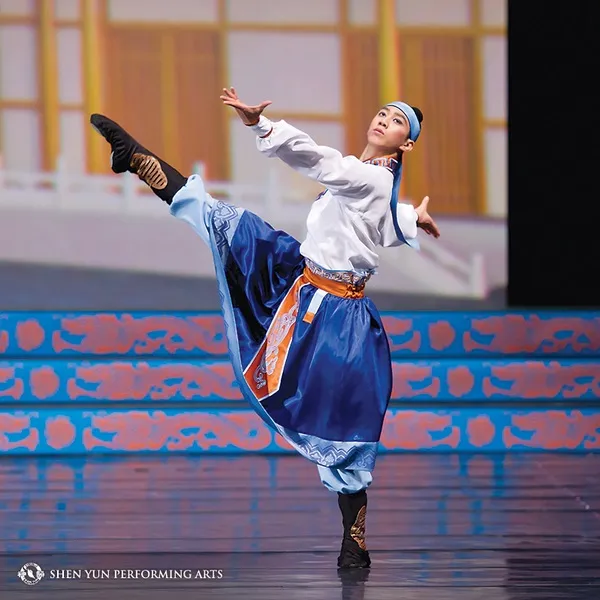 Shen Yun performer depicting Han Dynasty hero Han Xin
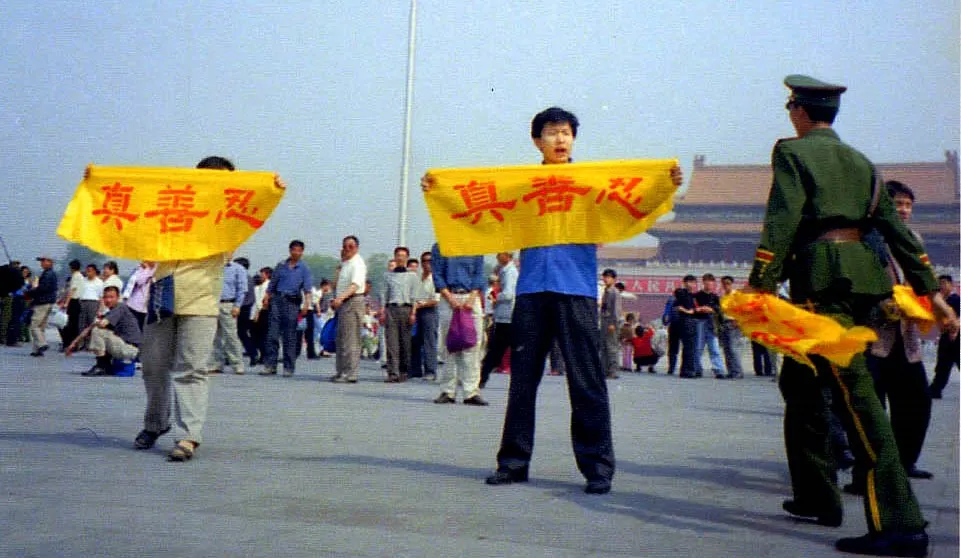 Falun Gong practitioners holding banners on Tiananmen Square before the crackdown
 A scene depicting the Monkey King from Journey to the West


