Book cover featuring Occasional Poetry title
We do not create from a void. Every syllable we utter carries the fossils of a time before writing, before the first plow broke the earth. Our language contains the accumulated resonance of millennia, a craft polished by ages. When we write, we inherit a civilization that is Classive—Greek, Roman, Hebraic—structured by the syllogism of reason and the physical reality of the human body.
Poetry is not merely an intellectual exercise; it grows from the lungs. It is the structure of breath.
Consider the line not as ink on paper, but as a duration of air. The body naturally suggests a specific length. Take a breath. Speak five iambs: dee-DUM, dee-DUM, dee-DUM, dee-DUM, dee-DUM.
You arrive at the end of your air just as the fifth foot concludes. This is why the iambic pentameter—the line of Shakespeare and Pope—feels native to English speech. It matches the capacity of the human lung. Push to six feet, and the voice strains; cut to four, and the rhythm hurries.
Variations create the art. You might substitute a heavy spondee (DUM-DUM) to add weight, or pause in the middle (caesura) to break the flow. Alexander Pope mastered this manipulation of speed to echo the sense of his subject.
When Ajax strives some rock’s vast weight to throw,
The line too labors, and the words move slow;
You can feel the heavy lifting in the spondees of “rock’s vast weight.” Contrast that with the speed of Camilla:
Not so, when swift Camilla scours the plain,
Flies o’er the unbending corn, and skims along the main.
Here, the rhythm accelerates, spilling into a sixth foot (hexameter) to mimic the exhaustion of a sprint. The sound does not just accompany the meaning; it becomes it.
Different occasions demand different pulses. The craft lies in selecting the heartbeat that suits the emotion.
Dimeter (Two Feet)
Often called “Skeltonic,” this meter is frantic, quick, and skipping.
Tell you I chyll,
If that ye wyll…
Trimeter (Three Feet)
Known as “Short Meter,” this length creates a romp or a sudden halt. Theodore Roethke utilized it to capture the tension of a domestic storm:
We romped until the pans
Slid from the kitchen shelf…
Tetrameter (Four Feet)
“Long Meter.” Balanced, song-like, often used for hymns or finality.
Fear no more the heat o’ the sun,
Nor the furious winter’s rages…
Pentameter (Five Feet)
The gold standard. Blank verse (unrhymed pentameter) mimics the flow of noble speech and organized thought.
Of Man’s first disobedience, and the fruit
Of that forbidden tree whose mortal taste…
Hexameter (Six Feet)
The “Heroic Meter,” echoing the classical epic lines of Greece and Rome. It is spacious and grand.
This is the forest primeval. The murmuring pines and the hemlocks…
Heptameter (Seven Feet)
The “Fourteener.” A long, sprawling line that allows for deep breath and lamentation.
The daughters of Mne Seraphim led round their sunny flocks.
Octameter (Eight Feet)
Rare in English, bordering on the hypnotic. It drives the obsessive rhythm of Poe:
Once upon a midnight dreary, while I pondered, weak and weary…
If the line is breath, the stanza is the body—the “room” (from the Italian stanza) where the conversation happens. A poem is a house of these rooms, and the architecture you choose dictates the interaction between ideas.
The Couplet
Two lines. A snap of wit. It creates a closed circuit of thought, perfect for the epigram or the tombstone.
Forgive, O Lord, my little jokes on Thee
And I’ll forgive the great big one on me.
The Triplet & Tercet
Three lines. A triplet is simply a long couplet, but a tercet (linked by rhyme) acts like a chain, pulling the reader forward.
Do not go gentle into that good night,
Old age should burn and rave at close of day…
The Quatrain
Four lines. The workhorse of English verse. It builds a narrative, stepping toward a conclusion or a turn.
The woods are lovely, dark and deep,
But I have promises to keep…
The sonnet combines these elements into a complex argument. It is a fourteen-line structure that has held the western imagination for centuries.
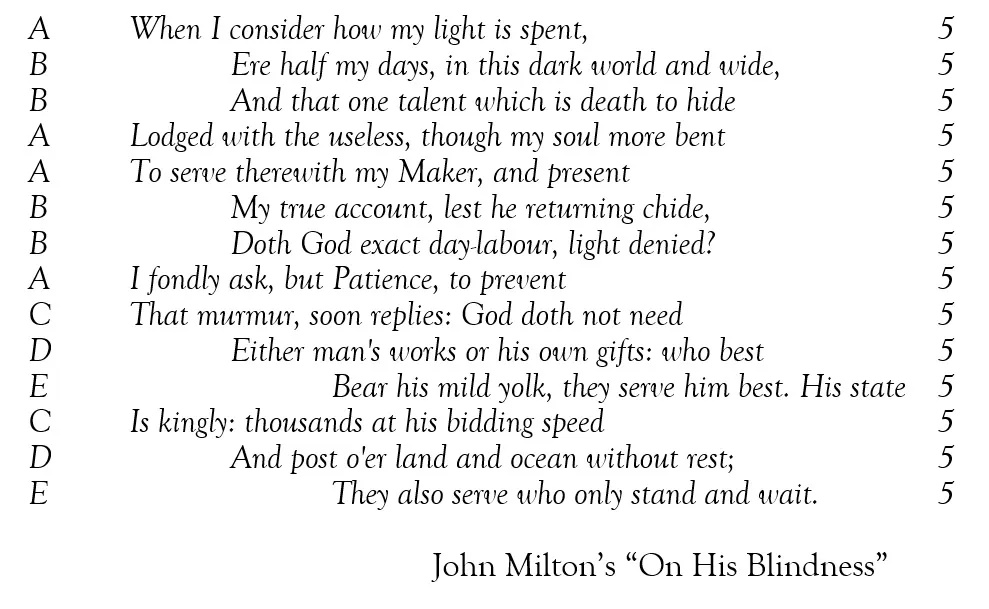
The Petrarchan Sonnet divides into an octet (two quatrains) and a sestet (two tercets). It poses a question or tension in the first eight lines, then “turns” (the volta) to answer it in the final six.
Milton’s usage here shows the intellect at work: the octet develops the despair of his blindness, while the sestet delivers the divine resolution: “They also serve who only stand and wait.”
The Shakespearean Sonnet changes the architecture. It uses three quatrains to deepen an argument, layer by layer, before snapping it shut with a final concluding couplet.
In Sonnet 29, the speaker laments his state in the first twelve lines—envying this man’s art and that man’s scope. But the final couplet reverses the entire gravity of the poem: the memory of love brings such wealth that he scorns to change his state with kings.
Whether through the soft persuasion of a lyric or the emphatic conclusion of a couplet, we build these rooms to house our ghosts, our loves, and our reasons. The tradition is not a cage; it is the blueprint that allows the structure to stand.
Joining Shen Yun in 2007, Angelia Wang (b. Xi'an, China) represents a benchmark in the…
"We're a team." It is a simple phrase, just three words, yet it holds more…
In the high-stakes theater of grand opera, survival requires a bifurcation of the self. For…
They say the second year of marriage is defined by cotton. It sounds simple, almost…
Two decades together is no small feat. It is a milestone that speaks to patience,…
poems The Merchant of Venice Student Edition---PDF and Complete TextThe water in Venice is never…
There is a specific kind of silence that settles in the garden after a loss.…
There is a specific kind of magic that happens when a photographer doesn't just capture…
In the ancient Italian town of Santarcangelo di Romagna, where history clings to the cobblestones…
The Princeton Club of New York, usually a bastion of quiet networking, recently became the…
A decade together is no small feat. It’s ten years of inside jokes, shared silences,…
In the vast and fragmented linguistic landscape of China, the spoken word has always been…
In an art world often preoccupied with jarring intellectualism or the pursuit of hyper-realistic technicality,…
For Joseph Scheier-Dolberg, the Oscar Tang and Agnes Hsu-Tang Associate Curator of Chinese Paintings at…
I still remember watching you when Grandma passed away. I saw how deeply you mourned,…
There is a distinct difference between seeing a moment with your eyes and seeing how…
Clothing has never been merely about protection against the cold. Across five millennia of human…
The first year of marriage is often a whirlwind of emotions. It is a period…
Ralph Waldo Emerson once observed that "Earth laughs in flowers," a poetic sentiment that reverberates…
There is a specific gravity to a poem carried in the pocket. It is different…
Mother’s Day is approaching, and if you are miles away from the woman who raised…
Winter has a way of changing the landscape of our lives, not just the view…
The allure of Japanese art often lies in its masterful negotiation between the void and…
There is a distinct fairy-tale quality to the work of Lison de Caunes, a resonance…
William Wordsworth (1770–1850) remains a titan of English letters, a figure whose life spanned the…
I was thinking today about how much ground we've covered together. You know, between two…
There is a paradoxical nature to porcelain. In its raw state, it is dense earth;…
The sonnet is not merely a form; it is a vessel for concentrated thought. To…
The intersection of heritage craftsmanship and avant-garde installation art often yields the most compelling dialogues…
I've been thinking a lot about the power of visibility lately, especially as we celebrate…