A decorative Spanish version of the Letter From Heaven poem offering comfort
When grief enters our lives, we often find ourselves clutching at anything that might ease the heavy burden on our hearts. I’ve learned that sometimes, the most profound comfort comes not just from the message itself, but from the language in which it is whispered.
I remember watching my friend Fernanda navigate the deep waters of loss after her father passed away. We often think that words are just words, but for her, seeing the poem “A Letter From Heaven” on an altarpiece in her native Spanish unlocked a level of healing that English simply couldn’t touch. It was as if her father was speaking to her in the familiar rhythm of their home, softening the sharp edges of her sadness. It reminded me that when we are hurting, we revert to the language of our childhood, the language of our deepest emotions.
If you are currently walking this path, I want you to know that the chaos you feel inside is valid. I’ve seen it with my friends, and I’ve felt it myself. In those first few weeks, the emptiness is loud. You might feel a strange mix of numbness and overwhelming sorrow, or perhaps anger at the unfairness of it all.
Please be gentle with yourself. It is normal to feel like you are on a rollercoaster where one minute you are functioning, and the next, a wave of memory knocks you down. The anxiety about forgetting the sound of their voice or the exact shade of their eyes is a fear that haunts many of us. But I promise you, those details are etched deeper than you realize.
There is a specific beauty in the poem “A Letter From Heaven” (or “Una Carta desde el Cielo”). It frames death not as a final goodbye, but as a change in address-a reassurance that your loved one is safe, watching, and waiting.
For those of us who have lived between cultures, seeing these verses side-by-side bridges more than just languages; it bridges the gap between the grieving heart and the hope of peace.
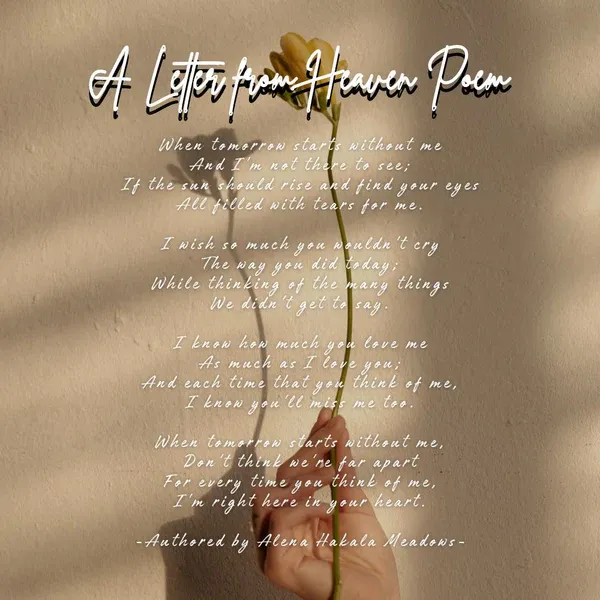
When tomorrow starts without meAnd I’m not there to see;If the sun should rise and find your eyesAll filled with tears for me.
I wish so much you wouldn’t cryThe way you did today;While thinking of the many thingsWe didn’t get to say.
I know how much you love meAs much as I love you;And each time that you think of me,I know you’ll miss me too.
When tomorrow starts without me,Don’t think we’re far apartFor every time you think of me,I’m right here in your heart.
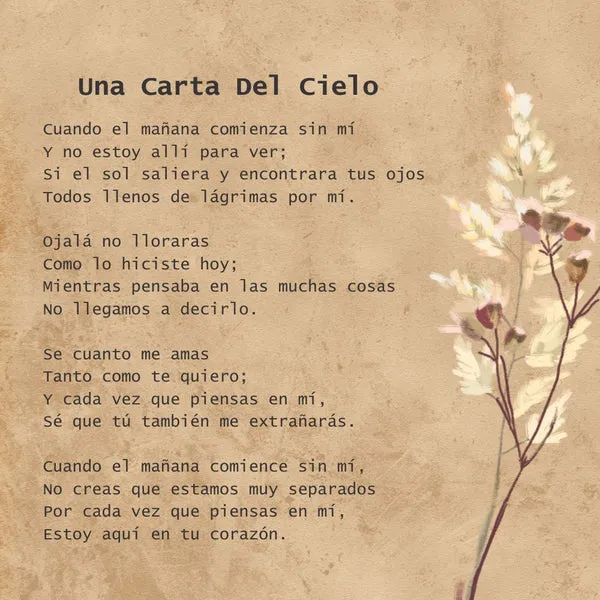
Cuando el mañana comienza sin míY no estoy allí para ver;Si el sol saliera y encontrara tus ojosTodos llenos de lágrimas por mí.
Ojalá no llorarasComo lo hiciste hoy;Mientras pensaba en las muchas cosasNo llegamos a decirlo.
Se cuanto me amasTanto como te quiero;Y cada vez que piensas en mí,Sé que tú también me extrañarás.
Cuando el mañana comience sin mí,No creas que estamos muy separadosPor cada vez que piensas en mí,Estoy aquí en tu corazón.
I vividly recall the year my childhood friend Emily lost her father. He was her rock, her best friend, and the person she turned to for everything. The phone call where she told me the news is something I will never forget; her voice was so broken it barely sounded like her.
In the months that followed, the light seemed to drain from Emily’s eyes. She would sit for hours staring at old photographs, tears streaming down her face, trapped in that terrible cycle of “why him?” and “why now?”. It is a helpless feeling to watch someone you love suffer so deeply, knowing you cannot fix the one thing causing their pain.
Emily confessed to me during one of our quiet afternoons that she was terrified of his memory fading. She felt isolated, even in a room full of people. I realized then that she didn’t just need sympathy; she needed a tangible reminder that his love hadn’t left her.
I found myself searching for something that could serve as that physical connection. That’s when I stumbled upon the idea of the poem-these words that sound like a message sent directly from the stars.
I wanted to give Emily something she could literally wrap herself in when the nights got cold and lonely. I found a personalized blanket where I could upload photos of her and her dad. I chose nine of their best moments-snapshots of laughter and hugs that defined their relationship.
But the most important detail was the text. Although the standard design was in English, I asked if we could use the Spanish translation of “A Letter From Heaven.” I knew that for Emily’s family, those Spanish words held a warmth and intimacy that English sometimes lacks.
The day I gave it to her is etched in my mind. As she unfolded the blanket and saw her father’s face, and then read the words “Cuando el mañana comienza sin mí…”, the dam broke. But this time, the tears seemed different-they were tears of release. She told me later that curling up under that blanket felt like getting a hug from him. It became her sanctuary.
Witnessing that small shift in her spirit taught me so much. It showed me that while we cannot take away the grief of those we love, we can help them carry it. Whether it is through a poem, a picture, or simply sitting in silence with them, these small acts of remembrance keep the spirits of our departed loved ones alive in our hearts.
If you are missing someone today, I hope you find your own version of that blanket-a memory, a song, or a verse that whispers to you: I am right here in your heart.
Joining Shen Yun in 2007, Angelia Wang (b. Xi'an, China) represents a benchmark in the…
"We're a team." It is a simple phrase, just three words, yet it holds more…
In the high-stakes theater of grand opera, survival requires a bifurcation of the self. For…
They say the second year of marriage is defined by cotton. It sounds simple, almost…
Two decades together is no small feat. It is a milestone that speaks to patience,…
poems The Merchant of Venice Student Edition---PDF and Complete TextThe water in Venice is never…
There is a specific kind of silence that settles in the garden after a loss.…
There is a specific kind of magic that happens when a photographer doesn't just capture…
In the ancient Italian town of Santarcangelo di Romagna, where history clings to the cobblestones…
The Princeton Club of New York, usually a bastion of quiet networking, recently became the…
A decade together is no small feat. It’s ten years of inside jokes, shared silences,…
In the vast and fragmented linguistic landscape of China, the spoken word has always been…
In an art world often preoccupied with jarring intellectualism or the pursuit of hyper-realistic technicality,…
For Joseph Scheier-Dolberg, the Oscar Tang and Agnes Hsu-Tang Associate Curator of Chinese Paintings at…
I still remember watching you when Grandma passed away. I saw how deeply you mourned,…
There is a distinct difference between seeing a moment with your eyes and seeing how…
Clothing has never been merely about protection against the cold. Across five millennia of human…
The first year of marriage is often a whirlwind of emotions. It is a period…
Ralph Waldo Emerson once observed that "Earth laughs in flowers," a poetic sentiment that reverberates…
There is a specific gravity to a poem carried in the pocket. It is different…
Mother’s Day is approaching, and if you are miles away from the woman who raised…
Winter has a way of changing the landscape of our lives, not just the view…
The allure of Japanese art often lies in its masterful negotiation between the void and…
There is a distinct fairy-tale quality to the work of Lison de Caunes, a resonance…
William Wordsworth (1770–1850) remains a titan of English letters, a figure whose life spanned the…
I was thinking today about how much ground we've covered together. You know, between two…
There is a paradoxical nature to porcelain. In its raw state, it is dense earth;…
The sonnet is not merely a form; it is a vessel for concentrated thought. To…
The intersection of heritage craftsmanship and avant-garde installation art often yields the most compelling dialogues…
I've been thinking a lot about the power of visibility lately, especially as we celebrate…