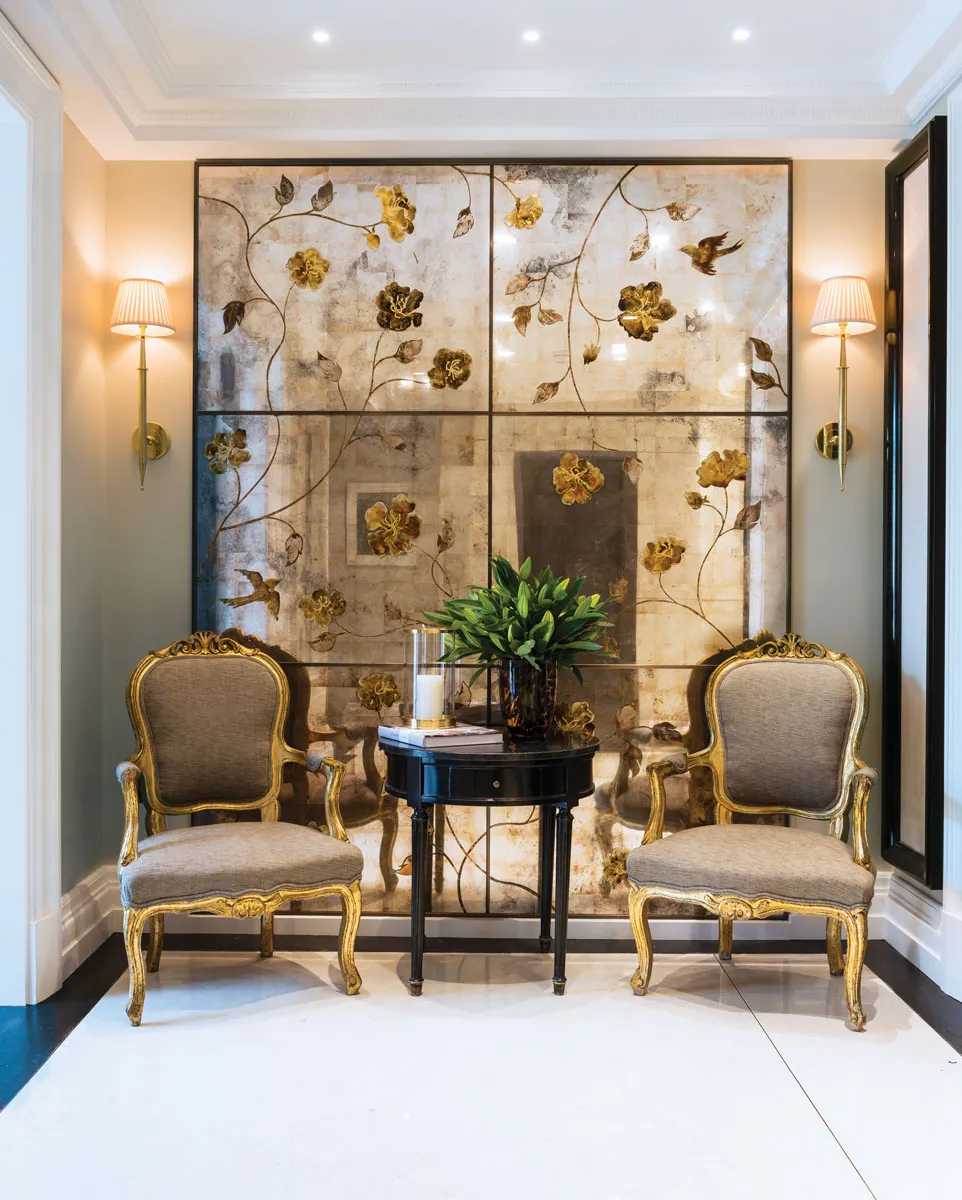
chinoiserie panel by Gorman Studios
In the quiet corners of Vancouver, far removed from the ephemeral trends of digital design, there exists a sanctuary where the decorative arts are not merely preserved but vigorously reinvented. Since 1983, Gorman Studios has operated less like a modern commercial firm and more like a Renaissance guild—a humble atelier where the hands of artisans breathe life into some of the world’s most opulent surfaces.
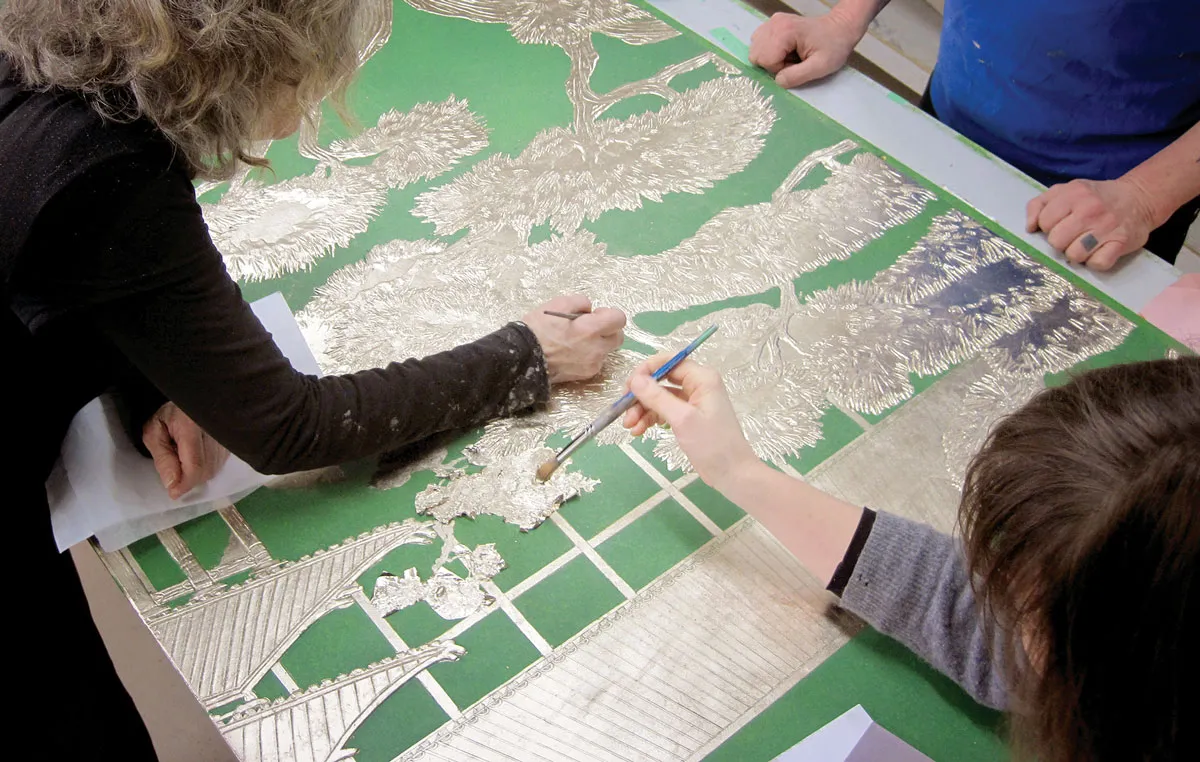
Under the direction of founder Peter Gorman, the studio has become a custodian of vanishing techniques, from the delicate intricacies of Chinoiserie to the luminous depths of reverse glass painting. It is a place where history is measured in layers of lacquer and palladium leaf.
The survival of high craftsmanship often hangs by a slender thread, passed from one master to a singular apprentice. By the mid-20th century, the great decorative lineages of Europe were fading, casualties of war and shifting industrial tastes. The revival of these arts in North America traces back to Isabella O’Neil in New York City during the 1950s, and subsequently to Gail Lawrence in San Francisco.
It is within this rare lineage that Peter Gorman stands. As the protégé of Gail Lawrence—widely considered the living authority on authentic Chinoiserie techniques—Gorman became the first decorative painter of his caliber in Vancouver in the early 1980s. This mentorship was not simply about learning to paint; it was an initiation into a philosophy of patience and precision. The studio operates on this guild model today, mentoring professional artists to expand the boundaries of what decorative art can achieve.
While rooted in tradition, Gorman Studios is defined by its willingness to transpose ancient techniques onto modern scales. The studio has become particularly renowned for its mastery of verre églomisé (reverse glass painting) and the application of Oriental lacquers.
The technical audacity required to execute these works is immense. One of the studio’s most significant breakthroughs involves the sheer scale of their glassworks. In a departure from the modest sizes of the past, Gorman and his team have successfully created single-piece glass panels measuring 11 feet high by 6 feet wide—a feat unmatched even by European ateliers.
This innovation allows for the creation of immersive environments, such as raised Chinese lacquer rooms where the walls themselves seem to possess a liquid depth. For a project in Jakarta, the studio produced massive panels that maintain a contemporary feel while utilizing proprietary techniques to ensure stability and luminosity.
The spiritual core of Gorman Studios lies in its dialogue with history. A pivotal moment for Peter Gorman occurred fourteen years ago at the Schönbrunn Palace in Vienna. While photographing Chinoiserie rooms for a client, he discovered that the palace curators were struggling to find European artisans capable of restoring the intricate works.
This realization—that the knowledge was fading from its continent of origin—sparked a renewed commitment to teaching. Gail Lawrence joined Gorman in his studio, not just to paint, but to transmit the “DNA” of the craft to a new generation.
For Gorman, the decorative arts are the visual legacy of civilization. He recalls a profound moment in the Apollo Ballroom of the Louvre in Paris, gazing at the painted ceilings and realizing that his work was part of a continuum stretching back centuries. In a poetic turn of fate, years later, a client would hand him a photograph of that very room, commissioning a space inspired by its grandeur.
The term “Chinoiserie” is often reductive, but in the hands of Gorman Studios, it reveals its true complexity. It is not merely an imitation of Chinese art but a distinct European decorative language with regional dialects. As Gail Lawrence identified, there are over 30 distinct styles—German, French, Italian, Portuguese, and even Mexican Chinoiserie—each influenced by local painters interpreting Eastern aesthetics through their own cultural lens.
Today, the studio’s work graces palaces in the United Arab Emirates, residences in Japan, and estates in Texas and California. It is a testament to the fact that while the specific styles may have become “lost arts” in some regions of Asia, the spirit of this craftsmanship remains alive. It survives not through stagnation, but through the vibrant, evolving practice of artists who understand that a wall is not just a barrier, but a canvas for history.
Joining Shen Yun in 2007, Angelia Wang (b. Xi'an, China) represents a benchmark in the…
"We're a team." It is a simple phrase, just three words, yet it holds more…
In the high-stakes theater of grand opera, survival requires a bifurcation of the self. For…
They say the second year of marriage is defined by cotton. It sounds simple, almost…
Two decades together is no small feat. It is a milestone that speaks to patience,…
poems The Merchant of Venice Student Edition---PDF and Complete TextThe water in Venice is never…
There is a specific kind of silence that settles in the garden after a loss.…
There is a specific kind of magic that happens when a photographer doesn't just capture…
In the ancient Italian town of Santarcangelo di Romagna, where history clings to the cobblestones…
The Princeton Club of New York, usually a bastion of quiet networking, recently became the…
A decade together is no small feat. It’s ten years of inside jokes, shared silences,…
In the vast and fragmented linguistic landscape of China, the spoken word has always been…
In an art world often preoccupied with jarring intellectualism or the pursuit of hyper-realistic technicality,…
For Joseph Scheier-Dolberg, the Oscar Tang and Agnes Hsu-Tang Associate Curator of Chinese Paintings at…
I still remember watching you when Grandma passed away. I saw how deeply you mourned,…
There is a distinct difference between seeing a moment with your eyes and seeing how…
Clothing has never been merely about protection against the cold. Across five millennia of human…
The first year of marriage is often a whirlwind of emotions. It is a period…
Ralph Waldo Emerson once observed that "Earth laughs in flowers," a poetic sentiment that reverberates…
There is a specific gravity to a poem carried in the pocket. It is different…
Mother’s Day is approaching, and if you are miles away from the woman who raised…
Winter has a way of changing the landscape of our lives, not just the view…
The allure of Japanese art often lies in its masterful negotiation between the void and…
There is a distinct fairy-tale quality to the work of Lison de Caunes, a resonance…
William Wordsworth (1770–1850) remains a titan of English letters, a figure whose life spanned the…
I was thinking today about how much ground we've covered together. You know, between two…
There is a paradoxical nature to porcelain. In its raw state, it is dense earth;…
The sonnet is not merely a form; it is a vessel for concentrated thought. To…
The intersection of heritage craftsmanship and avant-garde installation art often yields the most compelling dialogues…
I've been thinking a lot about the power of visibility lately, especially as we celebrate…