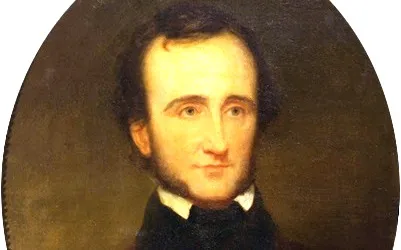
William Cullen Bryant
Hamlet referred to it as “the undiscovered country from whose bourne no traveler returns.” We simply call it the end. Yet, from the dust of ancient Egyptian scrolls to the ink of modern literary journals, the final curtain call remains the obsession of the pen. Poets have spent millennia trying to map that terrain, giving it names both tender and bitter.
Here is a curation of ten classical English poems that stare into the abyss without blinking.
Written by a mere seventeen-year-old, this meditation shaped American Romanticism for generations. Bryant does not ask us to fear the reaper. Instead, he instructs us to view the earth as a magnificent, shared sepulcher. There is a strange comfort in the decomposition he describes—a biological return to the elements where kings and beggars mix in the soil.
“All that tread / The globe are but a handful to the tribes / That slumber in its bosom.”
Ostensibly an elegy for a drowned classmate, Edward King, this pastoral ode is grief weaponized. Milton uses the occasion to launch a scathing attack on the corruption of the Anglican clergy and the commercialism of his fellow poets. It is a dense, multi-layered work where personal loss transforms into a critique of the state and the church.
“Fame is no plant that grows on mortal soil… / But lives and spreads aloft by those pure eyes / And perfect witness of all-judging Jove.”
If other poets view death as a sleep, Poe views it as a grotesque theater. In this piece, a weeping audience of angels watches a play titled “Man.” The plot consists of madness and sin, driven by invisible forces. The protagonist, however, is not human. It is a blood-red, writhing thing that consumes the actors, leaving the stage to silence.
“The play is the tragedy, ‘Man,’ / And its hero, the Conqueror Worm.”
Tennyson demanded that this poem conclude all future collections of his work. Written near the end of his own life, it replaces the terror of the unknown with the rhythm of the tide. The sandbar represents the boundary between the harbor of life and the boundless deep of eternity. He does not ask for mourning; he asks for a smooth passage to meet his Pilot.
“I hope to see my Pilot face to face / When I have crost the bar.”
A Jesuit priest watches a young child named Margaret weeping over the falling leaves of Goldengrove. With gentle melancholy, he reveals a hard truth: she is not crying for the forest. Her grief is a premonition of her own mortality, the “blight man was born for.”
“It is the blight man was born for, / It is Margaret you mourn for.”
This meditation on a rural graveyard challenges the hierarchy of memory. Gray wanders among the tombstones of plowmen and peasants, suggesting that potential is often murdered by poverty. Beneath the turf lie mute Miltons and guiltless Cromwells, proving that a lack of history does not equate to a lack of worth.
“The paths of glory lead but to the grave.”
Death arrives here not as a skeleton with a scythe, but as a polite gentleman suitor stopping his carriage. The journey is chillingly domestic. They pass the schoolyard and the setting sun, heading toward a house that is merely a swelling in the ground. The slant rhymes typical of Dickinson create a sense of unease, a rickety wheel on the road to eternity.
“Because I could not stop for Death – / He kindly stopped for me –”
Most poets promise their lovers immortality through verse. Shakespeare, in his most intimate sonnet, asks for the opposite: oblivion. He begs his beloved to let his name rot faster than his corpse. He fears the “wise world” will mock the mourner for loving a man such as him. It is a selfless plea—asking to be forgotten to protect the one left behind.
“Lest the wise world should look into your moan / And mock you with me after I am gone.”
Housman argues a provocative point: it is better to die at the peak of victory than to watch your record be broken. The crowd that cheered the runner through the marketplace now carries him shoulder-high to the grave. The silence of the coffin, Housman suggests, is no worse than the fading cheers of a fickle public.
“And silence sounds no worse than cheers / After earth has stopped the ears.”
A metaphysical smackdown. Donne strips Death of its arrogance, calling it a slave to fate, kings, and desperate men. He argues that opium can mimic the sleep of death just as well. The poem concludes with a famous paradox: death is merely a short intermission before eternal waking.
“One short sleep past, we wake eternally / And death shall be no more; Death, thou shalt die.”
Joining Shen Yun in 2007, Angelia Wang (b. Xi'an, China) represents a benchmark in the…
"We're a team." It is a simple phrase, just three words, yet it holds more…
In the high-stakes theater of grand opera, survival requires a bifurcation of the self. For…
They say the second year of marriage is defined by cotton. It sounds simple, almost…
Two decades together is no small feat. It is a milestone that speaks to patience,…
poems The Merchant of Venice Student Edition---PDF and Complete TextThe water in Venice is never…
There is a specific kind of silence that settles in the garden after a loss.…
There is a specific kind of magic that happens when a photographer doesn't just capture…
In the ancient Italian town of Santarcangelo di Romagna, where history clings to the cobblestones…
The Princeton Club of New York, usually a bastion of quiet networking, recently became the…
A decade together is no small feat. It’s ten years of inside jokes, shared silences,…
In the vast and fragmented linguistic landscape of China, the spoken word has always been…
In an art world often preoccupied with jarring intellectualism or the pursuit of hyper-realistic technicality,…
For Joseph Scheier-Dolberg, the Oscar Tang and Agnes Hsu-Tang Associate Curator of Chinese Paintings at…
I still remember watching you when Grandma passed away. I saw how deeply you mourned,…
There is a distinct difference between seeing a moment with your eyes and seeing how…
Clothing has never been merely about protection against the cold. Across five millennia of human…
The first year of marriage is often a whirlwind of emotions. It is a period…
Ralph Waldo Emerson once observed that "Earth laughs in flowers," a poetic sentiment that reverberates…
There is a specific gravity to a poem carried in the pocket. It is different…
Mother’s Day is approaching, and if you are miles away from the woman who raised…
Winter has a way of changing the landscape of our lives, not just the view…
The allure of Japanese art often lies in its masterful negotiation between the void and…
There is a distinct fairy-tale quality to the work of Lison de Caunes, a resonance…
William Wordsworth (1770–1850) remains a titan of English letters, a figure whose life spanned the…
I was thinking today about how much ground we've covered together. You know, between two…
There is a paradoxical nature to porcelain. In its raw state, it is dense earth;…
The sonnet is not merely a form; it is a vessel for concentrated thought. To…
The intersection of heritage craftsmanship and avant-garde installation art often yields the most compelling dialogues…
I've been thinking a lot about the power of visibility lately, especially as we celebrate…