Hamlet referred to it as “the undiscovered country from whose bourne no traveler returns.” We simply call it the end. Yet, from the dust of ancient Egyptian scrolls to the ink of modern literary journals, the final curtain call remains the obsession of the pen. Poets have spent millennia trying to map that terrain, giving it names both tender and bitter.
Here is a curation of ten classical English poems that stare into the abyss without blinking.
10. “Thanatopsis” by William Cullen Bryant
Written by a mere seventeen-year-old, this meditation shaped American Romanticism for generations. Bryant does not ask us to fear the reaper. Instead, he instructs us to view the earth as a magnificent, shared sepulcher. There is a strange comfort in the decomposition he describes—a biological return to the elements where kings and beggars mix in the soil.
William Cullen Bryant
“All that tread / The globe are but a handful to the tribes / That slumber in its bosom.”
9. “Lycidas” by John Milton
Ostensibly an elegy for a drowned classmate, Edward King, this pastoral ode is grief weaponized. Milton uses the occasion to launch a scathing attack on the corruption of the Anglican clergy and the commercialism of his fellow poets. It is a dense, multi-layered work where personal loss transforms into a critique of the state and the church.
John Milton
“Fame is no plant that grows on mortal soil… / But lives and spreads aloft by those pure eyes / And perfect witness of all-judging Jove.”
8. “The Conqueror Worm” by Edgar Allan Poe
If other poets view death as a sleep, Poe views it as a grotesque theater. In this piece, a weeping audience of angels watches a play titled “Man.” The plot consists of madness and sin, driven by invisible forces. The protagonist, however, is not human. It is a blood-red, writhing thing that consumes the actors, leaving the stage to silence.
Edgar Allan Poe by Samuel S Osgood
“The play is the tragedy, ‘Man,’ / And its hero, the Conqueror Worm.”
7. “Crossing the Bar” by Alfred, Lord Tennyson
Tennyson demanded that this poem conclude all future collections of his work. Written near the end of his own life, it replaces the terror of the unknown with the rhythm of the tide. The sandbar represents the boundary between the harbor of life and the boundless deep of eternity. He does not ask for mourning; he asks for a smooth passage to meet his Pilot.
“I hope to see my Pilot face to face / When I have crost the bar.”
6. “Spring and Fall: to a Young Girl” by Gerard Manley Hopkins
A Jesuit priest watches a young child named Margaret weeping over the falling leaves of Goldengrove. With gentle melancholy, he reveals a hard truth: she is not crying for the forest. Her grief is a premonition of her own mortality, the “blight man was born for.”
Gerard Manley Hopkins
“It is the blight man was born for, / It is Margaret you mourn for.”
5. “Elegy in a Country Churchyard” by Thomas Gray
This meditation on a rural graveyard challenges the hierarchy of memory. Gray wanders among the tombstones of plowmen and peasants, suggesting that potential is often murdered by poverty. Beneath the turf lie mute Miltons and guiltless Cromwells, proving that a lack of history does not equate to a lack of worth.
Portrait of Thomas Gray
“The paths of glory lead but to the grave.”
4. “Because I Could Not Stop for Death” by Emily Dickinson
Death arrives here not as a skeleton with a scythe, but as a polite gentleman suitor stopping his carriage. The journey is chillingly domestic. They pass the schoolyard and the setting sun, heading toward a house that is merely a swelling in the ground. The slant rhymes typical of Dickinson create a sense of unease, a rickety wheel on the road to eternity.
Emily Dickinson daguerreotype
“Because I could not stop for Death – / He kindly stopped for me –”
3. “No longer Mourn for Me” (Sonnet 71) by William Shakespeare
Most poets promise their lovers immortality through verse. Shakespeare, in his most intimate sonnet, asks for the opposite: oblivion. He begs his beloved to let his name rot faster than his corpse. He fears the “wise world” will mock the mourner for loving a man such as him. It is a selfless plea—asking to be forgotten to protect the one left behind.
Cobbe portrait of Shakespeare
“Lest the wise world should look into your moan / And mock you with me after I am gone.”
2. “To an Athlete Dying Young” by A. E. Housman
Housman argues a provocative point: it is better to die at the peak of victory than to watch your record be broken. The crowd that cheered the runner through the marketplace now carries him shoulder-high to the grave. The silence of the coffin, Housman suggests, is no worse than the fading cheers of a fickle public.
“And silence sounds no worse than cheers / After earth has stopped the ears.”
1. “Death Be Not Proud” by John Donne
A metaphysical smackdown. Donne strips Death of its arrogance, calling it a slave to fate, kings, and desperate men. He argues that opium can mimic the sleep of death just as well. The poem concludes with a famous paradox: death is merely a short intermission before eternal waking.
John Donne miniature
“One short sleep past, we wake eternally / And death shall be no more; Death, thou shalt die.”

 William Cullen Bryant
 John Milton
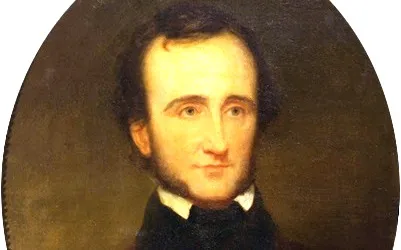 Edgar Allan Poe by Samuel S Osgood
 Gerard Manley Hopkins
 Portrait of Thomas Gray
 Emily Dickinson daguerreotype
 Cobbe portrait of Shakespeare
 John Donne miniature


