To speak of poetry for children is to speak of the last fortress of rhythm. In a literary landscape where meter has been chased out of “serious” writing, the nursery remains the one place where language still dances before it walks. We see this in the enduring genius of Julia Donaldson or the syncopated gait of Hairy Maclary; these authors understand that before a child comprehends meaning, they comprehend the pulse.
Yet, there is a barren path waiting. Once the nursery rhymes fade, young readers are too often steered toward artless prose and the cynicism of young adult fiction. We starve the ear to feed the plot. But if we look backward, to the era when prosody was a craft rather than an accident, we find a reservoir of “high art” that welcomes the smallest listeners. These works do not patronize; they enchant.
Here are seven selections that bridge the gap between the nursery and the library, proving that the best poetry for children is simply great poetry.
1. The Lullaby as High Art: Alfred Lord Tennyson
Tennyson possessed an ear tuned to the frequencies of the sea. While modern critics might scoff at his popularity or his politics, one cannot deny the physical sensation of his vowels. In “Sweet and Low,” originally tucked inside a satire, we find a lullaby that mimics the rocking of a cradle and the rolling of the tide.
Mural of Sweet and Low poem
It works not through complex intellect, but through the trochaic beat—a gentle, downward stroke of sound. The repetition here is not lazy; it is hypnotic, summoning the wind of the western sea to blow the father home.
Sweet and low, sweet and low, / Wind of the western sea…
2. The Forbidden Fruit: Christina Rossetti
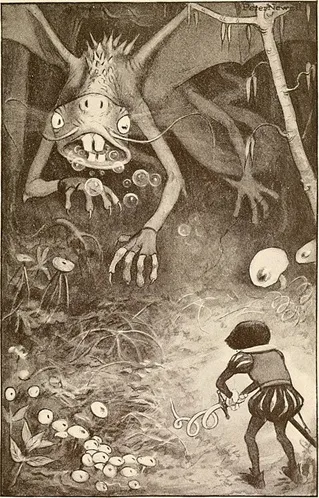
If Tennyson offers comfort, Rossetti offers the thrill of the forbidden. “Goblin Market” is a strange beast—part fairy tale, part Christian allegory, part fever dream. While scholars debate its subtext of addiction and redemption, children respond to the sheer, tactile excess of the goblin merchants.
Illustration from Goblin Market
Rossetti’s meter is loose, tripping over itself like a tumbling basket of fruit. The list of wares—citrons, dates, bullaces—creates a mouth-watering texture. It teaches the reader that words have flavors, some sweet to the tongue, others dangerous to the soul.
“Come buy our orchard fruits, / Come buy, come buy…”
3. The Joy of Nonsense: Edward Lear
Nonsense is too often dismissed as mere silliness. In the hands of Edward Lear, it becomes a liberation from the tyranny of logic. “The Owl and the Pussycat” does not subvert the world so much as it reinvents it.
Illustration of The Owl and the Pussycat
There is a specific, unearthly beauty in wrapping money in a five-pound note or dining with a “runcible” spoon—a word that appears in no dictionary yet feels perfectly solid in the hand. Lear reminds us that language is a toy, and the world is far more magical than the strict rules of physics would suggest.
They danced by the light of the moon, / The moon…
4. Texture Over Meaning: Lewis Carroll
Alice exclaimed that “Jabberwocky” filled her head with ideas, even if she didn’t know what they were. That is the poem’s genius. Carroll takes the Saxon roots of English and twists them into new shapes.
Alice looking at the Jabberwocky book
You do not need a definition for “slithy” or “gimble” to understand exactly how they move. The danger of the “vorpal sword” is felt in the sharp consonants. This poem teaches a vital lesson: meaning can be communicated through sound alone, bypassing the brain to strike directly at the nerves.
’Twas brillig, and the slithy toves / Did gyre and gimble in the wabe…
5. Painting in Monochrome: Walter de la Mare
Walter de la Mare understood that children possess a visionary imagination that calcifies as they age. In “Silver,” he strips away color to focus on light and shadow.
Ruins in Moonlight painting
There is no straining for effect here, no chaotic narrative. Just a quiet accumulation of “s” sounds and the recurring motif of silver coating the world—from the fruit to the thatch to the paws of a sleeping dog. It is a masterclass in atmosphere, turning a simple night scene into something reverent.
Slowly, silently, now the moon / Walks the night in her silver shoon…
6. The Delight of Disaster: Hilaire Belloc
Children have an innate, slightly wicked sense of justice. Hilaire Belloc taps into this with “Matilda,” a cautionary tale that satirizes the dour moralizing of the Victorian era while simultaneously indulging in it.
The structural discipline of the iambic tetrameter keeps the tone brisk and cheerful, even as the house burns down. It creates a comedic distance that allows us to laugh at the calamity. The rhyme scheme locks the inevitability of Matilda’s fate into place; she lied, so she must burn, and the rhythm marches her relentlessly toward that punchline.
Matilda told such Dreadful Lies, / It made one Gasp and Stretch one’s Eyes…
7. The Modernist at Play: T.S. Eliot
T.S. Eliot is rarely associated with the nursery, yet Old Possum’s Book of Practical Cats reveals a poet eager to prove that “versification” is not beneath dignity.
In “The Awefull Battle of The Pekes and The Pollicles,” Eliot abandons the fragmentation of The Waste Land for a rolling, thumping beat that demands to be read aloud. He captures the chaotic noise of a dogfight through the percussion of the language itself. It serves as a reminder that even the most intellectual of poets can, and perhaps should, occasionally return to the primal joy of a heavy rhyme.
The Pekes and the Pollicles, everyone knows, / Are proud and implacable passionate foes…

 Mural of Sweet and Low poem
 Illustration from Goblin Market
 Illustration of The Owl and the Pussycat
 Alice looking at the Jabberwocky book
 Ruins in Moonlight painting


