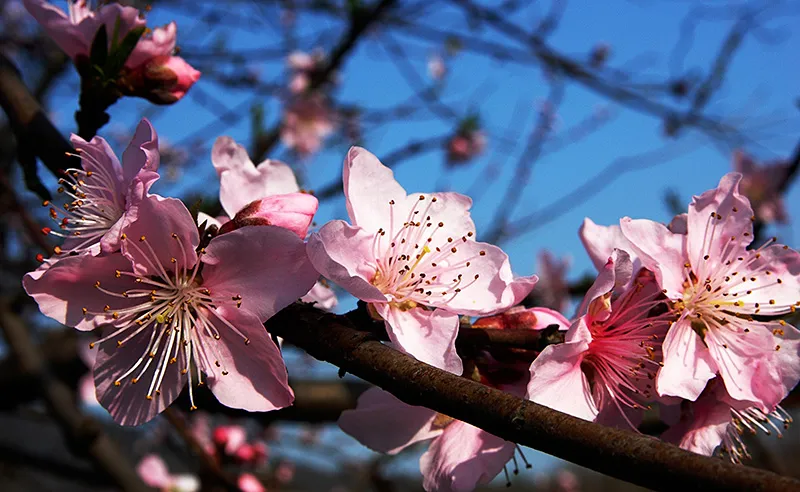
In the intricate calendar of ancient China, the blossoming of the peony coincides with the solar term known as the “Grain Rains” (Guyu). This period marks the heaviest rainfall of spring, a season characterized by rising heat and humidity-atmospheric conditions often associated in traditional medicine with internal pressure, anxiety, or stagnation. Yet, it is precisely within this humid intensity that the peony unfolds, offering a botanical counterpoint of serenity and grandeur.
The Imperial Muse
Revered as the “Queen of Flowers,” the peony holds a singular place in the visual history of the Tang Dynasty, an era widely regarded as the zenith of Chinese culture. Its lush, multi-layered petals became synonymous with the opulence and confidence of the empire.
The flower’s allure was such that Emperor Xuanzong, captivated by its presence in the royal gardens, summoned the legendary poet Li Bai to immortalize its beauty. Through Li Bai’s verses, the peony transcended its botanical nature to become a lasting cultural symbol of wealth, prosperity, and ephemeral beauty. However, beyond the courtly adoration, the flower carries a deeper philosophical significance rooted in resilience and the natural order.
The Defiance of the Winter Bloom
A profound legend regarding the peony centers on Empress Wu Zetian, the only female monarch in Chinese history. It is said that in a display of absolute power, she issued an imperial decree demanding that all flowers in the royal gardens bloom simultaneously in the dead of winter. Fearing her authority, every species forced open their buds-except one.
The peony refused to bloom against the season.
Enraged by this botanical insubordination, Empress Wu banished the peonies from the capital city of Chang’an to the city of Luoyang. Yet, upon being replanted in exile, the flowers bloomed with even greater magnificence. In a final act of fury, the Empress ordered the gardens to be burned. Even then, the following year, the peonies emerged from the scorched earth, their blossoms vibrant amidst the ashes. This narrative arc transforms the peony from a mere symbol of riches into an emblem of integrity and unyielding character.
A detailed view of the Tang Flower Scarf featuring the peony motif
Alignment with the Tao
The legend of the peony serves as a parable for the ancient concept of “living in the Tao.” This philosophy emphasizes harmony with Heaven and Earth, respecting the innate timing of the universe. True prosperity, the story suggests, cannot be coerced; it must follow the natural way.
Just as the peony blooms only when the “Grain Rains” arrive, not when an Empress commands, true fulfillment is found in aligning with the cosmic flow. The flower’s resilience-surviving banishment and fire-demonstrates that when one remains true to their essential nature, they possess a vitality that external forces cannot suppress.
Tang Flower Compact Mirror showcasing the intricate floral design
A Continuing Visual Lineage
The visual language of the Tang Dynasty continues to influence modern aesthetics. The peony motif, with its dense, overlapping petals and balanced geometry, remains a favored subject in contemporary design. Whether translated into the fluid medium of silk or the rigidity of precious metals, the flower retains its aura of “nourished beauty.”
Tang Flower Scarf Ring in Rose GoldTang Flower Scarf Ring in Gold
Objects such as silk scarves and finely crafted accessories serve as modern canvases for this ancient iconography. By adorning oneself with the peony, one does not merely wear a floral pattern, but carries a symbol of the “Grain Rains”-a reminder of the calm that persists through the pressure of the changing seasons.

 A detailed view of the Tang Flower Scarf featuring the peony motif
 Tang Flower Compact Mirror showcasing the intricate floral design
 Tang Flower Scarf Ring in Rose Gold
 Tang Flower Scarf Ring in Gold
 Tang Floral Silk Tie in Gold