In the realm of contemporary ceramics, there exists a delicate tension between the ephemeral nature of organic life and the permanence of fired earth. London-based Japanese artist Kaori Tatebayashi navigates this duality with a profound quietness, transmuting the fleeing beauty of botanical gardens into white, three-dimensional ghosts upon the wall. Represented by the Tristan Hoare gallery, Tatebayashi has spent decades exploring the paradoxical qualities of clay—a medium she favors for its inherent fragility during creation, yet its stone-like endurance once fired.
Her sculptures are not merely botanical studies; they are attempts to arrest time. By stripping the plant life of its color and rendering it in the stark, textural purity of ceramic, she invites the viewer to look past the surface vibrancy of a flower and focus instead on its structural architecture and the memory of its form. The resulting works transform indoor spaces, allowing the silence of a winter garden to inhabit the domestic wall.
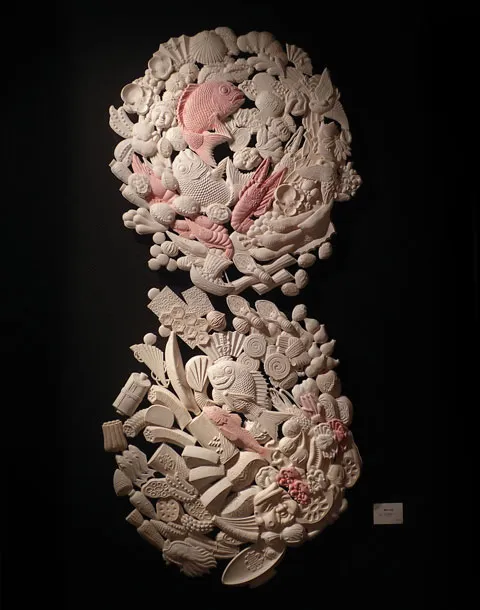
Kaori Tatebayashi's detailed white ceramic sculptures of plants installed on a wall, capturing the texture of nature
The Observation of Cycles
For Tatebayashi, the artistic process begins long before her hands touch the clay. It starts with a keen, almost scientific observation of the seasons. She does not seek to create a generic ideal of a flower, but rather to capture a specific moment in a plant’s life cycle—the precise curve of a wilting stem, the unfurling of a new leaf, or the brittleness of a dried seed pod.
“Nature fascinates me, and studying plants uplifts my spirit,” Tatebayashi reflects. “This challenges me like nothing else, making it a perpetually exciting endeavour.” Once a specimen is selected, it is brought into the studio, where the translation from organic matter to inorganic art begins. This phase is one of intense scrutiny, where the artist must internalize the minute details of the plant—its veins, its weight, its posture—to ensure that the clay reproduction retains the spirit of the living original.
The Alchemy of the Kiln Shelf
Tatebayashi’s technical approach is defined by an intimacy with her material that spans over thirty years. Eschewing complex machinery, she moulds her pieces primarily by hand, relying on touch and a simple, rudimentary tool she crafted decades ago. This direct contact imbues each petal and stem with a tactile sensibility that mass-produced molds cannot replicate.
The fragility of her un-fired work dictates a unique methodology. “I prefer to work directly on the kiln shelf so the delicate pieces can go into the kiln without being moved,” she explains. This technique reveals the precarious nature of her art; the sculptures are so fine that the mere act of transferring them could destroy them. Once formed, they are subjected to searing stoneware temperatures.
Kaori Tatebayashi seated in her studio, meticulously studying plant specimens for her ceramic work
The firing process creates a permanent fossil from the soft clay. Tatebayashi allows the pieces to cool naturally, a slow conclusion to a process of intense heat and transformation. What emerges from the kiln is no longer a fragile imitation of a plant, but a resilient object of memory—a preservation of nature that defies the decay of time.

 Kaori Tatebayashi's detailed white ceramic sculptures of plants installed on a wall, capturing the texture of nature
 Kaori Tatebayashi seated in her studio, meticulously studying plant specimens for her ceramic work