“No people are within sight in the empty mountains;
Only the echoes of voices can be heard.
Evening sunlight reenters the deep forest
And shines again upon the green moss.”
— Wang Wei, The Deer Fence
There is a distinct acoustic quality to the silence found in the poetry of Wang Wei, the revered Tang Dynasty master. It is not merely the absence of noise, but a profound stillness where nature speaks in echoes and light. This specific frequency of silence finds a contemporary visual counterpart in the works of Taiwanese painter Yang Yi Syuan. Standing before his canvases, one does not merely look at a landscape; one listens to the quietude of the deep forest.
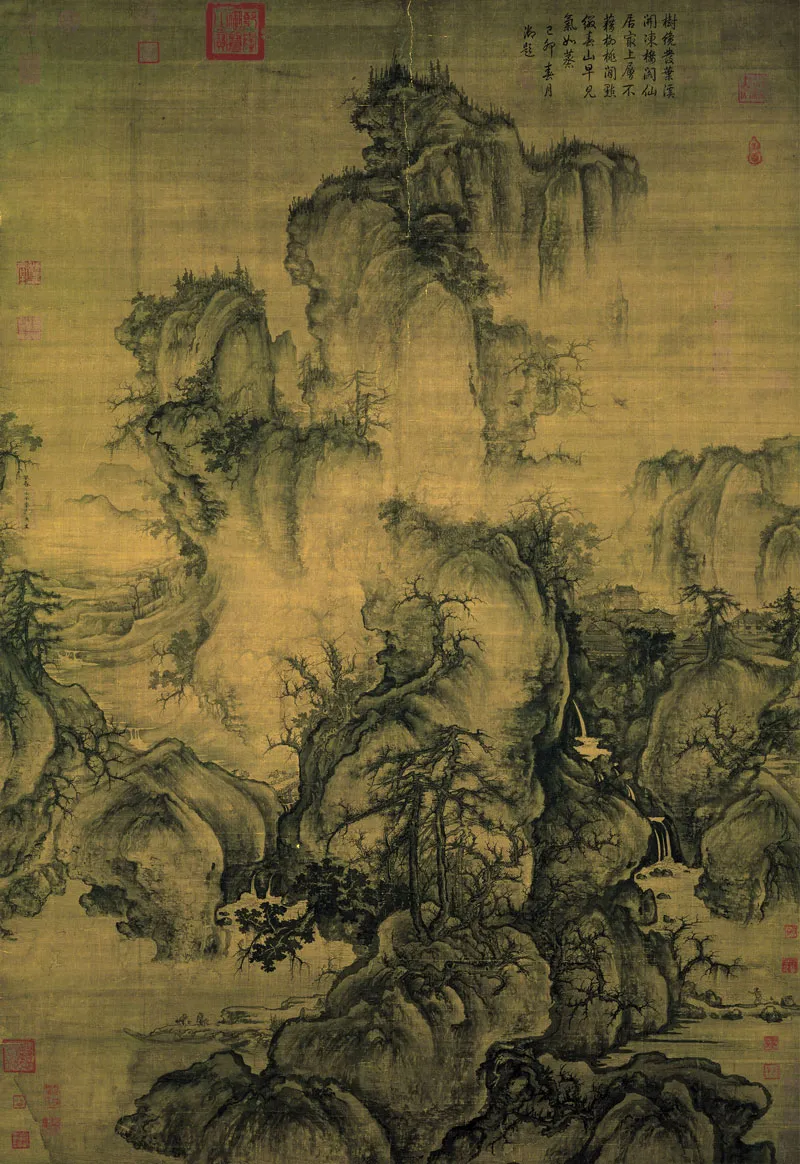
Yang’s oeuvre is a sophisticated dialogue between two seemingly distinct artistic lineages. On the surface, he employs the medium of Western oil painting, utilizing its viscosity and texture to build physical depth. However, the soul of the composition belongs entirely to the East, specifically echoing the monumental landscape traditions of the Northern Song Dynasty. It is a fusion where the realistic density of oil paint reconstructs the ethereal spirit of traditional ink wash.
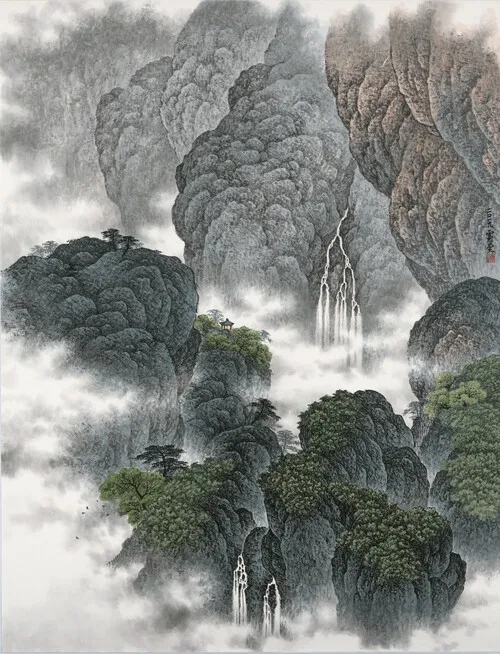
Yang’s oil painting Ascending the Mountain portrays a majestic and vast mountain with a delicate and ethereal pathway leading to its summit.
In Ascending the Mountain, Yang presents a topography that is both physical and metaphorical. The composition is dominated by the sheer weight of the mountain, vast and imposing, yet the eye is drawn to a delicate, almost ethereal pathway winding toward the summit. This is not a snapshot of a specific geographic location, but a landscape of the mind.
The artist uses this imagery to materialize the concept of the human journey. The twisting path suggests the nonlinear nature of life—the arduous climbs, the pauses for breath, and the persistent movement toward an unseen peak. Every stroke carries the weight of memory; the canvas becomes a repository for the artist’s own history of joy and pain, rendered into rock and foliage.
The decision to work primarily in monochrome is a deliberate philosophical choice. By stripping away the distraction of color, Yang forces the viewer to confront the fundamental relationship between form and void, presence and absence. In this grayscale world, the passage of time seems to arrest, offering a temporary escape from the chaotic saturation of modern life. It creates a “moment of Zen,” a sanctuary where the mind can settle into the rhythm of the brushwork.
Yang’s oil painting Sound of the Mountains combines the realistic techniques of Western oil painting with the scattered perspective of Chinese painting.
This immersion is palpable in Sound of the Mountains. Here, Yang applies the “scattered perspective” typical of classical Chinese painting—a technique that rejects a single vanishing point in favor of a mobile, roaming viewpoint—to a Western medium. The result is a forest that feels all-encompassing.
The intricate portrayal of the trees and the layering of textures evoke an auditory sensation; one can almost hear the low, majestic rumble of the mountain range or the wind passing through the dense canopy. It requires immense patience and devotion to achieve such delicate details with oil paint, a medium often associated with bolder, broader strokes. In Yang Yi Syuan’s hands, the paint becomes as fluid as ink, and the landscape becomes a mirror for the internal self—silent, vast, and timeless.

 Yang’s oil painting Ascending the Mountain portrays a majestic and vast mountain with a delicate and ethereal pathway leading to its summit.
 Yang’s oil painting Sound of the Mountains combines the realistic techniques of Western oil painting with the scattered perspective of Chinese painting.