While the traditional painter relies on pigment and bristle to capture the world, Taiwanese artist Joyce Lin commands a more volatile medium: the kiln’s blaze. Represented by Eastern Aesthete, Lin operates not merely as a ceramicist but as a modern-day alchemist. Her canvas is the treacherous environment of the furnace, and her subject is the delicate, ephemeral leaf, which she immortalizes through the revived, centuries-old tradition of Konoha Tenmoku ware.
A detailed ceramic plate featuring a leaf motif that resembles a dancer, showcasing golden veins against a dark background
In her work Ethereal Dance, Lin orchestrates a visual transmutation where a simple leaf assumes the grace of a ballerina. The natural architecture of the foliage—its veins and organic patterns—provides the structural detail for this phantom dancer. It is a dialogue between nature and heat, where the fragility of the material is not destroyed by fire but rather fossilized into something permanent and radiant.
The Celestial Accident of Jizhou
The origins of this technique are rooted in a serendipitous moment over a millennium ago in the Jizhou district of China’s Jiangxi province. Legend dictates that during the Song Dynasty, a leaf drifted down onto a Tenmoku bowl awaiting the kiln. Under the intense heat, the leaf did not turn to ash in the traditional sense; instead, its organic matter vaporized, leaving behind a skeletal imprint of golden veins against the obsidian black glaze.
The result was visually likened to stars shimmering in a night sky, a poetic aesthetic that quickly garnered the favor of imperial families and scholars. However, this golden era was abruptly severed. The turmoil of the 13th century, driven by the campaigns of Genghis Khan and the subsequent social unrest, pushed Konoha Tenmoku to the brink of extinction. For seven centuries, the craft vanished, leaving no written records of its complex methodology. It was only in the 1980s that diligent potters in the craft’s birthplace began the arduous process of rediscovering the lost formula.
A close-up of a ceramic bowl interior showing a golden leaf imprint on a dark, glossy glaze
Lin’s piece Devotion serves as an ode to this history and the concept of fleeting beauty. Her fascination with Konoha Tenmoku lies in its paradoxical nature: the ability to capture the extreme fragility of a leaf using the destructive power of fire. Her journey to master this technique was a decades-long quest, requiring her to apprentice under master craftsmen and navigate a history defined by silence.
The Architecture of Heat
The production of Tenmoku tea bowls is notoriously unforgiving. The “firing” process alone involves hundreds of meticulous steps, layering complexity upon the already intricate discipline of pottery. The central challenge lies in the thermal dynamics; the artisan must ensure that the leaf, composed of delicate organic matter, remains visually intact despite temperatures high enough to melt stone.
Success depends on a precise constellation of variables. Moisture content, ambient temperature, the timing of log loading, and the specific atmospheric conditions within the kiln must all align perfectly. A slight deviation in any metric results in the leaf burning away completely or the glaze failing to crystallize.
A ceramic artwork depicting a dragonfly poised near a leaf, rendered in warm, earthy tones
In Perpetual Dance, Lin captures a dragonfly preparing to take flight from an autumn leaf, freezing a micro-moment of nature in perpetual stasis. This piece is the result of unyielding patience and countless experiments. Because the primary tool is fire, the process retains an element of unpredictability.
Joyce Lin emphasizes that the intrinsic value of her work lies in its singularity. “Each of my creations is unique because of the distinctiveness of every leaf,” she observes. “Replicating a piece becomes nearly impossible, and that quality makes the work even more special.” In a world of mass production, Lin’s ceramics stand as a testament to the specific, the singular, and the enduring power of nature passed through fire.

 A detailed ceramic plate featuring a leaf motif that resembles a dancer, showcasing golden veins against a dark background
 A close-up of a ceramic bowl interior showing a golden leaf imprint on a dark, glossy glaze
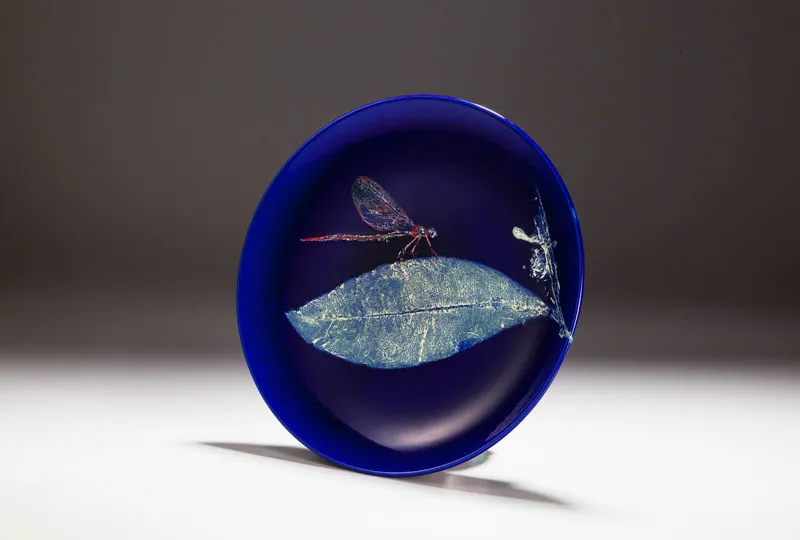 A ceramic artwork depicting a dragonfly poised near a leaf, rendered in warm, earthy tones


