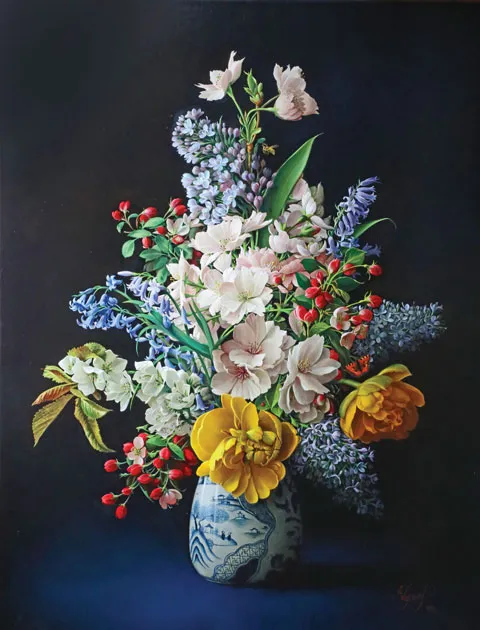
Ralph Waldo Emerson once observed that “Earth laughs in flowers,” a poetic sentiment that reverberates through the history of art and human experience. Flowers, in their fragile and fleeting existence, have long served as nature’s most captivating messengers, infusing vitality into the spaces they inhabit and commanding awe with their vivid hues. Yet, their beauty is inherently transient—a momentary laugh before the silence of wilting.
The artistic desire to capture this ephemeral laughter has spanned centuries and civilizations. From the calculated obsession of the 17th-century Dutch tulip mania, where blossoms were currency, to the immersive, impressionistic hazes of Claude Monet’s Water Lilies, the floral motif remains a perennial anchor in art history. Contemporary creators continue this lineage, seeking not just to replicate the appearance of flora, but to immortalize its essence through mediums that defy the organic decay of nature.
The Alchemist of Light and Gold
Among the modern maestros interpreting this timeless subject is Chiemi Watanabe, an artist whose work transcends the traditional boundaries of sculpture. Watanabe does not merely shape forms; she orchestrates a delicate dialogue between two distinct materials: the cool, transparent clarity of glass and the warm, lustrous opacity of gold.
Represented by the distinguished UK-based gallery Adrian Sassoon, Watanabe’s practice is a study in material alchemy. Her sculptures are intricate, possessing a rich detailing that suggests a biological complexity frozen in time. The artist explores the demarcation between the tangible world of objects and the ephemeral quality of light, creating works that seem to float in a space between reality and memory.
A Fusion of Tradition and Transparency
What distinguishes Watanabe’s work is a specialized process she has developed and perfected—a technique that bridges the gap between modern glass artistry and ancient craftsmanship. She employs a unique inlay method inspired by centuries-old lacquer traditions. In the world of lacquerware, techniques like chinkin (gold-inlay) are used to highlight designs on dark surfaces; Watanabe adapts this philosophy to the unforgiving medium of glass.
Life Stream III by Chiemi Watanabe, featuring gold inlay within glass
In works such as Life Stream III, the result is a mesmerizing interplay of textures. The glass provides a vessel for light, allowing it to pass through and refract, while the gold inlay catches that light, grounding the ethereal form with a sense of precious weight. This technique allows the sculpture to glow from within, much like a living organism illuminated by the sun.
Through this exquisite synthesis, Watanabe transports the viewer to an irresistible world. Here, the fleeting beauty of flora is not merely preserved; it is elevated into a permanent state of grace, an eternal laughter captured in silica and gold.

 Life Stream III by Chiemi Watanabe, featuring gold inlay within glass