Five centuries ago, Michelangelo Buonarroti dedicated his final breaths to the Pietà Rondanini. Unlike the polished perfection of his earlier David, this last work remains rough, raw, and unresolved. In the marble’s unfinished surface, the maestro captured something perhaps more profound than perfection: the eternal struggle of the visionary artist to pull spirit from matter.
It is this specific union—between the rough essence of stone and the polishing hand of the human—that serves as the spiritual anchor for the Michelangelo Foundation for Creativity and Craftsmanship. Based in Geneva, this non-profit organization, founded by Johann Rupert and Dr. Franco Cologni, is not merely a patron of the arts; it is a defensive line against the erosion of human touch in an increasingly automated world.
The Measure of Man
We live in an era where value is often calculated by speed and disposability. Johann Rupert, chairman of the luxury group Richemont, observes a troubling shift in the global psyche. “We put so much value on personality, on entertainment, and on what is explicitly made to not last,” Rupert notes. “It seems healthy to me that we question why we value these things.”
The Foundation proposes a return to the core tenant of the first Renaissance: the Greek philosophical notion that “Man is the measure of all things.” This is not an act of nostalgia, but of preservation. They term this movement “Artisan Humanism”—a belief that our distinct humanity is most active and visible when we are creating.
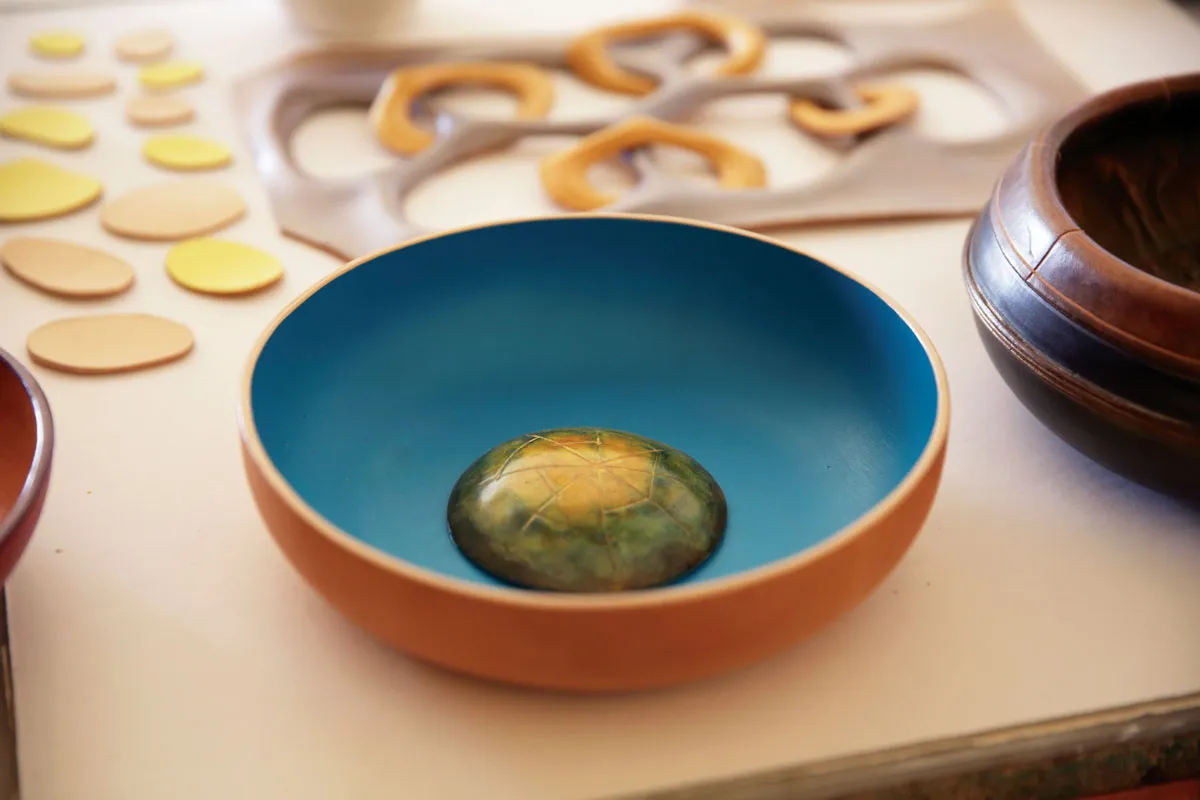
José Luis Bazan is a master leatherworker living in a remote village in Spain.Close up of one of Bazan’s leather bowls.
In the face of unbridled technological growth—where drones, algorithms, and machines threaten to render human labor obsolete—the artisan stands as a defiant figure. They are the keepers of “inherently valuable things,” focusing on depth over breadth, and permanence over the ephemeral. As Rupert asserts, “We have to bring human beings back to center stage.”
The Intelligence of the Hand
A quiet crisis haunts modern design schools: they are filled with brilliant minds that have forgotten the intelligence of the hand. The industrial revolution, followed by the information age, has created a schism between conception and execution. We laud the head but neglect the fingers.
“Craftsmanship provides a counterbalance to these trends,” Rupert explains. “It highlights and represents what humans can do that machines cannot. It also connects us to the natural world and reminds us that ultimately the source of beauty is distinctly human.”
Kostia (Constantin Laan), a furniture-maker, works with wood, bronze and lacquer in his workshop.
This disconnection is more than an economic issue; it is a spiritual one. When technology strips away the necessity of craft, it removes a sense of purpose. Talent, the Foundation argues, is like a muscle—an innate gift that must be exercised or lost. The artisans championed here are described as “living treasures,” individuals who have aligned their destiny with the pursuit of perfection.
Guardians of the Rare
To understand the scope of this mission, one must look at the individuals keeping these flames alive. They are scattered across Europe, often in remote villages or quiet ateliers, practicing métiers d’art that balance on the edge of extinction.
Take José Luis Bazan, a master leatherworker in Spain, whose connection to his territory is as vital as his tools. Or Kostia (Constantin Laan), whose furniture bridges the gap between sculpture and function using wood, bronze, and lacquer. These are not merely manufacturers; they are what Rupert calls “the world’s heroes.”
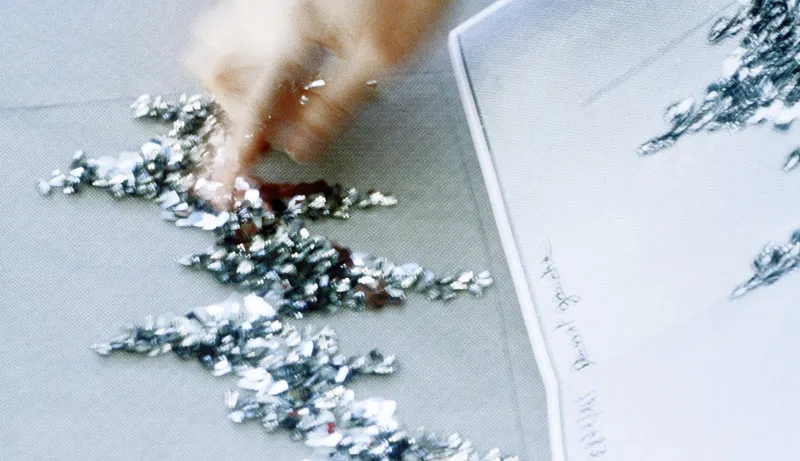
Haute couture embroidery from the workshop of Pino Grasso.
In Milan, the atelier of Pino Grasso transforms haute couture embroidery into a discipline of delicate precision. Meanwhile, Elena dal Cortivo dedicates herself to the incredibly rare skill of sculpting parchment rosettes for baroque instruments—a task requiring a silence and focus that the modern world rarely affords.
A New Cultural Ecosystem
The ambition of the Michelangelo Foundation extends beyond recognition; it aims to build a sustainable ecosystem. By digitally connecting virtuosos and facilitating real-world apprenticeships, they hope to ensure that generational secrets are not buried with their masters. The goal is to cultivate a constant dialogue between the worlds of design and craftsmanship.
“We are living in a critical moment of systemic change,” Rupert observes. The structures that have carried society for centuries are dissolving. In this void, the responsibility falls on the present generation to build for the future.
“This is what differentiates human beings from other creatures,” he concludes. “Our ability to look into the future and to contribute to it.” Through the lens of artisan humanism, that future looks less like a factory, and more like a workshop—where the heart, the soul, and the hand work in unison.
Elena dal Cortivo in her atelier in Milan with a hand-sculpted parchment rosette.

 José Luis Bazan is a master leatherworker living in a remote village in Spain.
 Close up of one of Bazan’s leather bowls.
 Kostia (Constantin Laan), a furniture-maker, works with wood, bronze and lacquer in his workshop.
 Haute couture embroidery from the workshop of Pino Grasso.
 Elena dal Cortivo in her atelier in Milan with a hand-sculpted parchment rosette.