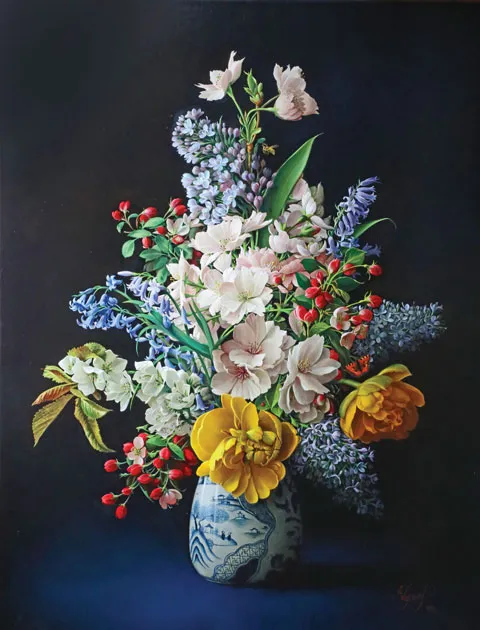
In an era saturated by the immediacy of high-definition photography, the relevance of hyper-realistic painting is often called into question. When a device in one’s pocket can capture light and shadow with algorithmic precision, what is the role of the oil painter? For Chinese realist artist Zhang Liang, the answer lies not in the replication of reality, but in the infusion of weight, depth, and spirit—dimensions that the camera lens often fails to perceive.
Zhang draws a parallel to calligraphy to articulate this distinction. While computer typography has achieved technical perfection, it can never replicate the transcendent sentiment of Lanting Xu (Preface to the Poems Collected from the Orchid Pavilion) by the 4th-century sage Wang Xizhi. The machine offers precision; the hand offers qi (energy).
“At any time, solid basic skills and traditional aesthetic principles fundamentally determine the depth and weight of the creation,” Zhang observes. While modernism frequently prioritizes concept over craft, Zhang argues that the material discipline is the vessel through which the spirit speaks.
Zhang Liang stands in front of some of his works
The Convergence of Form and Void
It is a telling paradox that in the digital age, students of animation and film—mediums of the future—often return to the studio to study classical composition. The industry recognizes that while tools change, the architecture of beauty remains constant. Zhang notes that while the Western fine art world has, in places, discarded traditional perspectives, the cinematic arts have quietly preserved them.
Zhang’s practice is not merely an act of preservation, but one of synthesis. He operates at the intersection of two profound artistic lineages: the rigorous structural realism of the West and the symbolic, internal focus of classical Chinese art.
In the Western tradition, the gaze is often directed outward, obsessing over light, anatomy, and form. In the East, particularly in freehand brushwork, the gaze turns inward, prioritizing symbolism and the “spirit resonance.” Zhang attempts to bridge these worlds. He renders objects with the tactile fidelity of a Western master, yet imbues them with the philosophical silence of the East.
“When you represent the realist expression of Western oil painting in subtle space and then use freehand brushwork to convey wisdom of Oriental culture, it is a new thing,” he explains.
Comparison between Michelangelo Merisi da Caravaggio’s Basket of Fruit and Li Song’s A Basket of Flowers
A Prodigious Lineage
Zhang’s journey into the meticulous world of realism began with an act of discovery. At age twelve, during a recruitment session by art teacher Liang Wenxue, Zhang sat face-to-face with a peer, tasked with a portrait. The teacher, observing the boy’s intuitive grasp of structure, recruited him on the spot. His progress was so rapid that it invited skepticism; in one early competition, judges disqualified him, refusing to believe a twelve-year-old could possess such technical maturity without interference.
This foundation allowed Zhang to later absorb the influence of Leng Jun, widely considered one of the most significant contemporary realist painters in China. Zhang admires Leng not just for his photorealistic capability, but for the “human spirit” that permeates the paint. In Leng’s work, detail never descends into tedium; it remains loose, breathing, and alive.
Following this path, Zhang uses the vocabulary of realism to articulate the grammar of Confucianism, Buddhism, and Taoism. His still lifes are exercises in balancing yin and yang—harmonizing the tangible texture of an object with the invisible atmosphere that surrounds it.
Zhang Liang’s oil painting Things Go the Way You Want
The Semiotics of Still Life
The painting Peaches offers a window into Zhang’s dualistic approach. The composition is deceptively simple: five peaches resting on a swath of denim. Yet, the arrangement forms a triangle—a shape of stability that, in this context, hints at underlying tension.
For Zhang, the work is an autobiographical reflection on the immigrant experience in North America. The symbolism is linguistic and cultural; in Chinese, the word for “peach” shares a homophone with “prosperity” and “escape.”
“I think anyone who comes to an unfamiliar country will have a sense of insecurity,” Zhang reflects. The denim—a fabric of labor and modernity—contrasts with the soft, organic vulnerability of the fruit. The painting navigates the space between the desire for success (prosperity) and the wisdom of withdrawal (escape). “Success in life is a kind of power, but knowing how to take a step back is also a sign of wisdom.”
Zhang Liang working on a painting in his studio
The Gaze that Preserves
There is a metaphysical dimension to Zhang’s realism that borders on the mystical. He recounts a phenomenon that occurred during the creation of a piece involving peaches. He selected two from a group of four to paint, leaving the others in reserve. Addressing the fruit with a sense of reverence, he told them, “Don’t go bad. I’m painting you.”
Six weeks later, upon retrieving the reserve fruit, he found the unpainted peaches had rotted. The two he had spent weeks studying and rendering, however, remained fresh, their colors vibrant.
Zhang interprets this not as magic, but as the power of appreciation. “When you really appreciate an object from deep inside, it will really bloom for you,” he says. “And the abandoned will quickly wither.”
This philosophy extends beyond the canvas. It suggests that the artist’s gaze is a form of energy—a way of honoring the life within matter. Whether painting longans or persimmons, Zhang treats his subjects with an unbiased reverence, seeing the “glowing qualities” in all life forms.
Zhang Liang’s oil painting The Fresh Breeze Plucks Longans
Through the slow, meditative process of oil painting, Zhang Liang achieves a state of being that photography cannot easily access. It is a practice of patience and attunement, a way of navigating the currents of fortune and misfortune with a tranquil heart. As he notes, the goal is to remain natural, “whether clouds flow high or low.”

 Zhang Liang stands in front of some of his works
 Comparison between Michelangelo Merisi da Caravaggio’s Basket of Fruit and Li Song’s A Basket of Flowers
 Zhang Liang’s oil painting Things Go the Way You Want
 Zhang Liang working on a painting in his studio
 Zhang Liang’s oil painting The Fresh Breeze Plucks Longans