To classify Lee Chen-Lin merely as a textile artist is to overlook the architectural weight of her medium. While the designation acknowledges her material of choice, it fails to capture the temporal duality she weaves into every square inch of her work. Lee acts not just as a weaver, but as a modern interpreter of an ancient logic, standing at the intersection where the warmth of hand-spun heritage meets the stark precision of contemporary design.
Her practice is a rebellion against the ephemeral. Having trained in fashion design, Lee found herself disillusioned by the industry’s acceleration—a world of fast fashion built on inferior materials and fleeting trends. It was in the tactile resistance of hand-woven textiles that she found her anchor. “You can feel the weight and warmth of a piece of hand-woven textile when you grasp it in your hands,” Lee observes. This sensory gravity became the foundation of her departure from commercial design, pushing her toward a slower, more deliberate exploration of structure and fiber.
Stars, Lee’s textile artwork from the Second Mountain series.
The Binary of History
Lee’s transition from fashion to fine art was marked by a deep dive into the mechanics of the loom, specifically the Jacquard technique. There is a profound irony and beauty in her choice of tool. The Jacquard loom, with its complex system of punch cards controlling individual warp threads, is widely considered the ancestor of modern computing. It is a device where history and mathematics converge.
By adopting this method, Lee engages with a lineage that stretches back to the intricate silk brocades of China’s Han Dynasty and the coveted velvets of the Ming and Qing eras. However, she does not seek to replicate these historical artifacts. Instead, she utilizes the loom’s “programming”—the binary logic of raised and lowered threads—to construct narratives that resonate with the modern psyche.
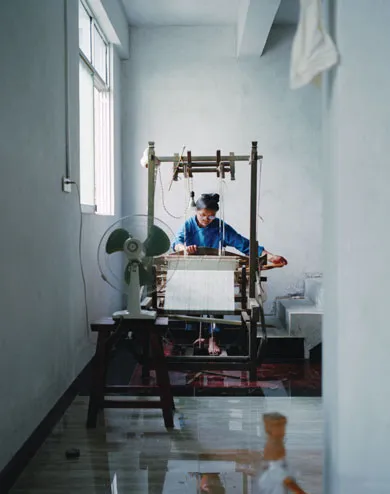
Lee uses a hand-operated Jacquard loom. Each artwork is woven from tens of thousands of warp and weft threads.
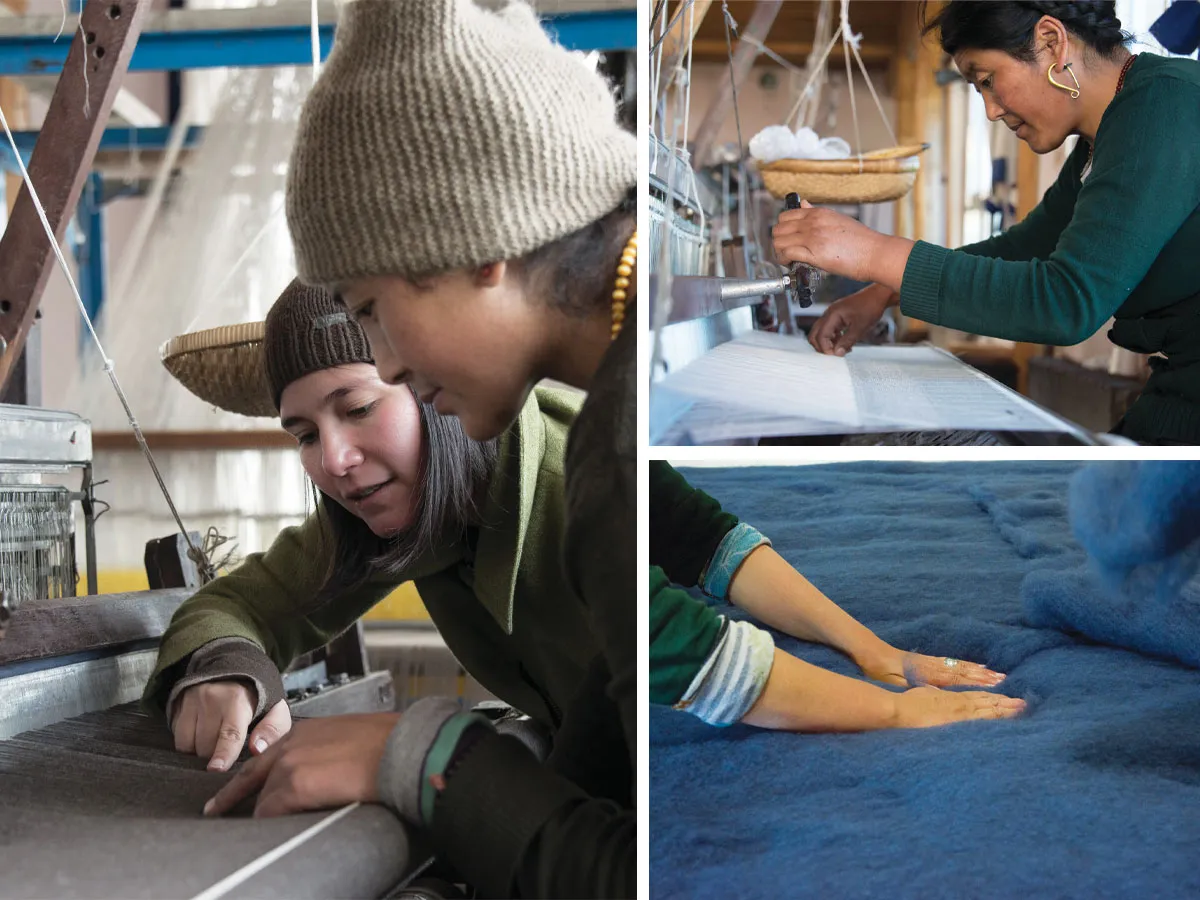
The process is an exercise in extraordinary patience. While the mechanism allows for complex pattern generation, Lee executes her work almost entirely by hand. The setup alone involves the precise placement of tens of thousands of threads, a tedious prelude to the arduous act of shuttle weaving. In this repetitive motion, the loom transforms from a machine into an instrument of meditation, demanding a rhythm that allows no room for haste.
Landscapes of the Mind
The visual language of Lee’s tapestries is heavily informed by the spatial philosophy of Eastern gardens. A pilgrimage to the classical gardens of Suzhou, China, provided the initial spark. Lee was captivated by how these spaces condensed vast, rolling landscapes into contained, harmonious environments. She sought to translate this concept of “borrowed scenery” into the two-dimensional plane of the tapestry, turning fabric into a window overlooking an imagined world.
This exploration deepened after Lee visited the Zen gardens of Japan. There, she observed how monks used rakes to etch repetitive patterns into gravel—simulating clouds or rippling water, with stones placed deliberately to represent mountains or islands. This practice of abstraction resonated with the grid of the loom.
Five Sacred Mountains, Three Peaks, One Wonder is Lee Chen-Lin’s textile artwork from the Fairy Mountain series.
In her Immortal Mountain collection, these influences manifest as sinuous, wave-like patterns that fill the negative space, guiding the eye toward stylized peaks. The fabric becomes a terrain where golden nymph auras dance along the woven currents. By mimicking the raked gravel of Zen courtyards within the weave structure, Lee creates a texture that is both visual and tactile, inviting the viewer to trace the path of the “water” with their eyes.
The resulting imagery is not a depiction of a specific location, but rather a symbol of an idealistic realm. “I wanted Immortal Mountains to transcend the scenery we see in the real world,” Lee explains. It is a reconstruction of nature through the lens of human idealism—a utopia composed of thread.
Detail of Lee Chen-Lin's textile work showing intricate wave patterns inspired by Zen gardens.
The Unforgiving Grid
Behind the poetic softness of the final image lies a rigid, unforgiving blueprint. Weaving, unlike painting, allows for no improvisation once the shuttle begins to move. The entire composition must be mapped out beforehand on graph paper, where every grid square represents a specific intersection of warp and weft.
This phase of creation is akin to musical composition. Lee views herself as a composer writing a symphony, where every note must be placed with absolute precision to ensure the harmony of the whole. A single miscalculation—a thread of the wrong color, or an intersection missed by a millimeter—ruins the integrity of the fabric, often requiring the artist to start over.
In the textile piece Hidden Retreat from Lee’s Second Mountain series, a boat sails towards a fairy mountain.
As she weaves, Lee often contemplates the ancient fable of Peach Blossom Spring, the story of a fisherman who stumbles upon a hidden utopia living in perfect harmony with nature. This narrative of a “hidden retreat” mirrors her own artistic journey. In a world obsessed with speed and mass production, Lee Chen-Lin has found her own utopia within the grid of the loom—a quiet, disciplined space where tradition and innovation are woven into a single, enduring fabric.

 Stars, Lee’s textile artwork from the Second Mountain series.
 Lee uses a hand-operated Jacquard loom. Each artwork is woven from tens of thousands of warp and weft threads.
 Five Sacred Mountains, Three Peaks, One Wonder is Lee Chen-Lin’s textile artwork from the Fairy Mountain series.
 Detail of Lee Chen-Lin's textile work showing intricate wave patterns inspired by Zen gardens.
 In the textile piece Hidden Retreat from Lee’s Second Mountain series, a boat sails towards a fairy mountain.