“I tried to express the surging blue waves, the ocean shimmering under the moonlight, the waves full of energy as they embrace an island, and much more.” — Jian Yoo
To understand the art of Jian Yoo is to first understand the light of the ocean. Mother-of-pearl, or nacre, is not merely a material; it is a biogenic archive of the sea, harvested from mollusks like abalone, freshwater mussels, and pearl oysters. For over a millennium across China, Japan, and Korea, this iridescent substance has been harvested for its ability to fracture light into a spectrum of color, serving as the luminous soul of lacquerware.
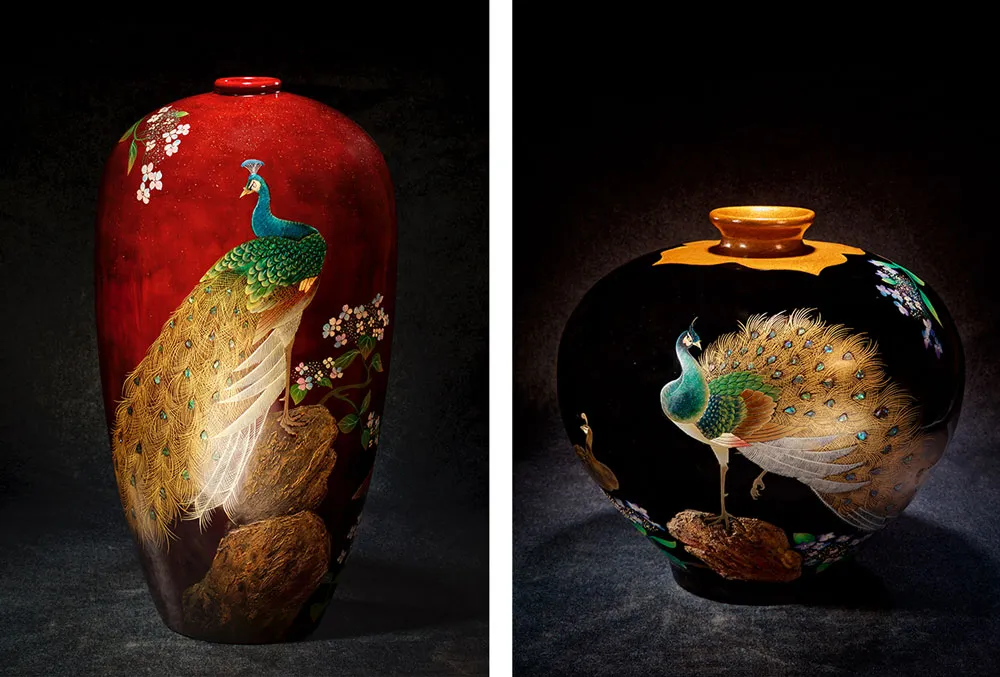
In Korea, this craft is known as najeon chilgi. The term itself is a fusion of function and material—najeon referring to the mother-of-pearl, and chilgi to the lacquerware. Historically, the discipline was defined by its intricate depictions of nature, where craftsmen would painstakingly cut and inlay shells to form flowers, birds, and butterflies against a void of deep black lacquer.
Detail of mother-of-pearl texture
While traditional najeon chilgi adheres to a strict Eastern aesthetic often frozen in time, contemporary artist Jian Yoo has sought to release the material from its ornamental constraints. She does not simply decorate surfaces; she manipulates light and texture to evoke the visceral energy of nature itself.
The Inheritance of Light
Yoo’s fluency in this medium is not academic; it is ancestral. She is the daughter of Chulhyun Yoo, a renowned master craftsman of najeon chilgi. Her childhood was not spent in a nursery, but in a workshop—a space filled with the sharp scent of lacquer and the dust of ground shells.
For the young Yoo, the shimmer of nacre was mundane, a standard fixture of domestic life. Her home was populated with furniture and objects that gleamed with iridescent inlays, leading her to assume that such beauty was a universal standard. It was only upon relocating to New York to study design that she encountered a stark realization: the world outside her father’s studio was largely matte.
“Even among people who know what mother-of-pearl is, there aren’t many who’ve personally used and encountered its beauty up close,” Yoo reflects. “That made me realize that I had grown up with a very unique and special experience.”
This distance offered clarity. By stepping away from the tradition, she was able to see its distinct value. Initially hesitant to follow in her father’s footsteps, she eventually recognized that her deep, tactile familiarity with the material—knowing its brittleness, its luster, and its physical limits—was an artistic strength that could not be taught in a classroom.
The Intersection of Eras
Today, Yoo operates Studio Arijian in Namyangju, South Korea. Her work represents a deliberate convergence of heritage and modern design thinking. Unlike the craftsmen of the past who focused on repetitive auspicious symbols, Yoo treats mother-of-pearl as a medium for abstract expressionism.
Her approach is perhaps best exemplified in her The Intersection series. Here, she reinterprets the visual language of Korean lacquerware furniture from the 1950s to the 1990s—a period considered the “Golden Age” of najeon chilgi, where the material was abundant and the craftsmanship peaked.
The Intersection series by Jian Yoo
In these works, the mother-of-pearl is not just decorative; it provides structural rhythm. The inlays do not merely sit upon the surface; they seem to flow through the object, mimicking the “surging blue waves” she often references. By fusing traditional knowledge with contemporary forms—ranging from sculptural fine art to functional furniture—Yoo ensures that the iridescent legacy of the ocean continues to evolve, catching the light of a new era.

 Detail of mother-of-pearl texture
 The Intersection series by Jian Yoo