At Design Miami 2023, amidst the spectacle of contemporary collectible design, the collaboration between the Roman luxury house Fendi and the transdisciplinary studio Bless offered a quiet yet profound subversion of the typical showroom dynamic. Titled Backfrontal, the installation did not merely occupy space; it dissected the relationship between image and object, presenting a nuanced inquiry into what we see versus what we touch.
The project, conceived by Desiree Heiss and Ines Kaag of Bless, manifests as a structural study in duality. At first glance, the presentation appears as a series of four double-sided paravents—imposing screens that traditionally serve to divide or conceal. However, Heiss and Kaag utilize this format to disrupt the hierarchy of viewing. The “front” of these structures presents a flattened reality: life-size photographic documents and graphic coverings that replicate the interiors of Fendi, offering an optical illusion of depth that remains strictly two-dimensional.
Desiree Heiss and Ines Kaag standing within the Backfrontal installation
It is in the navigation to the reverse side that the installation’s true intent is revealed. Here, the two-dimensional image surrenders to three-dimensional utility. The “back” is not a support structure but a functional landscape. Crafted in rosewood by Fendi Casa, this side hosts a system of tangible living elements—seating, tables, and storage units integrated directly into the paravents.
This inversion challenges the conventional priority of the façade. As Ines Kaag observes, “This side holds the true richness.” The design forces the viewer to move past the surface—the photogenic “face” of the brand—to engage with the tactile substance of craftsmanship that supports it.
The collaboration delves further into the micro-details of daily existence, infusing the mundane with Fendi’s material heritage. The installation features everyday utilitarian items, such as spray bottles, re-contextualized through the application of opulent furs and leathers. These are not merely decorative flourishes but a “whimsical yet luxurious encounter,” suggesting that the essence of luxury lies not in distance, but in the tactile quality of the tools we use to maintain our environments.
The double-sided paravents featuring photographic fronts and utilitarian backs
Beyond the physical architecture of the booth, Backfrontal serves as a narrative vessel for the human element within the luxury house. Through their immersion in the Fendi universe, Heiss and Kaag identified a “familial power” resonating among the employees—a sense of communal craftsmanship that they sought to translate into the installation’s welcoming, functional rear interactions.
This approach mirrors the long-standing philosophy of Bless. Since their inception, Heiss and Kaag have operated in the interstitial spaces between definitions, refusing to be pinned down as solely fashion designers, artists, or industrial designers. Their work is generated through dialogue rather than dictation.
“It grows older together with us,” Heiss reflects on their evolving ethos. “Initially, we were adamant about avoiding fashion catwalk shows; we wanted to transcend predefined labels… We refused to confine ourselves to a specific category and instead embraced our unique field of activity.” In Backfrontal, this resistance to categorization creates a space where the image of luxury and the reality of living are not opposing forces, but two sides of the same screen.

 Desiree Heiss and Ines Kaag standing within the Backfrontal installation
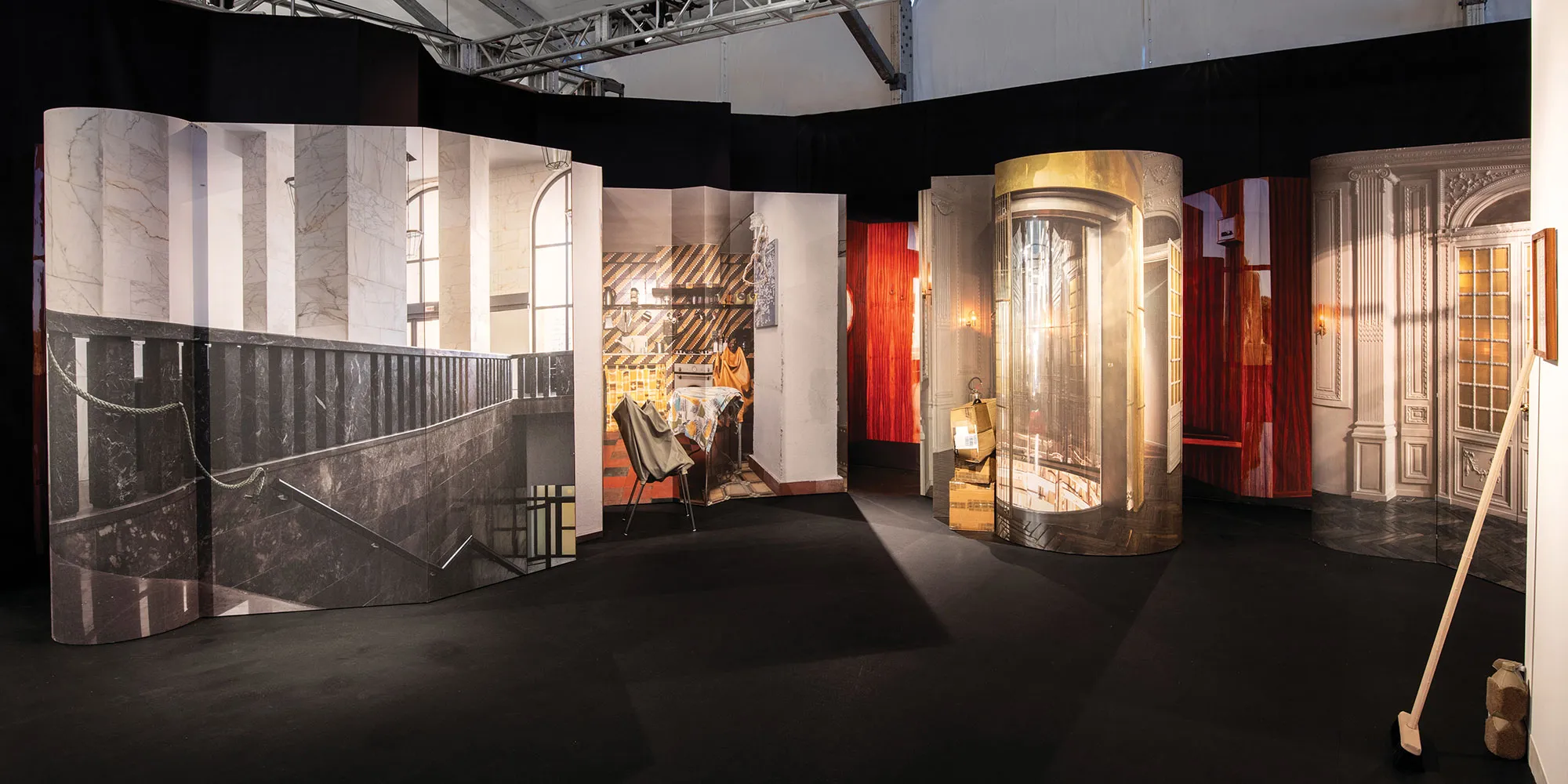 The double-sided paravents featuring photographic fronts and utilitarian backs