In the landscape of contemporary design, where the prevailing aesthetic often leans toward the sleek, the industrial, and the frictionless, the presence of the human hand can feel like a radical act. For Zanat, a Bosnian furniture brand established in 2015, the surface of an object is not merely a finish but a repository of history.
“We want the carvings to be the essence of the product’s design,” states Orhan Nikšić, CEO and co-owner of Zanat. This declaration marks a departure from the decorative to the structural, implying that the texture of the wood is as vital as the silhouette itself.
When Orhan and his brother Adem launched Zanat, the design world was heavily saturated with minimalism. To introduce texture—specifically the deep, rhythmic gouges of traditional woodcarving—was to challenge the “clean line” dogma of the era. Yet, drawing upon four generations of artisanal legacy, the Nikšić brothers envisioned a convergence where the archaic and the avant-garde could not only coexist but elevate one another.
The Resonance of Konjic
The narrative of Zanat begins long before its 2015 inception, rooted deeply in the soil of Konjic, a small town in Bosnia and Herzegovina known for its woodcarving heritage. The lineage traces back to the brothers’ great-grandfather, Gano Nikšić. In the late 19th century, Gano mastered techniques from pioneer woodcarvers in the region, a skill set so refined that by the turn of the century, works from Konjic were being celebrated in cultural capitals like Budapest, Vienna, and Paris.
The Dama-T Lounge Chair, designed by Ludovica + Roberto Palomba, has thin, curved surfaces with checkered hand-carved patterns.
For the Nikšić brothers, who remain residents of Konjic, the task was not simply to preserve this history but to translate it. They understood that the heart of their legacy—the exquisite, labor-intensive act of hand-carving—was immutable. However, the context in which it existed needed to shift. The challenge lay in stripping away the “folkloric” associations often attached to craft and presenting the technique as a sophisticated, modern language.
“We took a new approach to furniture design and production, emphasizing craftsmanship while showing how traditional hand-carving techniques can open up new possibilities for design,” Orhan explains.
From Ornament to Essence
Zanat, which translates to “craft” in Bosnian, operates on a philosophy that distinguishes it from mass production: the belief in the irreplaceable nuance of human touch. “The belief that machines can’t do the work of a human being is essential to our approach,” says Orhan. “That fine filigree work creates a trust between the creator, the tools, and the customer.”
This trust is built through tactility. In the brand’s evolution, the Nikšić brothers made a conscious decision to move away from traditional patterns that defined regional history. Instead, they sought “abstract, visually appealing elements.” The carving became a method to enhance the sensory experience of the furniture—transforming a chair or a bowl into an object that demands to be touched.
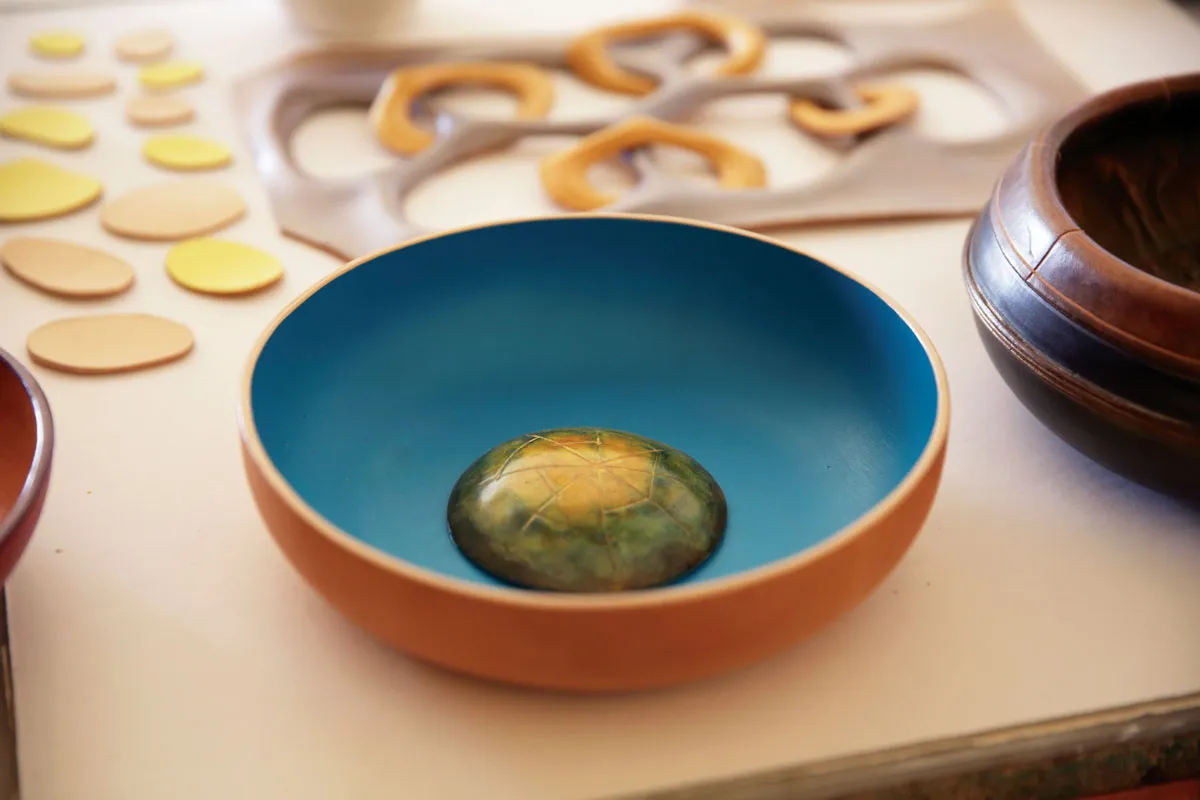
Zanat Bowls showcasing the intricate texture of hand-carving.
The result is a collection where the carving does not sit on the object; it is the object. It influences how light hits the surface, how the wood ages, and how the user interacts with the piece. It is a rejection of the superfluous in favor of the essential.
The Atelier as a Laboratory
To bridge the gap between rural artisanry and high-end design, Zanat opened its doors to European designers, inviting them to reinterpret the Bosnian heritage. This collaboration requires a physical presence; prospective designers must visit the atelier in Konjic to witness the carving process firsthand. They must understand the resistance of the wood and the rhythm of the chisel before they can draw a line.
Orhan notes that these collaborations are rarely driven by financial incentives typical of major manufacturers. “We know we’re not going to make nearly as much money in royalties… but we don’t care,” is a sentiment Orhan frequently hears from visiting creatives. “The carving gave them a new medium through which they could explore their creative skills.”
Before collaborating on a product with Zanat, prospective designers must visit the company’s atelier to see the traditional techniques used by the artisans to carve the products.
This synergy between the modern designer’s vision and the craftsman’s execution creates objects that possess a timeless quality. They are designed with the intent of permanence, countering the culture of disposability. “Our products can be inherited and passed down from generation to generation,” Orhan reflects. “They’re beautiful, functional pieces today but can become an heirloom piece or a museum exhibit tomorrow.”
In Zanat’s work, the wood remembers the hand that carved it, ensuring that even in a modern context, the human spirit remains the central pillar of design.

 The Dama-T Lounge Chair, designed by Ludovica + Roberto Palomba, has thin, curved surfaces with checkered hand-carved patterns.
 Zanat Bowls showcasing the intricate texture of hand-carving.
 Before collaborating on a product with Zanat, prospective designers must visit the company’s atelier to see the traditional techniques used by the artisans to carve the products.