For millennia, the human imagination has sought to capture the ephemeral nature of water—its clarity, its depth, and its life-giving force. In the mineral kingdom, aquamarine stands as the most potent manifestation of this desire. Deriving its name from the Latin aqua marina, or “water of the sea,” this beryl variety has long been revered not merely as ornamentation, but as a talisman of safe passage. Ancient mariners believed these stones were treasures spilled from the jewelry boxes of mermaids, favored by Poseidon to calm the tempests.
Beyond myth, the stone possesses a unique optical serenity. Its azure gaze suggests a perpetual youth and a clarity of mind, inviting the viewer to look into the gem rather than simply at it. In the hands of master jewelers, aquamarine ceases to be a static object; it becomes a medium through which light flows like a liquid, sculpted into forms that evoke the rhythm of the tides, the geometry of ice, and the lushness of submerged worlds.
Wallace Chan
A Necklace and Earrings Set with the Ocean Soul
The ocean is never still, and capturing its perpetual motion requires a mastery of both physics and aesthetics. Wallace Chan achieves this kinetic fluidity in a set that feels less like jewelry and more like a captured current. The centerpiece is a staggering 379.21-carat aquamarine, cut to resemble a rudder—a symbolic tool of navigation through the vast deep.
Chan employs titanium for the chains, a material chosen for its lightness and strength, allowing the structure to sway with the wearer’s movements. This engineering permits the white diamonds, crystals, and sapphires to undulate, mimicking the scattering of sunlight on rolling waves. It is a piece that breathes, embodying the “ocean soul” not as a static image, but as a living, shifting force.
Cartier
A Bracelet of Cascading Stones
Cartier’s approach shifts from the fluid to the sculptural. Here, the house employs its signature stone engraving technique to transform the gem from a facet of light into a tactile object. The bracelet is a study in volume and botanical density, where carved aquamarines mingle with tanzanites and moonstones in a lush, monochromatic garden.
The composition relies on the interplay of opacity and translucence. The carved “leaves” and “petals” absorb light differently than traditional faceted cuts, creating a softness that contrasts with the rigorous structure of the white gold setting. Accented by onyx bands and over three carats of brilliant-cut diamonds, the piece evokes a moonlit grotto where flora and water merge.
David Michael
A Koi Pond Captured in a Brooch
There is a distinct voyeuristic pleasure in gazing into a clear pond. Australian atelier David Michael encapsulates this serenity in a brooch that functions as a miniature ecosystem. The choice of a six-sided aquamarine acts as a window pane, providing a clear view into a meticulously constructed world beneath the surface.
Inside this gemological aquarium, a lifelike Koi fish appears suspended in motion. The illusion of depth is enhanced by the surrounding “vegetation”—clouds of green tsavorite and diamonds that frame the central stone. It is a moment of stillness, a tropical pause worn upon the lapel, inviting the viewer to lose themselves in its verdant depths.
Nigel O’Reilly
A Unique Golden Lattice Ring
Drawing inspiration from the avant-garde, Nigel O’Reilly’s Zephyrus ring references the futuristic aquatic aesthetics of Alexander McQueen’s Plato’s Atlantis. The piece is a dialogue between the organic and the architectural, anchored by a 5.9-carat cushion-cut aquamarine.
The genius of this ring lies in its basket. The 18-karat rose gold is worked into an intricate lattice, a cage that seems barely able to contain the energy of the stone within. Paved with pink sapphires and blue diamonds, the setting creates a vibrant contrast, warming the cool blue of the center stone and suggesting the refraction of light through a coral reef.
Baumer
A Necklace with an Icy Appeal
If Wallace Chan evokes the liquid ocean, Baumer captures the moment it freezes. This necklace abandons the curve for the jagged, majestic geometry of ice shards. It is an architectural arrangement where rock crystal provides the structure, layering transparent planes over a white gold and pavé diamond base.
The aquamarines in this composition do not dominate with size but with placement. They glint mysteriously from within the icy fissures, appearing like pockets of deep blue water trapped within a glacier. The effect is one of cold, precise beauty, celebrating the crystalline nature of the material itself.
Sicis Jewels
Artful Mosaic Earrings
Sicis Jewels translates the ancient art of micromosaic into high jewelry, treating stones as pigment. These earrings capture the kinetic energy of a splash, freezing the split second a Koi breaks the water’s surface.
The craftsmanship here is microscopic; tiny diamonds are hand-set to create the gradient scales of the white gold fish. The aquamarines dangle below, not merely as ornamentation, but as the physical manifestation of the water droplets falling from the creature’s tail. It is a playful, narrative approach that prioritizes movement and storytelling.
Verdura
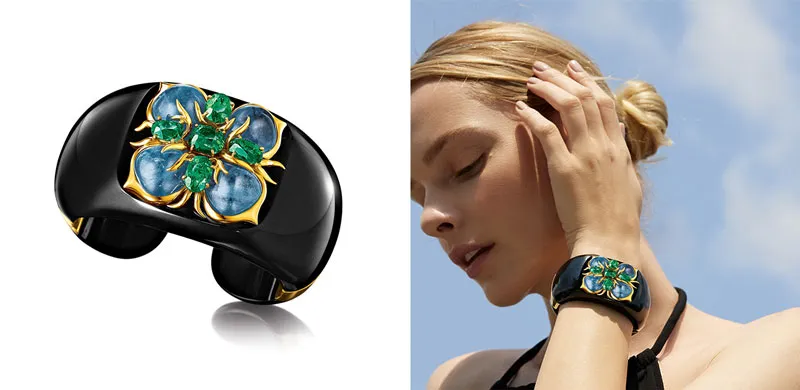
An Iconic Black Jade Cuff
Fulco di Verdura was a master of bold contrasts, and this Dogwood Cuff is a testament to his enduring legacy. Drawing from the brand’s 1930s archives—and a brooch immortalized in a Dali painting—this piece juxtaposes the profound density of black jade with the ethereal lightness of aquamarine.
The choice of black jade as the canvas is crucial; its matte, dark surface absorbs light, forcing the eye to focus entirely on the luminosity of the aquamarines and emeralds arranged in a cross pattern. The result is a piece of jewelry that feels substantial, historic, and strikingly modern in its graphic simplicity.
Thomas Jirgens
Pastel Chandelier Earrings
Light, when passing through water, breaks into a spectrum. Thomas Jirgens captures this prismatic effect in chandelier earrings that evoke the softness of a sun shower. The structure creates a lace-like filigree of white gold, delicate enough to let the stones appear to float.
The palette is intentionally soft—a mix of gold beryls, aquamarines, and morganites. These pastel hues do not compete; rather, they blend to mimic the elusive colors of a rainbow fading into a grey sky. Framed by sapphires and paraiba tourmalines, the earrings are a study in atmospheric optics.
Elizabeth Gage
A Ring of Imperial Opulence
There is a weight and history to Elizabeth Gage’s work that recalls the splendor of the Ottoman court. This ring centers on a 16-carat cabochon aquamarine. The cabochon cut, smooth and unfaceted, emphasizes the stone’s internal glow rather than its surface sparkle, giving it a water-drop quality.
The setting is equally significant—a bombé gallery of 18-karat yellow gold, detailed with gold beads and blue enamel. The rich gold tones provide a regal frame for the cool blue, creating a piece that feels like an excavated treasure, heavy with the memory of empires.
Simone Jewels
A Golden Winged Bracelet
In the Birds in Poetry collection, Simone Jewels transmutes the aquatic nature of the stone into an aerial one. Here, the aquamarine represents the sky as much as the sea, a symbol of hope cradled within the concept of flight.
The bracelet features overlapping wings crafted from gold and diamonds, protecting the central stone. The texture of the feathers is rendered with precision, creating a soft, tactile casing for the gem. It acts as a metaphor for freedom, suggesting that the stone is ready to take flight from the wrist.
Fawaz Gruosi
An Aquamarine Ring with a Touch of Amber
Fawaz Gruosi is known for defying convention, and this ring is a masterclass in unexpected alchemy. He pairs the glacial, emerald-cut aquamarine with amber—the “gold of the North.”
This combination is a study in thermal and temporal contrast. The aquamarine is cool, mineral, and crystalline; the amber is warm, organic, and fossilized. The sunny glow of the ancient resin vibrates against the watery blue, while blue sapphires along the shank bridge the gap between these two elemental forces.
Ricardo Basta
A Ring Breathing with Sea Life
The cocktail ring becomes a stage for Ricardo Basta, who dramatizes the deep sea with sculptural flair. A 37-carat aquamarine serves not just as a stone, but as the ocean volume itself, around which a narrative unfolds.
Tentacles of yellow gold and diamonds wind around the gem, claiming it. The scene is populated with diamond starfish and coral made of enameled pearl. It is a dynamic, slightly wild depiction of nature, where the jewelry mimics the chaotic abundance of a reef.
Wartski
A Vintage Treasure Brooch
From the Edwardian era comes a piece of pure restraint and elegance. This vintage brooch, circa 1910, presents aquamarine in its most classic form: a suspended drop of crystalline water.
The design relies on the quality of the stones—a pear-shaped drop suspended from an oval top, both framed in diamonds. It whispers of a time when jewelry was designed to complement the grace of the wearer rather than overwhelm the eye. The versatility of the piece, with its detachable elements and ability to be worn as a tiara, speaks to the ingenuity of early 20th-century craftsmanship.
Antonio Seijo
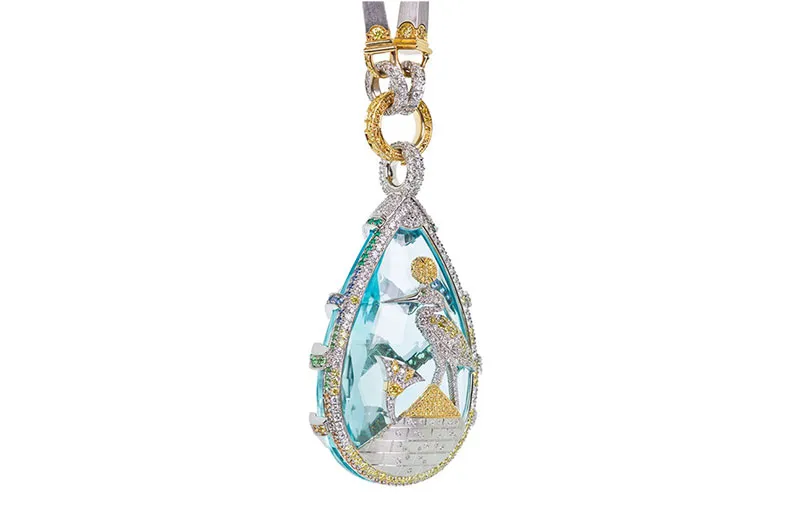
A Pendant of Symbol and Myth
Antonio Seijo delves into the esoteric, creating a pendant that functions as a talisman. The piece is anchored by a massive 102-carat briolette aquamarine. The briolette cut, faceted all around, allows light to enter from every angle, making the stone glow with an internal fire.
The imagery is mythical: a diamond-encrusted heron perched atop a golden pyramid. On the back of the aquamarine, the hieroglyph for water is engraved, sealing the stone’s connection to its elemental source. It is a piece laden with symbolism, representing the meeting point of sky, earth, and water.
Coomi
A Captivating Geometric Necklace
Coomi moves away from the organic curves of water to the geometry of light rays. This 20-karat yellow gold necklace uses rectangular aquamarines to create a structure that feels both ancient and modernist, like a sunburst or a primitive totem.
The “bars” of gold and stone total 127 carats, creating a rhythmic visual cadence. The inclusion of opals within circular frames adds a secondary layer of iridescence, but it is the architectural rigor of the aquamarine placement that gives the piece its dramatic weight.
Veschetti
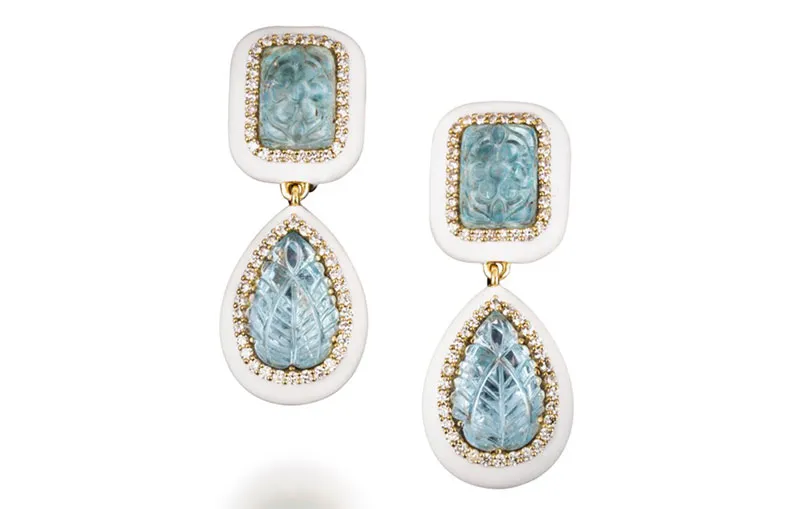
Vintage-Inspired Enamel Earrings
Veschetti channels the romance of the Italian coast through a lens of vintage charm. These earrings utilize white enamel to create a soft, matte boundary for the sparkling stones, reminiscent of sea foam washing over blue glass.
The silhouette merges a rounded rectangle with a pear shape, a harmonious union that feels balanced and classical. The 18-karat yellow gold provides a warm undercurrent, ensuring the piece feels sun-drenched despite the cool tones of the gems.
Caratell
A Blossoming Tweedia Ring
Nature’s fragility is the focus for Caratell, who replicates the budding Tweedia flower. The ring is not a static setting but a moment of growth; the metalwork mimics the organic flourish of a vine.
A 6.26-carat aquamarine sits at the heart of this bloom, wrapped in petals of white and rose gold. Paved with pink sapphires, the setting enhances the blue of the center stone through complementary color theory, capturing the delicate, fleeting beauty of a garden in spring.
Brigitte Ermel
A Ring in Shades of Blue
The transition from concept to creation is a rigorous journey for Brigitte Ermel, involving gouache studies and clay modeling before the first stone is set. This dedication to form is evident in her hypnotic ring, which treats the aquamarine as a droplet of pure color.
The 14.38-carat tear-shaped stone is elevated on a frame of blue sapphires. By layering blue upon blue, Ermel creates a monochromatic depth, mimicking the way the ocean darkens as the water deepens. It is a piece of quiet power, relying on the quality of the gem and the perfection of the gradient.
Farah Khan
A Bracelet with Indian Flair
Farah Khan weaves her Persian and Indian heritage into a bracelet that behaves like a textile. The 18-karat yellow gold is crafted to resemble an interlacing ribbon, fluid and flexible, wrapping the wrist in a lattice of light.
Scattered across this golden fabric are Zambian emeralds and diamonds, but the 38.50 carats of aquamarines command the most attention. The combination of green emeralds and blue aquamarines is a classic Mughal pairing, reimagined here with a contemporary, airy structure.
Munnu
A Playful Pair of Earrings
Legacy meets whimsy in the work of Munnu, a house with roots in the Mughal Empire. These earrings remind us that the sea is not just a place of mystery, but of play.
Fashioned from 22-karat yellow gold—a rich, buttery metal favored in traditional Indian jewelry—the earrings take the shape of fish. Their bodies are formed from aquamarine, accented with drops of lilac iolite. It is a joyous design, celebrating the abundance of life beneath the waves.
Etho Maria
A Cuff with Colors of Sand and Sea
Greek jeweler Etho Maria strips away the superfluous to focus on the elemental. This wide cuff is a geological cross-section, layering the colors of the shoreline in a bold, stratified pattern.
Rows of aquamarines alternate with yellow diamonds, mimicking the visual rhythm of waves lapping against the sand. Set in a mix of yellow and white gold and platinum, the bracelet is a statement of texture and tone, capturing the essence of the Greek landscape in a solid, unyielding form.
Alessio Boschi
A Ring of Two Coasts
Alessio Boschi concludes this journey with a piece that is a literal map of memories. Inspired by the waters of the Mediterranean and the Pacific, this ring creates a dialogue between two oceans.
The center cabochon aquamarine, with its soft, glowing dome, represents the crystal waters of home, surrounded by the electric neon of Paraiba tourmalines. Yet, the details—diamond-crusted corals and sapphire fish—speak of exotic, distant reefs. It is a microcosm of the marine world, worn on the hand as a reminder of the vast, interconnected nature of the seas.

 A Necklace and Earrings Set with the Ocean Soul
 A Bracelet of Cascading Stones
 A Koi Pond Captured in a Brooch
 A Unique Golden Lattice Ring
 A Necklace with an Icy Appeal
 Artful Mosaic Earrings
 An Iconic Black Jade Cuff
 Pastel Chandelier Earrings
 A Ring of Imperial Opulence
 A Golden Winged Bracelet
 An Aquamarine Ring with a Touch of Amber
 A Ring Breathing with Sea Life
 A Vintage Treasure Brooch
 A Pendant of Symbol and Myth
 A Captivating Geometric Necklace
 Vintage-Inspired Enamel Earrings
 A Blossoming Tweedia Ring
 A Ring in Shades of Blue
 A Bracelet with Indian Flair
 A Playful Pair of Earrings
 A Cuff with Colors of Sand and Sea
 A Ring of Two Coasts