To engage with the works of Sha Ching-Hwa is to surrender to a suspension of physics, where gravity is optional and time loops upon itself. His canvas is not merely a surface for representation but a portal into a whimsical, boundless universe. For Sha, the act of facing a blank sheet of Xuan paper is akin to setting sail into an uncharted ocean. He invokes the spirit of Sinbad the Sailor—an explorer destined for encounters with mythical beasts and supernatural phenomena—suggesting that the artistic process is an adventure fueled by variables and uncertainties.
It is within this unpredictability that Sha finds his rhythm. Unconstrained by predetermined outcomes, he allows the ink to guide him into unexplored imaginative realms. In this universe, enigmatic islands float amidst rainbow-draped clouds, and charming cottages nestle into the embrace of lush, gravity-defying greenery.
The Architecture of Nostalgia
The genesis of Sha’s visual language can be traced back to the uninhibited gaze of childhood. Long before he mastered the brush, he found landscapes in the mundane; water stains on a ceiling transformed into dynamic scenes, setting the stage for a lifelong dialogue with the imaginary. This early pareidolia eventually matured into a formal pursuit of ink-wash painting, a medium he chose to articulate a world filled with dragons and extraterrestrial wanderers.
However, the serenity in his work is born from a profound rupture. During his graduate studies, Sha received news that his childhood village had been demolished. The physical coordinates of his history were erased, leaving a void filled with grief and nostalgia. In response, art became his method of reconstruction. He developed a unique brushstroke technique—dense, layered, and textually rich—specifically to depict the lush mountains and foliage of a home that no longer exists in reality.
In Sha Ching-Hwa’s painting Mountain and Water, Heart’s Abode, a tranquil rural landscape, resembling both an island and a mountain, hovers in the air.
Sha’s floating islands, therefore, are not just fantasies; they are acts of preservation. Elements like cerulean lakes, playful fauna, and subtropical flora serve as narrative anchors to the past. At the center of these drifting topographies often stands a solitary cottage. Its window, consistently painted with a hint of warm yellow, symbolizes the eternal, comforting light of a home that refuses to be extinguished by the march of progress. For the viewer, often trapped in the concrete rigidity of modern urban life, these conceptual havens offer a nurturing embrace—a psychological refuge where the soul can rest.
“I’ve moved from painting physical landscapes to capturing the landscapes of my inner world,” Sha reflects. “Here, I can freely explore and express myself. I can articulate my longing for my lost homeland, create a utopian world, and give life to my boundless imagination.”
The Porosity of Time
Beyond the floating islands, Sha’s oeuvre is defined by his obsession with “Beehive Rocks.” Sculpted by millennia of weathering and sea erosion, these geological oddities are marked by countless cavities—honeycombed surfaces that speak of endurance and attrition. For Sha, these massive boulders are not static; the millennium-worn cavities appear as portals, connecting the viewer to different dimensions of time.
An exceptional piece among Sha’s creative paintings, Time and Space Lotus Blossom features two circular halos that seem to form a connection between heaven and earth.
While traditional Chinese landscape painting has a rich lexicon for depicting mountains and rocks—often emphasizing the grandeur and solidity of nature—Sha focuses on the void. He innovates upon traditional techniques of layering and shading to construct textured formations that capture the mystique of erosion. By focusing on the cavity-ridden surfaces, he creates a visual metaphor for the passage of time, tracing the spectrum of existence from birth to maturity.
The artist’s fascination with these forms has led to a surreal metamorphosis in his recent work. In the Mechanic Landscapes series, the organic, pitted surfaces of the rocks transform into complex networks of interconnected gears. The majesty of the mountain becomes a celestial machine, evoking the relentless, mechanical march of time. Each gear serves as a component within a vast, unseen system, symbolizing the mystical inner workings of nature where seasons cycle and invisible forces dictate the rhythm of the universe.
Sha’s painting The Legend of the Mundane World symbolizes a journey to distant lands in search of a mountain that engraves people’s memories into its rock face.
Despite these surrealist and geometric interventions, Sha remains fiercely loyal to the materiality of his heritage. “My tools are traditional—brushes and Xuan paper—nothing elaborate. What matters is the integrity of the painting process and the authenticity that radiates from the work,” he asserts. He embraces the unforgiving nature of ink, where errors are permanent, viewing the medium’s ethereal qualities as irreplaceable. He sees himself not as a custodian of tradition, but as an expander of it, tasked with exploring new avenues for creation within the ancient discipline.
The Tao of the Brush
The philosophical undercurrent of Sha’s work is deeply rooted in the Taoist concept of “the oneness of heaven and man.” This state of unity goes beyond mere observation; it requires a dissolution of the self into the subject. When Sha studies the seaside rocks, he perceives a history spanning millions of years, envisioning their journey across galaxies before their earthly manifestation. To him, rocks are not inanimate objects but vessels of cosmic memory.
“When I stand upon these natural rocks, it feels as if the divine is communicating directly with me. It’s an experience of unity with nature, of losing oneself,” Sha describes. This deep immersion is perhaps why the tradition of ink painting is often associated with longevity. The process induces a meditative state, stabilizing cardiac rhythms and nurturing mental well-being—a tranquility Sha hopes to transmit to his audience.
Sha’s painting Warm Spring features splashes of pink and bright yellow representing the blossoming flowers of spring.
This philosophy was given monumental form in his work Endless Generations, a nine-meter-long painting displayed at Taiwan’s Taoyuan International Airport between 2021 and 2023. The piece features soaring, mountain-like beehive rocks and a massive Tai Chi symbol emerging from the water, surrounded by swarms of intricately detailed fish. Upon closer inspection, the organic stones reveal the complex gears within their cavities, synthesizing his themes of life’s intricate interconnections, the mechanical nature of time, and the organic flow of the Tao.
The sheer scale of such projects poses significant physical and mental challenges, yet these hurdles signal new artistic chapters. Sha remains committed to the rhythm of his own creation, unbound by deadlines, stating simply that he will continue painting until he is satisfied. In doing so, Sha Ching-Hwa presents a compelling argument for the contemporary relevance of ink painting, proving that an ancient medium can still capture the shifting, floating anxieties and dreams of the modern world.
Sha’s painting Above the Ordinary depicts lotus blossoms flourishing atop rugged rocks, creating a hazy and ethereal atmosphere.

 In Sha Ching-Hwa’s painting Mountain and Water, Heart’s Abode, a tranquil rural landscape, resembling both an island and a mountain, hovers in the air.
 An exceptional piece among Sha’s creative paintings, Time and Space Lotus Blossom features two circular halos that seem to form a connection between heaven and earth.
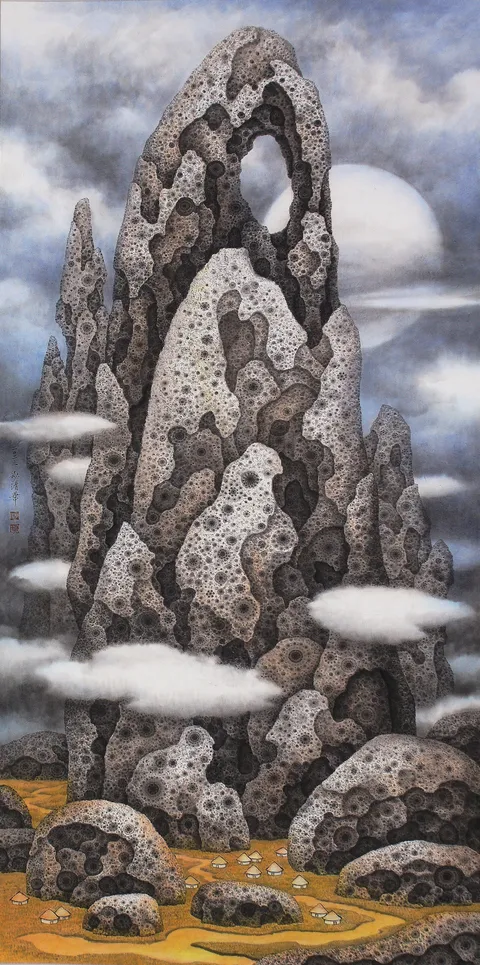 Sha’s painting The Legend of the Mundane World symbolizes a journey to distant lands in search of a mountain that engraves people’s memories into its rock face.
 Sha’s painting Warm Spring features splashes of pink and bright yellow representing the blossoming flowers of spring.
 Sha’s painting Above the Ordinary depicts lotus blossoms flourishing atop rugged rocks, creating a hazy and ethereal atmosphere.