When the curtain rises, time dissolves into color. Fifteen figures from the Tang Dynasty emerge, draped in turquoise gowns, their movements trailing long, pink silk sleeves that extend twice the length of their arms. They do not merely walk; they drift, akin to celestial beings skimming the surface of a lake. As the dancers extend their limbs, the fabric does not just hang—it snaps, flutters, and ripples, transforming the stage into a kinetic painting of waves and wind.
This visual poetry is central to Sleeves of the Tang Palace, a piece performed by Shen Yun Performing Arts, with principal dancer Angela Xiao at its center. Yet, behind this spectacle of liquid grace lies a rigorous discipline where physics meets philosophy, and where the softness of silk demands a will of iron.
Xiao is in the centre as the lead of Sleeves of the Tang Palace, performed by Shen Yun Performing Arts in last year’s world tour. Photo Courtesy of Shen Yun Performing Arts
The “water sleeves” technique, a legacy tracing back to the Han and Tang dynasties, serves as a profound metaphor for classical Chinese dance itself. To the observer, the movement appears effortless, a magical extension of the human form. However, controlling yards of flowing silk with precision requires a harmonization of body, mind, and spirit that borders on the meditative.
“The water sleeves are elegant and light in the eyes of the audience members, but achieving gracefulness with the technique is not easy,” observes Xiao. The silk acts as an elongation of the dancer’s intent. To manipulate it, energy must be projected far beyond the fingertips, requiring a unique internal force. When Xiao first began her training, the fabric was unruly, tangling in the air as if caught in a gale. The challenge was not just physical strength, but “bearing”—the invisible, inner characteristic of classical Chinese dance from which all movement originates.
Angela Xiao
To master the sleeves is to master a paradox. Xiao’s journey led her beyond the dance studio and into the ancient texts of Taoism. She found guidance in the words of Laozi: “There is nothing in the world softer and weaker than water, and yet for attacking things that are firm and strong, there is nothing that can take precedence over it.”
This philosophical insight unlocked the technique for her. Xiao realized that the silk, like water, obeyed laws of counter-intuition. “I realized I should exert my strength in the opposite direction of where I want them to go,” she explains. “It’s like paddling in water—if you want the boat to go forward, you have to paddle backwards.” By analyzing video recordings of her practice, she learned to surrender to the nature of the material rather than forcing it, finding the power that lies within softness.
Xiao learned many principles about dance and life by studying the nature of water. Dress by Max Mara / Photo by Binggan Zhang
This surrender also mirrored Xiao’s personal evolution. having immigrated to Vancouver at the age of four, she carried a quiet, gentle demeanor that eventually led her to the prestigious Fei Tian Academy in New York. However, the transition from a student to a principal dancer brought with it the paralyzing weight of perfectionism. The spotlight of the solo performance often induced anxiety; a single mistake in rehearsal could spiral into a restlessness that clouded her entire performance.
Her teacher’s advice—to approach each class “like a sheet of blank paper”—became a mantra for shedding these accumulated anxieties. The discipline of the water sleeves taught her that rigidity, whether in fabric or in mind, leads to entanglement.
Cultivating inner beauty is what Xiao believes to be an essential quality of classical Chinese dance. Dress by Delpozo / Photo by Binggan Zhang
The resolution came through a shift in perspective, moving from the ego of the soloist to the unity of the collective. During a rehearsal, observing the grandeur of the group choreography, Xiao understood her place within the larger tapestry. “I’m like a drop of water,” she reflects. “I shouldn’t enlarge myself on the stage. It will be fine as long as I try my best.”
In this dissolution of self, the burden of perfection lifted. The dance was no longer about her individual execution, but about becoming a vessel for a 5,000-year-old culture. The water sleeves, once a source of frustration, became a conduit for history—a flowing, silken language that speaks of ancient virtues, carried forward by a dancer who learned that to truly lead, one must first learn to flow.

 Xiao is in the centre as the lead of Sleeves of the Tang Palace, performed by Shen Yun Performing Arts in last year’s world tour. Photo Courtesy of Shen Yun Performing Arts
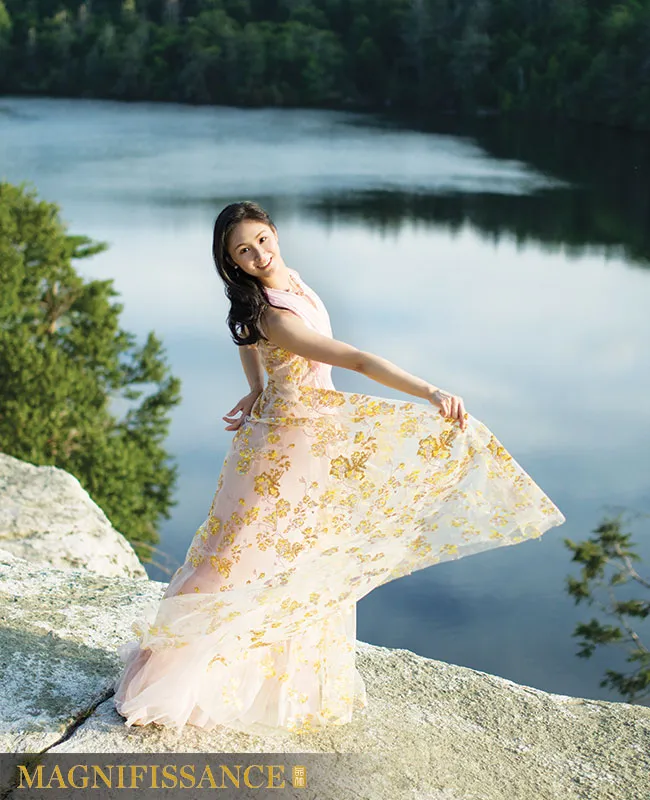 Angela Xiao
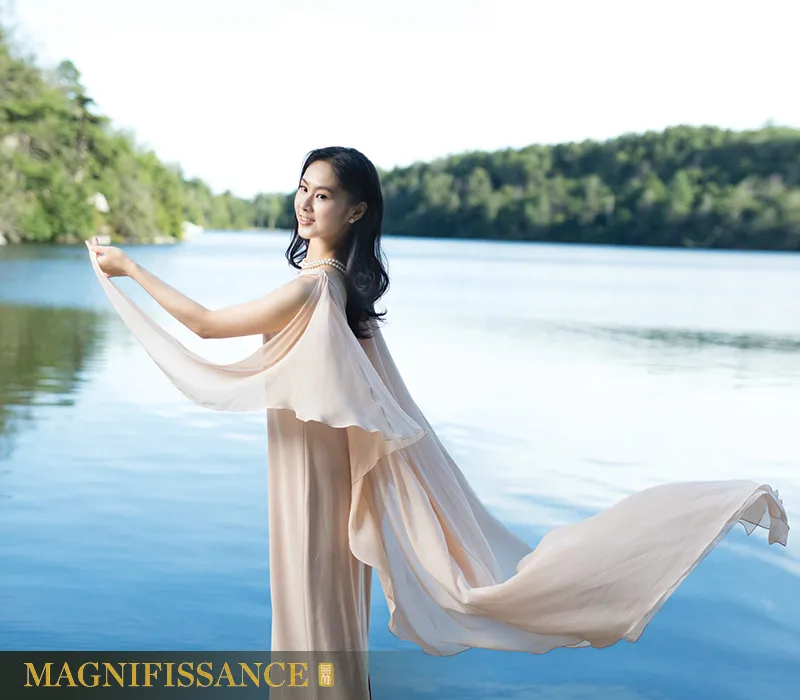 Xiao learned many principles about dance and life by studying the nature of water. Dress by Max Mara / Photo by Binggan Zhang
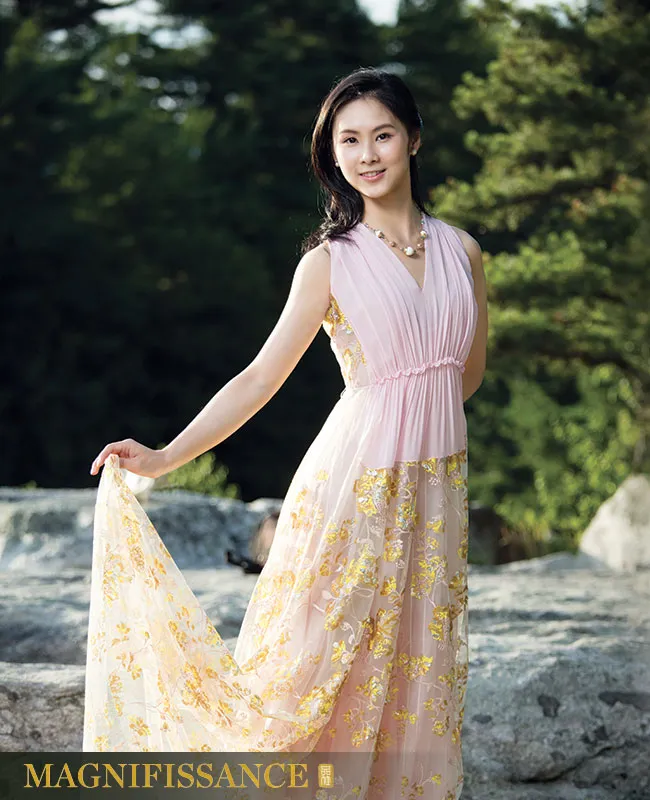 Cultivating inner beauty is what Xiao believes to be an essential quality of classical Chinese dance. Dress by Delpozo / Photo by Binggan Zhang