“If I’m playing Beethoven, that’s a force that’s bigger than me. To channel that and let it pass through me to an audience is a transcendental experience when it’s done well.”
For Charlie Siem, the violin is less an object of wood and string, and more a conduit for the metaphysical. In the hands of this British virtuoso, the instrument ceases to be a tool of technical display and becomes a medium for something essentially human yet deeply abstract. Music, in his view, is the most effective architecture for emotion precisely because it bypasses the literal.
Educated at Eton and Cambridge, and trained under maestros like Shlomo Mintz, Siem has established himself as one of the most compelling figures in contemporary classical music. While his profile has crossed into the visual lexicon of high fashion—representing Armani, Chanel, and Dior—his core remains tethered to the rigors of the concert hall. From the London Symphony to the Moscow Philharmonic, Siem’s career is defined not by the glare of the spotlight, but by a dedication to the invisible art of resonance.
The Echo of Lineage
The trajectory of an artist is rarely linear; often, it is a circle closing upon itself. For Siem, the initial spark was an almost uncanny recognition. At three years old, hearing a radio broadcast of Beethoven’s Violin Concerto, he turned to his mother with a startling clarity: “I want to play this. I want to make this sound myself.”
This was not a fleeting childish whim. In the cluttered living room of an elderly music therapist, amidst a scattering of drums and flutes, the toddler gravitated instinctively toward the violin. It was a tactile confirmation of a destiny that perhaps lay dormant in his bloodline.
Siem’s father is Norwegian, a heritage that links him to the legendary 19th-century violinist Ole Bull. Bull was a “Viking-like” maverick—a self-taught improviser who traveled the world in a custom-built carriage adorned with royal jewels. He was a larger-than-life character who prioritized passion over convention.
Today, Siem honors this ancestry not merely through genetics, but through ritual. He performs at Ole Bull’s fairytale castle on the Norwegian coast, channeling the spirit of a man who lived entirely for the moment.
“I admire people who live for the moment and have a passionate approach to how they live their lives,” Siem reflects. It is this synthesis of the wild, improvisational spirit of the past and the disciplined structure of the present that defines his sound.
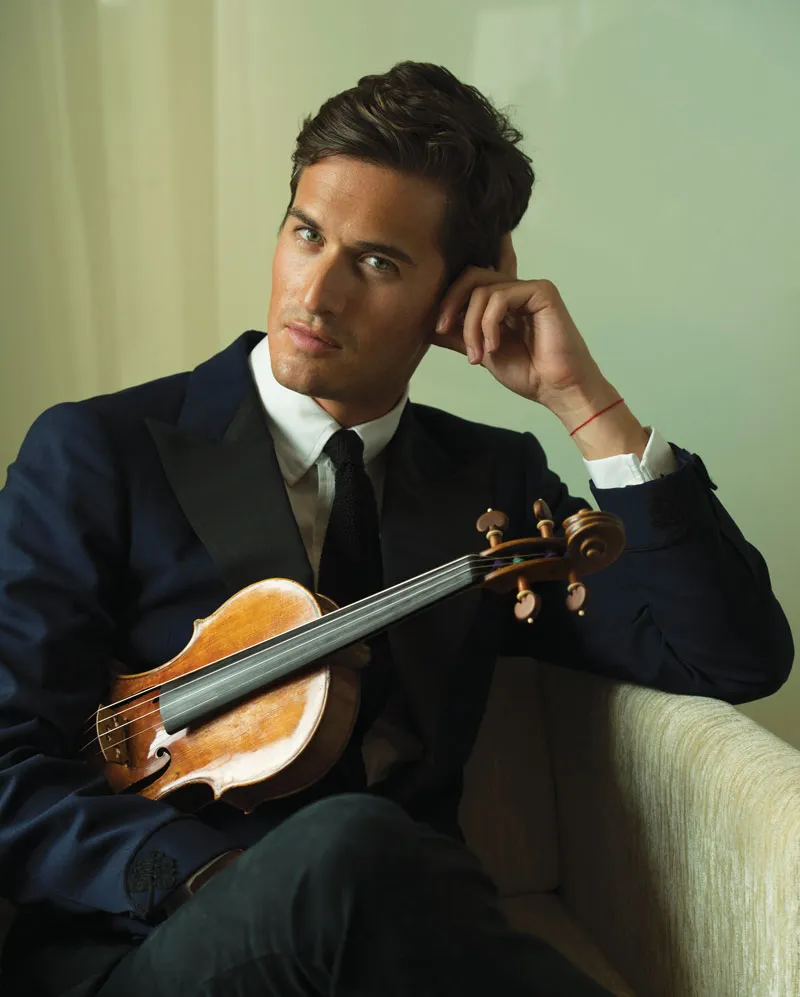
Violin virtuoso Charlie Siem with his prized 1735 Guarneri del Gesù violin, known as the d’Egville
The Sculptor of Sound
Behind the seemingly effortless grace of a virtuoso lies a landscape of rigorous internal architecture. Siem views the classical arts as a discipline of accumulation and reduction—much like a sculptor chipping away at marble to reveal the form within.
“The classical arts recognize a long tradition before you,” Siem observes. “There is a very rigorous discipline to what the classical arts represent. There is no shortcut to achieving a certain level.”
Unlike the modern obsession with instant gratification, the path of the violinist is one of slow, often painful, refinement. Siem describes his education as an “observational” journey, absorbing technique like a sponge, but ultimately turning the gaze inward. The mastery of the instrument requires a confrontation with oneself—a willingness to suffer the misery of limitations in order to break them.
He likens this process to a Shakespearean actor building an arsenal of tools, only to abandon them to the spontaneity of the moment on stage. The goal is to reach a state where the rigorous preparation dissolves into pure presence.
“Life is about how you experience it and what you grow out of it,” he says. “Having one thing to do for a long period of time is a great exercise in reflecting internally on who you are.”
Charlie Siem performing, emphasizing the connection between the artist and the audience through the abstract nature of music
A Cyclic Return
The narrative of Siem’s life recently converged on a single point: the 250th anniversary of Ludwig van Beethoven’s birth. For decades, Siem had avoided performing Beethoven’s Violin Concerto—the very piece that had ignited his passion at age three.
“It’s so pure and so essential to me, I didn’t feel I could really deal with it,” he admits. The reverence was paralyzing; the fear of disappointment, immense.
Yet, the realization that one is “never ready” prompted the plunge. When Siem finally approached the concerto, the experience was overwhelming. The piece, characterized by its straightforward arpeggios and heroic scales, revealed itself to contain the “whole spectrum of life.”
Beethoven’s markings are meticulous, dictating the exact placement of the bow and the swelling of dynamics. The challenge for the interpreter is to adhere to this blueprint while finding a personal pulse within it. “The great challenge is finding my own personal connection with the music, not trying to replicate what I’ve heard, but what really resonates within me as an individual,” Siem explains.
When the symphony plays the opening four-note motif, Siem feels an internal electricity. The timeline of his life collapses. He does not see a chronological list of events, but a holistic capsule—his identity, his choices, and his history evolving to meet the music in the present tense.
“Suddenly it seems to be my reality,” Siem concludes. “I see my whole existence and identity before me when I’m on the stage playing it.” In that moment, the vessel is full, and the force passes through, unbroken.

 Violin virtuoso Charlie Siem with his prized 1735 Guarneri del Gesù violin, known as the d’Egville
 Charlie Siem performing, emphasizing the connection between the artist and the audience through the abstract nature of music


