For architect and photographer James Howard Smith, the built environment is never merely about shelter or function. It is a dialogue with the human spirit, a tangible resonance of an absolute value. He finds his definition of this value in the verses of John Keats: “Beauty is truth, truth beauty.”
Smith, now established in the Hudson Valley after a childhood spent navigating the landscapes of Australia and the cultural tapestries of Europe and Asia, views architecture through a lens of moral geometry. To him, beauty is not subjective ornamentation; it is the intuitive recognition of truth. When a design possesses this quality, it strips away the complexity of modern life, returning the observer to a state of purity and simplicity.
The Weight of Antiquity
Smith’s architectural vocabulary was forged in the shadow of the ancients. As a boy wandering the streets of Athens, he was struck not just by what stood above, but by what lay beneath. He observed public squares where the earth opened up to reveal ruins resting ten to twenty feet below street level—a literal stratification of history.
Architect James Howard Smith discussing the principles of classical design
The Parthenon, sitting atop the Acropolis, offered him an early lesson in the power of bold, unadulterated form. It was there that he understood architecture as a vessel for ancient wisdom, a physical manifestation of a civilization’s highest ideals nestled seamlessly into the urban fabric. This exposure to the classical orders instilled in him a belief that design must possess resilience—a structural and aesthetic fortitude that allows it to endure the erosion of time.
The Sacred Void
While Greece provided the foundation of form, it was in Florence, the cradle of the Renaissance, that Smith encountered the spiritual verticality of architecture. Entering the Duomo of Florence, he describes the experience of the “enormous void” of the main nave—a space designed to dwarf the ego and elevate the soul.
The journey down the nave leads to the dome, where the interior frescoes depict the layers of existence, ascending from the infernal to the celestial. For Smith, this was not merely a passive viewing experience but a somatic one. The architecture acted as a bridge, connecting the individual to the cosmos. This sensation of awe, of being small yet connected to a greater universe, became a touchstone for his own practice. He realized that as a designer matures, the desire to dazzle with technical tricks fades, replaced by a pursuit of subtlety and the creation of calm, uplifting spaces.
The spiritually inspiring interior of the Florence Cathedral, emphasizing verticality and light
The Tian Jing: Light as a Threshold
Smith’s design philosophy represents a synthesis of Western classical proportions and Eastern spatial wisdom. He draws a profound parallel between the courtyards of Italian villas and the traditional temples of Taiwan. In both traditions, the courtyard serves as a lung for the building, but in Chinese architecture, it holds a specific metaphysical function.
This feature is known as the Tian Jing, or “Heavenly Window.”
In the temples Smith visited, the open courtyard creates a focused column of light. The rooflines cast deep shadows that act as thresholds, while the Tian Jing invites the sky down into the earth. It is a directional device: the light draws the visitor in, and once centered, casts their attention upward. It is an architectural mechanism for spiritual connection, turning a domestic or religious space into a conduit for the cosmos.
The Tian Jing, or Heavenly window, allowing a direct connection between residents and the sky above
The Fo Tang House
Smith applied these cross-cultural concepts to his “Fo Tang House,” a project conceived for an imaginary client dedicated to Eastern spiritual traditions. The name derives from Fo (Buddha) and Tang (Hall/Room), essentially designating an “Enlightened Room.”
The design anchors itself in the aesthetics of the Tang Dynasty—China’s golden age of culture—utilizing large, overhanging eaves and bold wooden brackets that recall the strength and uprightness of that era’s architecture.
The Fo Tang house featuring horizontal overhanging eaves and bold Tang-style columns
Central to the house is an atrium that functions as a modern Tian Jing. With large windows and a glass front door, this space floods with natural light, acting as a transition zone between the secular and the sacred.
The layout narrates a daily ritual. Upon entering, one can move left toward the living quarters or cross the atrium, ascending a few stairs into the Fo Tang. This sanctuary is screened by glowing rice paper Shoji doors, beckoning the resident to meditation. The light here is not static; it is a living element that guides the inhabitant from the mundane noise of daily life into a space of refinement and silence.
The Fo Tang, or enlightened room, with glowing shoji screens inviting meditation
Inner Architecture
Smith’s sensitivity to these “enlightened spaces” is mirrored by his own internal cultivation. Years ago, while suffering from a fractured back, he began practicing Falun Dafa, an ancient Chinese meditation discipline. The practice facilitated a miraculous physical recovery, but its impact on his perception was even more profound.
He likens the state of a cluttered mind to the background roar of a city; once the noise subsides, one can finally hear the silence of the countryside. The meditative practice cleared the “haze” of busy thoughts, allowing him to perceive the essential truth in forms and spaces. This clarity is what allows him to see the Parthenon not just as stone, but as spirit, and to design homes that are not just dwellings, but instruments for looking upward.

 Architect James Howard Smith discussing the principles of classical design
 The spiritually inspiring interior of the Florence Cathedral, emphasizing verticality and light
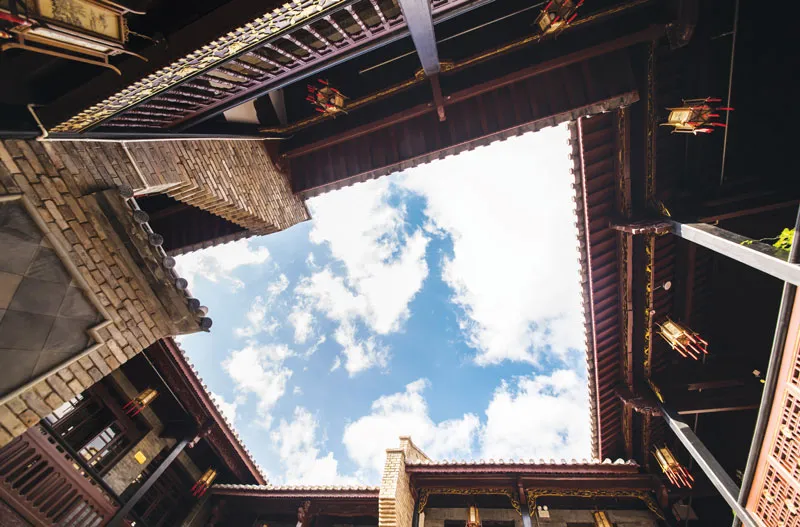 The Tian Jing, or Heavenly window, allowing a direct connection between residents and the sky above
 The Fo Tang house featuring horizontal overhanging eaves and bold Tang-style columns
 The Fo Tang, or enlightened room, with glowing shoji screens inviting meditation