In the high-stakes theater of grand opera, survival requires a bifurcation of the self. For soprano Sondra Radvanovsky, this division is explicit. On stage, there is “Sandy Singer”—an athletic force of nature, capable of sustaining the vocal immensity required for three hours of Donizetti’s royal rage or the tragic weight of Bellini’s Norma. This persona is the vessel for the “angry queen,” the stamina-fueled performer who must project to the back of the Metropolitan Opera.
Offstage, however, there is simply Sondra. Reserved, private, and deeply anchored in faith, she operates in a quieter frequency. The ritual that bridges these two worlds is a private prayer offered to her father, who passed away when she was seventeen. It is a plea not for glory, but for sufficiency—to simply do “the very best I can do today.” In an industry defined by towering expectations, this mantra is her method of grounding, a way to silence the noise and focus on the honesty of the moment.
The Geography of Heritage
For Radvanovsky, the operatic stage is not merely a platform for technical display; it is a space where personal history and artistic narrative converge. This is perhaps most poignant in her engagement with Antonín Dvořák’s Rusalka, a work that serves as a map of her own genetic identity.
The opera stands at the intersection of her lineage. The music is by Dvořák, a favorite of her Czech father; the narrative is drawn from The Little Mermaid by Hans Christian Andersen, the quintessential storyteller of her mother’s Danish culture. “It really encompasses who I am,” Radvanovsky observes. While her father, a Czech immigrant, encouraged her to assimilate (“You’re American, you should speak English”) and never taught her the language, the music has forced a reclamation of that heritage.
Sondra Radvanovsky on the cover of Magnifissance
Singing in Czech is a formidable technical challenge—a linguistic obstacle course where one must navigate words boasting five consonants and a single vowel. Yet, Radvanovsky has mastered the art of making these dense clusters sound fluid and lyrical.
The emotional core of this reclamation is the aria Song to the Moon. For Radvanovsky, Rusalka’s plea to the moon—”Tell my love that I miss him”—transcends the libretto. It becomes a direct communication with her late father. As she portrays the water nymph longing for her prince, the soprano is simultaneously a daughter speaking to a parent she lost too soon. The performance becomes an act of remembrance, processed through the lens of her mother’s failing health and her grandmother’s bedtime stories of Copenhagen’s harbor.
The Sacred and the Profane
Radvanovsky’s relationship with the voice began in the church, yet her path was never strictly pious. Her origin story contains a moment of imperfect humanity that foreshadowed the unpredictable nature of live theater.
Growing up in Indiana, her talent was nurtured by choir leaders. She recalls her first solo at age eight: her father, the head usher, beaming as he walked down the aisle with the offertory plate; her mother watching from the pew. Standing in the pulpit to sing He Shall Feed His Flock, the young prodigy forgot the lyrics. In the panic of the moment, a curse word slipped out, amplified clearly to the congregation.
The reaction was immediate and auditory: her father dropped the collection plate. The sound of coins—ching, ching, ching—rang out against the shocked silence of the sanctuary. It was a “holy mess,” but one that illustrated early on that the voice is a human instrument, subject to error even in sacred spaces.
Sondra Radvanovsky portrait
Alchemy of the Soul
What drives a performer to endure the rigors of this career? For Radvanovsky, the answer was solidified at age eleven, watching Plácido Domingo in Tosca on television. She witnessed a power that could, as The New York Times described, set ears tingling and thrill the spirit. She turned to her mother and asked, “Can I do that?”
Her philosophy of performance is rooted in catharsis. “I want to touch someone’s soul,” she explains. “Music cleanses a person’s soul and their being.” This is not abstract idealism; it is a tangible exchange of energy.
Decades after watching him on a screen, Radvanovsky found herself validating this purpose with Domingo himself. While performing Sister Angelica in Puccini’s Il Trittico at the Los Angeles Opera—where Domingo served as general manager—she enacted a harrowing scene of suicide, repentance, and vision. Upon leaving the stage, she found the legendary tenor in tears, deeply moved by her portrayal. “If I can touch him that much,” she realized, “then I guess I’m doing okay.”
The Shadow of Realism
Opera is often dismissed as melodramatic, yet its emotional demands can be brutally realistic. Radvanovsky recalls her role as Manon in Manon Lescaut at the Royal Opera House as psychologically grueling. Portraying a woman who trades herself for wealth, she felt the weight of the character’s exploitation.
The production did not shy away from the darker implications of the story. Standing before rows of men, she felt “paid for and bought and ogled.” The experience was so visceral that she would return home feeling “cheap and useless,” weeping to her husband. This performance occurred just prior to the rise of the #MeToo movement, and in retrospect, Radvanovsky sees it as a resonance with the silent experiences of countless women. The art form, despite its period costumes, held a mirror to contemporary pain.
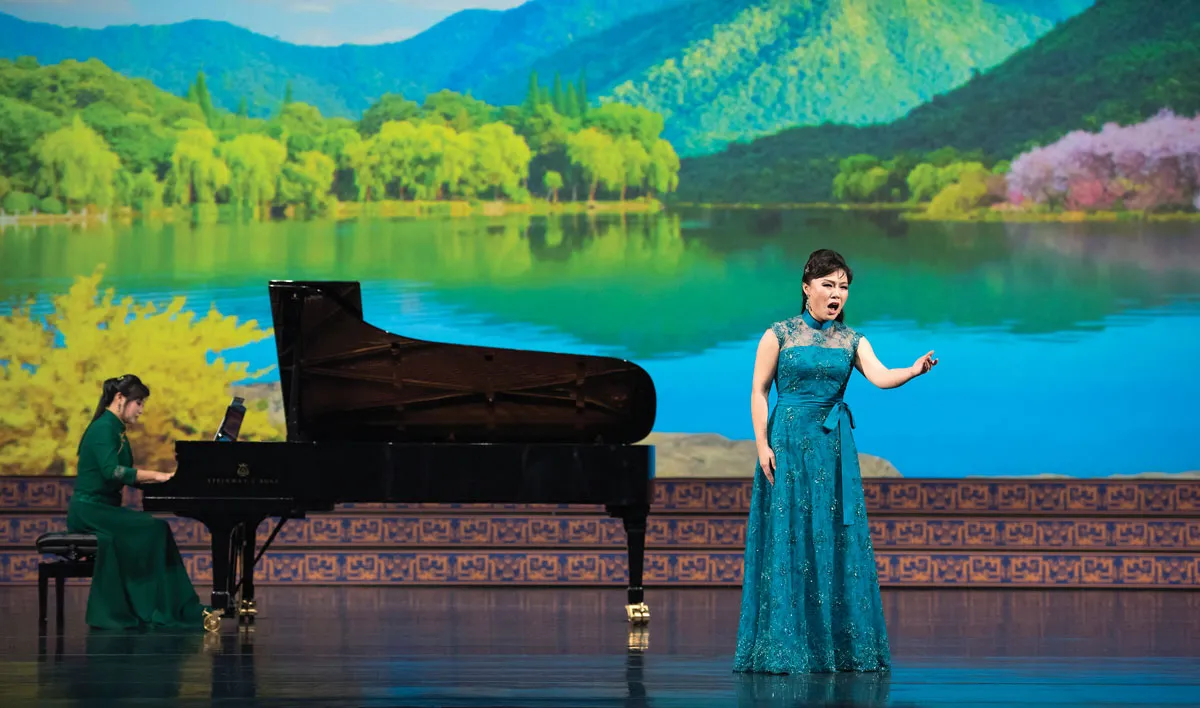
Sondra Radvanovsky in performance
Grounding the Diva
Despite the gravity of her roles, Radvanovsky remains tethered to the earth by the inevitable chaos of live performance and her own spiritual grounding. The stage is a place where elevators get stuck, forcing singers to improvise both sides of a duet, and where sweaty synthetic gloves can send a prop knife flying during a murder scene, turning a tragedy into a scramble for control.
These moments of absurdity serve as a check against the ego. They remind her that the “glitz and glamour” are ephemeral. Her husband, Duncan Lear, serves as her anchor, pulling her back when she starts to “fly too high.”
Ultimately, the duality resolves itself. “Sandy Singer” may command the stage with the power of a storm, but it is Sondra—the woman who prays to her father, cherishes her heritage, and laughs at the memory of spilled coins—who gives the voice its soul. In the transient business of opera, she remains grounded in the conviction that her art is a service, a way to cleanse the soul, one note at a time.

 Sondra Radvanovsky on the cover of Magnifissance
 Sondra Radvanovsky portrait
 Sondra Radvanovsky in performance