In the lexicon of classical Chinese dance, the smallest gesture often holds the heaviest weight. For Michelle Lian, a principal dancer with the world-renowned Shen Yun Performing Arts, the concept of beauty is not a broad stroke, but an accumulation of microscopic details—a philosophy encapsulated in the mudra known as “lotus fingers.”
This hand position appears deceptively simple: the fingers articulate to mimic the floral bloom. Yet, the precise elevation of a single digit acts as a mirror to the dancer’s internal world. “If you move your finger just slightly lower or higher, that small detail is going to change the posture,” Lian observes. It is here, in the geometry of the hand, that the concept of yun—a dancer’s inner bearing and artistic expression—manifests physically.
The positioning of the hand is not merely a technical requirement; it is an index of character. “The reason one finger is slightly higher or looks better is a reflection of her yun,” she notes. To achieve the aesthetic ideal, the internal state must align with the external form. The spirit must be “tender and compassionate” for the movement to resonate comfortably with the viewer. Beauty, in this context, is not a visual facade but a transmission of benevolence.
Portrait of Shen Yun Dancer Michelle Lian, photography by Binggan Zhang
The Invisible Foundation
The ethereal quality of classical Chinese dance often belies the immense fortitude required to sustain it. The ease witnessed by the audience is constructed upon a foundation of relentless repetition. Lian finds profound inspiration in these fleeting moments of perfection, recognizing the hidden cost behind them.
“When I see a dancer who does something for one second that was just perfect, that really inspires me because I know she has put in so much effort to achieve it,” Lian reflects. “That means you’ve practiced it more than 10,000 times.”
However, technical mastery is only the substrate. Lian argues that the essence of beauty is multidimensional, extending beyond the visible surface to create a specific emotional resonance within the observer. True beauty is defined by its ability to generate a positive feeling in others, a standard that requires the artist to constantly dissolve the ego in service of the art form. “I don’t think I’ve ever felt beautiful, because there’s always room for improvement,” she admits. “Beauty takes time and practice.”
The Collective Breath
Confidence, for a performer of Lian’s caliber, is not inherent; it is forged through vulnerability. Even with impeccable posture, a lack of conviction renders a performance hollow. This lesson was sharply learned during her early days as a lead dancer in the piece Yellow Flowers. The choreography was technically modest, demanding instead a depth of inner feeling that Lian struggled to locate.
“I used to just smile with my face, like my skin is smiling. But really I was nervous thinking about the tempos and coordination,” she recalls. The gap between her external expression and internal anxiety was palpable. In classical Chinese dance, the artist must express what lies at a deeper level, a feat impossible to fake.
The turning point arrived not through solitary practice, but through a realization of collective support. During a critical rehearsal, Lian noticed a subtle shift in the ensemble. The veteran dancers were modulating their movements, intentionally blending into the background to allow her to shine.
Michelle Lian performing in Yellow Flowers with Shen Yun Performing Arts
“All the moves they did, they tried to make themselves stand out less in order to make me come out more from the group,” she says. They were pouring their intent into her success, a silent, selfless exertion that redefined her understanding of leadership. “I didn’t find confidence myself. My teammates simply gave it to me.”
Secure in the knowledge that a “strong backbone” supported her, Lian surrendered the fear of judgment, allowing her performance to mature.
Transcendence Through Selflessness
The interplay between the physical body and the spiritual mindset was tested to its limit during a tour featuring the vignette Lotus Fairies. Cast as the lead lotus fairy, Lian was tasked with a repertoire of acrobatic techniques requiring extreme spinal flexibility—back bends and leaps that became agonizing due to a severe back injury.
For two weeks, pain was a constant companion, persisting even when she walked. The pressure was compounded by a grueling schedule often involving two shows a day. “I was anxious before every show,” she confesses. Yet, the obligation to the audience—thousands of strangers unaware of her physical state—forced a shift in perspective.
Lian began to view the performance as a duty that superseded her personal suffering. Hobbling backstage, she directed her focus outward: to the orchestra, the crew, her fellow dancers, and the spectators. “It is about letting go of how I personally feel. I’m just one person,” she reasoned. “If I carry my personal emotions onto the stage… that disappointment would be much greater than my physical pain.”
Michelle Lian featured on the 2019 Shen Yun Performing Arts poster
This surrender triggered a phenomenon that bordered on the miraculous. Often, as the music began and she stepped into the light, the pain would vanish, only to return the moment the curtain fell. It was an experience that fundamentally altered her relationship with her art.
“It doesn’t matter if your body feels perfect or doesn’t feel right. It’s your mindset that really matters,” Lian asserts.
Ultimately, the dancer views confidence as a layer of truthfulness. It is an emanation of the inner self. If the interior world is cultivated to be true and compassionate, the confidence to reveal it follows naturally. For Michelle Lian, the discipline of dance is a vehicle for elevating the spirit, refining the human vessel until it is clear enough to radiate positive energy.
Michelle Lian in The Story of Liang Zhu, 2019 Shen Yun World Tour

 Portrait of Shen Yun Dancer Michelle Lian, photography by Binggan Zhang
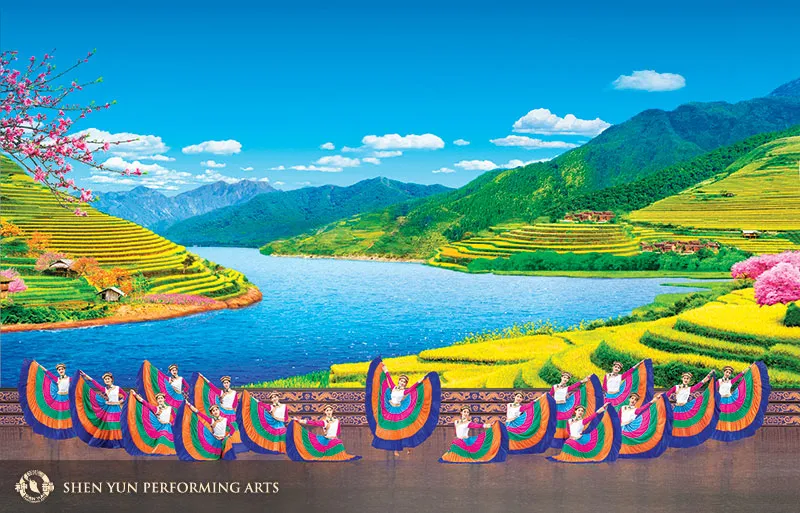 Michelle Lian performing in Yellow Flowers with Shen Yun Performing Arts
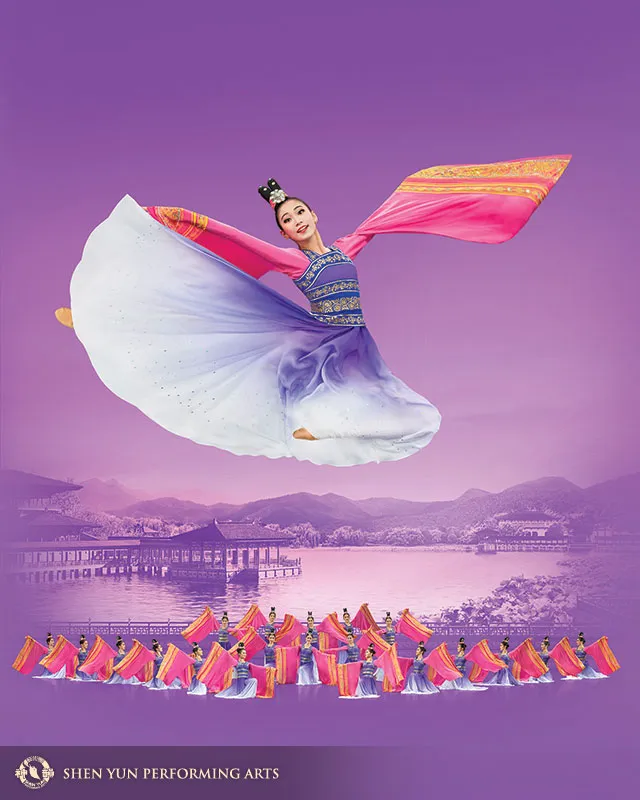 Michelle Lian featured on the 2019 Shen Yun Performing Arts poster
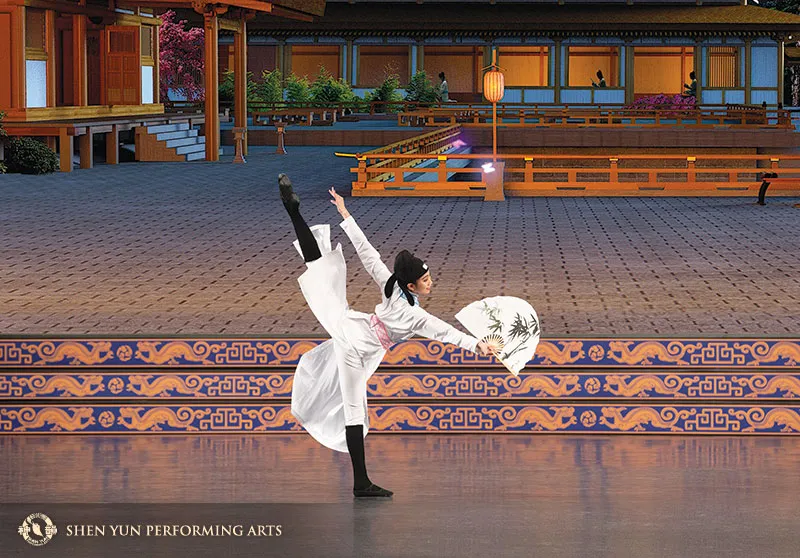 Michelle Lian in The Story of Liang Zhu, 2019 Shen Yun World Tour


