There is a specific kind of romance in the impossible image: the lush, broad green of summer banana leaves blanketed under a layer of pristine white snow. It is a sight that reality rarely permits, yet in the realm of the mind, it evokes a dissolution of time and space. This is the poetic threshold where Cheng-I Wu operates. His ink artistry is not merely a depiction of geography, but an ode to the sublime, blurring the lines between the tangible world and the internal landscape.
As a professor at the Taipei National University of the Arts, one of Taiwan’s most respected institutions, Wu occupies a space where academic rigor meets creative intuition. His scholarly work, including volumes such as Contemporary Taiwanese Art: Literati Ink Painting, informs a practice that is deeply rooted in history yet distinctly modern. His paintings, held in prestigious museum collections, serve as a bridge between the ancient literati tradition and the fragmented perspective of the contemporary observer.
The Architecture of Ink and Air
In Wu’s work, the viewer encounters a sophisticated reinterpretation of classical Chinese ink art. While traditional literati painting often emphasizes flatness and calligraphic line, Wu introduces a structural depth—an unusual three-dimensionality that gives his mountains and waters a sculptural presence. However, this modern spatial awareness does not sacrifice the fluidity of the medium; the ink still moves with the expressive vigor characteristic of the classical masters.
Island: The Frontier, displaying a coastal landscape where mountains and sea meet under a full moon
This balance is vividly realized in Island: The Frontier. Inspired by the coastal topography of Taiwan, the piece presents a coexistence of mountain and sea beneath the quiet illumination of a full moon. The atmosphere is ethereal, suggesting a moment suspended in time.
For Wu, the highest aspiration of landscape painting remains unchanged from antiquity: to unveil the “invisible grace” perceived through a deep communion with the natural world. This essence, he argues, cannot be replicated through technical refinement alone; it must mirror the artist’s consciousness. Wu notes a profound shift in this dynamic: unlike the ancient literati, who lived in intimate rhythm with nature’s nuances, the modern artist creates from a place of estrangement. The challenge today is to grasp that ephemeral beauty while navigating a life disconnected from the wild.
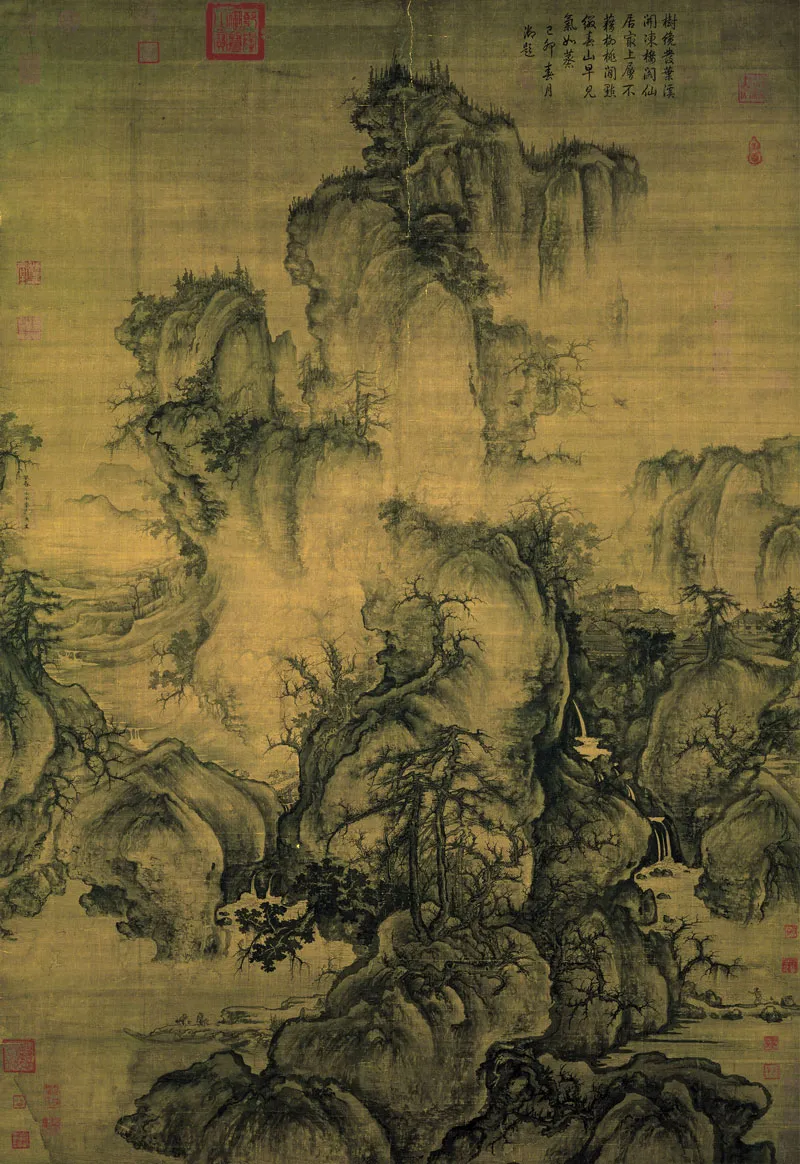
To resolve this, Wu looks to the panoramic reconstructions of nature found in the Five Dynasties and Northern Song eras. He cites Guo Xi’s Early Spring, a masterpiece at Taipei’s National Palace Museum, as a pivotal influence. He observes the “richly layered landscape,” where the artist meticulously built up perhaps ten strata of ink to capture the shifting moisture and air. Wu adopts this reimaging of nature, using the accumulation of ink not just to define form, but to trap the very atmosphere within the paper.
The Fluidity of the Internal Horizon
Wu’s mountains and boundless seas serve as his primary inspirations, yet they rarely adhere to strict realism. In his compositions, the laws of physics are gently subverted to serve a psychological truth. Mountains, whether viewed from a distance or intimate proximity, appear to float upon the sea or hover weightlessly in the sky.
The distinctions between elements become porous in Wu’s hands. Clouds drift with the heaviness of water, while ocean waves unfold and billow with the lightness of clouds. This interchangeability suggests that the landscape is a projection of the artist’s internal state—a “frozen moment” where the majesty of the external world aligns perfectly with the ebb and flow of the mind. The distant is not necessarily illusory, and the near is not always concrete; they exist in a state of flux.
Island Reverie: The Music of the Waves, showing deep blue waters and undulating layers of ink wash
In Island Reverie: The Music of the Waves, this rhythmic quality takes center stage. The painting depicts a vast, undulating sea, where layers of ink wash and delicate brushstrokes create a musical cadence in the deep blue waters. A rugged, craggy island stands in the distance, echoing the crash of the waves. The visual experience is auditory; one can almost hear the melody of the ocean carried through the gradient of the ink.
To Cheng-I Wu, the practice of ink painting is a “sophisticated amalgamation” of poetry, calligraphy, painting, and seal carving. It is an art form that transcends the constraints of physical space, allowing the viewer to enter a narrative that flows with an intrinsic sense of poetry. His work reminds us that even in a modern era estranged from nature, the ink brush can still summon the snow onto the banana leaf, creating a reality that is truer than the one we see.

 Island: The Frontier, displaying a coastal landscape where mountains and sea meet under a full moon
 Island Reverie: The Music of the Waves, showing deep blue waters and undulating layers of ink wash